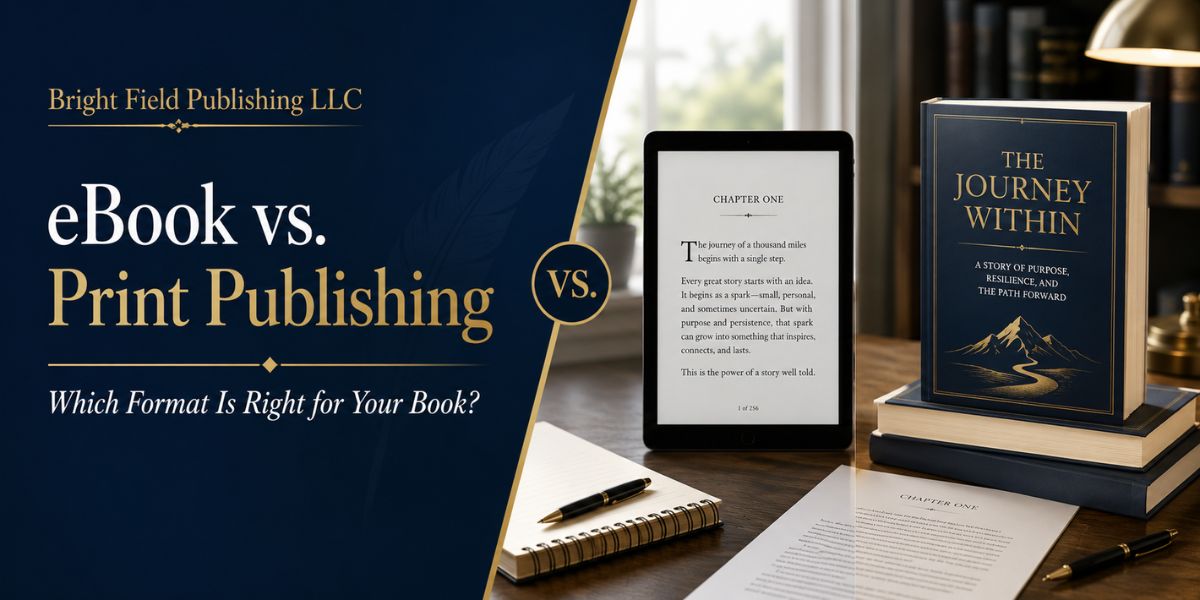

Publishing a book involves several important decisions, and one of the biggest is choosing between eBook and print publishing. Both formats provide valuable opportunities for authors, but they serve readers in different ways. Some people prefer the convenience of digital books, while others enjoy holding a printed copy, turning physical pages, and displaying books on a shelf.
For authors, the right format depends on the target audience, publishing goals, budget, genre, and marketing strategy. Understanding the differences between eBook and print publishing, including digital book publishing options and print-ready book production, can help you make an informed decision and prepare your manuscript properly.
What Is eBook Publishing?
eBook publishing, often described as digital book publishing, involves converting a manuscript into a digital format that readers can access through Kindle readers, tablets, smartphones, laptops, and desktop computers. EPUB is one of the most widely used digital book formats because it allows text to adjust to different screen sizes.
One of the main benefits of eBook publishing is accessibility. Readers can purchase and download a book within minutes from almost anywhere. Authors can reach readers in different countries without worrying about printing, storage, physical inventory, or international shipping.
Digital publishing can also reduce production expenses. Although authors still need professional editing, cover design, formatting, conversion, and marketing, they do not have to pay for the manufacturing of each copy.
eBooks are especially useful for fiction, self-help books, business guides, educational resources, devotionals, memoirs, and other text-focused publications.
Advantages of eBook Publishing
Convenience is one of the strongest reasons readers choose eBooks. Hundreds of books can be stored on a single device, making digital reading practical for travelers, students, commuters, and people with limited storage space.
Digital reading platforms may also offer adjustable font sizes, search functions, built-in dictionaries, bookmarking tools, and screen-reading features. These options can improve the reading experience for people who need larger text or additional accessibility support.
Another important benefit is global distribution. Digital books can be made available through major online platforms, allowing authors to reach a wider audience. Authors can also use temporary discounts, promotional pricing, digital giveaways, and online campaigns to attract new readers.
However, professional eBook formatting and eBook conversion services are essential. A poorly converted manuscript may contain broken paragraphs, inconsistent spacing, misplaced images, incorrect chapter links, or navigation problems. Proper conversion ensures that the book remains readable and visually consistent across multiple devices.
What Is Print Publishing?
Print publishing produces a physical copy of a book, usually as a paperback, hardcover, or specialty edition. Paperback and hardcover publishing require professional book formatting services and a complete cover design that includes the front cover, spine, and back cover.
The physical reading experience remains one of the strongest advantages of print publishing. Many readers enjoy holding a book, turning its pages, highlighting passages, making notes, and building a personal library.
Printed books can also feel more valuable as gifts. They are commonly used during author signings, book fairs, conferences, workshops, school visits, speaking events, and launch celebrations.
Print publishing is particularly well-suited to children’s books, journals, workbooks, cookbooks, photography books, activity books, and titles that rely heavily on illustrations or carefully arranged page layouts.
Advantages of Print Publishing
Printed books can create a strong sense of credibility and permanence. Authors can use physical copies during presentations, professional meetings, media appearances, direct sales, and promotional events.
A professionally designed printed book may also strengthen an author’s personal or business brand. It provides a tangible product that readers can keep, share, recommend, or display.
Print-on-demand publishing has made printed books more accessible to independent authors. Instead of ordering hundreds of copies in advance, books can be produced when customers place orders. This reduces storage requirements and lowers the financial risk associated with bulk printing.
Print publishing still requires careful technical preparation. The interior must follow the correct trim size, margins, bleed settings, page numbering, image resolution, and printer specifications. The cover dimensions must be calculated according to the book’s page count, paper type, and binding method.
Even small formatting errors can delay platform approval or affect the appearance of the finished product.
Cost Differences Between eBook and Print Publishing
eBook publishing generally has lower production costs because no physical copy is manufactured. Common expenses include editing, cover design, digital formatting, file conversion, distribution setup, and book marketing. Authors comparing eBook publishing costs should also consider the quality of professional preparation rather than price alone.
Print publishing includes many of the same professional services, but it also involves physical production. The retail price must account for printing expenses, platform fees, distribution costs, and author royalties.
Full-color books usually cost more to print than black-and-white books. Hardcovers are also generally more expensive to produce than paperbacks.
Authors should not select a format based only on cost. The least expensive option may not be the best choice for the book’s audience or purpose. The goal should be to create a polished product that meets reader expectations and supports long-term publishing plans.
Which Format Reaches More Readers?
eBooks offer immediate worldwide availability and appeal to readers who value convenience. Print books attract readers who prefer a physical product and provide additional opportunities for direct and in-person promotion.
Reader preferences often depend on genre, age group, lifestyle, and reading purpose. A business guide may perform well in both digital and paperback formats. A children’s picture book may benefit more from print because illustrations and page turns are essential to the reading experience.
A traveler may prefer carrying an eBook, while someone purchasing a journal, workbook, or activity book will usually need a printed edition so they can write directly on the pages.
Understanding your target audience can help determine which format deserves the greatest attention.
Should Authors Publish in Both Formats?
For many authors, publishing both an eBook and a print edition is the most practical multi-format publishing strategy. Offering multiple formats allows readers to choose how they want to experience the book and helps the author reach a broader market.
Multiple editions can also support different pricing levels, marketing campaigns, promotional offers, and sales channels.
However, each format requires separate professional preparation. A print-ready PDF cannot simply be used as an eBook. Similarly, an EPUB file cannot replace a properly formatted print interior.
The layout, typography, navigation, images, cover specifications, and technical settings must be optimized for each edition.
How Bright Field Publishing LLC Supports Authors
Bright Field Publishing LLC provides complete publishing solutions and self-publishing support for authors preparing eBook and print editions. Its services include professional book editing, interior formatting, custom cover design, eBook conversion, print setup, ISBN support, publishing assistance, marketing, and worldwide book distribution.
The company helps authors transform their manuscripts into polished books while protecting their authentic voices and creative vision. Professional guidance can also prevent formatting problems, platform rejections, inconsistent designs, and other costly publishing mistakes.
Whether an author chooses digital publishing, print publishing, or both, proper preparation ensures that the finished book looks professional, functions correctly, and meets publishing platform requirements.
Final Thoughts
The choice between eBook and print publishing depends on the book’s purpose, audience, design, budget, and sales strategy. eBooks provide convenience, fast access, lower production costs, and broad digital reach. Print books offer a tangible reading experience, strong presentation value, and valuable opportunities for direct promotion.
Authors do not always need to choose only one format. Publishing both editions can increase accessibility, expand market reach, and give readers more ways to connect with the book.
With professional editing, design, formatting, conversion, and distribution support from Bright Field Publishing LLC, authors can confidently publish in the format that best supports their goals and provides the strongest reading experience.