
There are careers that prepare you for pressure. And then there are moments that redefine what pressure actually means.
Bradley Akubuiro had worked through plane crashes, civil wars, activist campaigns, and countless high-stakes situations before he became Boeing’s Chief Spokesperson during the 737 MAX crisis. Two fatal crashes. A global fleet grounding. A DOJ criminal settlement. The kind of crisis that does not test your communications strategy so much as it tests the character of an entire organization.
He arrived with a framework he trusted. Identify the problem. Contain it. Explain what you are doing. Demonstrate progress. It had worked for years across some of the most difficult environments imaginable. And then it stopped being enough.
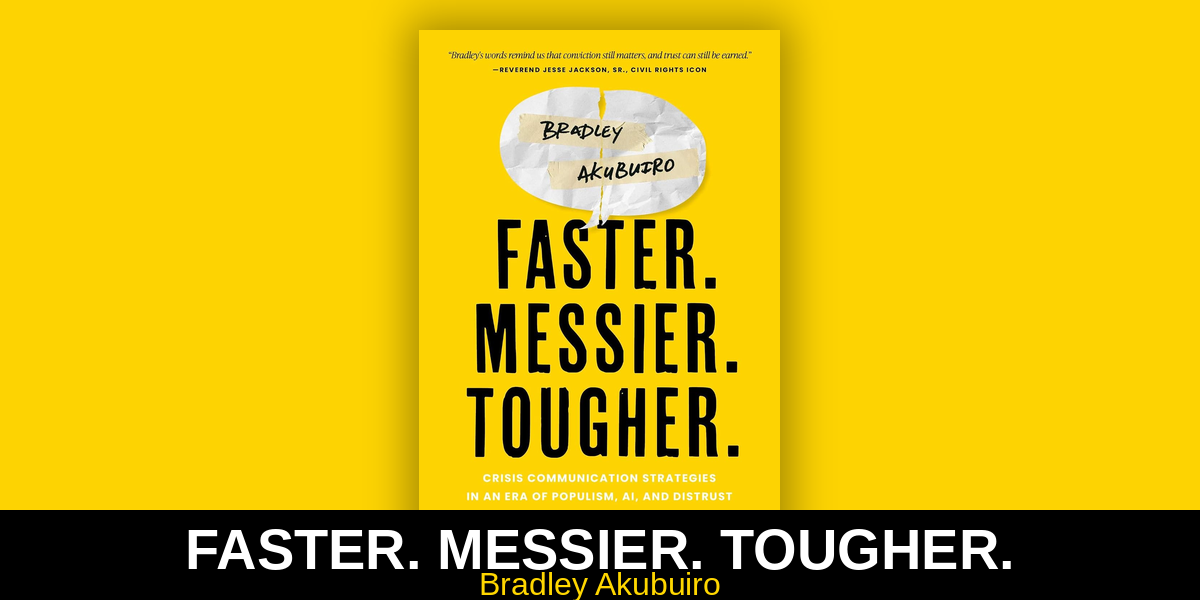
What the 737 MAX crisis taught him is the foundation of his book Faster. Messier. Tougher.: Crisis Communication Strategies in an Era of Populism, AI, and Distrust. And it starts with a realization that no simulation can fully deliver: communications is not about finding the perfect statement. It is about earning enough trust that people are willing to believe your actions.
The Lesson About Silence
The single most common piece of conventional crisis communication wisdom that Bradley now believes can make things worse is the advice to wait until you have all the facts before saying anything.
That guidance made sense in a slower media environment. Today, silence is not neutral. It creates a vacuum that others may immediately fill, with speculation, rumor, and narratives that are often more damaging than the honest uncertainty a leader could have communicated instead.
He is not suggesting organizations speculate or communicate before they are ready. But there is a significant difference between premature speculation and the kind of presence that acknowledges uncertainty, explains what is known, describes what is being done to learn more, and commits to ongoing transparency.
In today’s environment, people do not necessarily expect perfection from the organizations they are watching respond to a crisis. They expect presence.
When Charlottesville Changed Everything
The experience that most fundamentally shifted Bradley’s thinking about crisis communication was not Boeing. It was Charlottesville.
Watching CEOs wrestle with whether and how to respond to events that many would have previously considered outside the traditional boundaries of corporate communications forced him to rethink what he believed about neutrality, stakeholder expectations, and leadership. It was the moment he realized the communications operating system he had spent his career mastering had shifted.
Organizations today are increasingly expected to respond not only to business crises but also to cultural, political, and societal events. That requires a different mindset than simply managing reputational risk. The question is no longer just what happened and what you are doing about it. It is who are you, what do you stand for, and can we believe you when you say it?
Trust Is Built Before the Crisis, Not During It
One of the most important ideas in the book is also one of the most counterintuitive. Strong organizations do not begin building trust during crises. They build it long before crises arrive.
That means communicating consistently when nothing is wrong. Explaining decisions rather than simply announcing them. Listening to employees as seriously as customers. Admitting mistakes before someone else uncovers them. Making sure that what an organization says consistently matches what it does.
Trust is not created by messaging alone. It is created when messaging consistently matches behavior. And when a crisis hits, the organizations with deeper reserves of that kind of trust are often the ones better positioned to navigate it without losing what they have built.
Bradley has spent decades watching the difference between organizations that had those reserves and organizations that did not. In his view, the gap in outcomes can be significant.
If you want to understand what crisis communication looks like when the stakes are as high as they get, Faster. Messier. Tougher. by Bradley Akubuiro is available now on Amazon. Written by the man who stood at the podium during one of the most consequential corporate disasters in modern history.