

In the early 2010s, the watch industry entered a period of adjustment worldwide. Consumer demand gradually shifted from purely low-cost timepieces to mid-range mechanical and quartz watches that balanced durability, material quality, and price. Industry reports in that period consistently indicated that mid-tier watches accounted for the majority of unit sales worldwide, while luxury brands dominated revenue share. Those manufacturers positioned between mass production and luxury adjusted by tightening production standards and refining internal processes to meet changing expectations.
In this context, between 2011 and 2019, Billow Time Watch Co., Ltd. gradually shifted its manufacturing focus to the middle- to high-end segment. The company was established in Shenzhen, China, in 2004 by Chen Fu Jun and Wang Jian. Before that, for several years, it had been developing inspection systems and component-handling practices. By the early 2010s, its operations were organized to respond to more complex production needs, reflecting wider market demand for watches that prioritized material integrity and performance consistency over brand recognition.
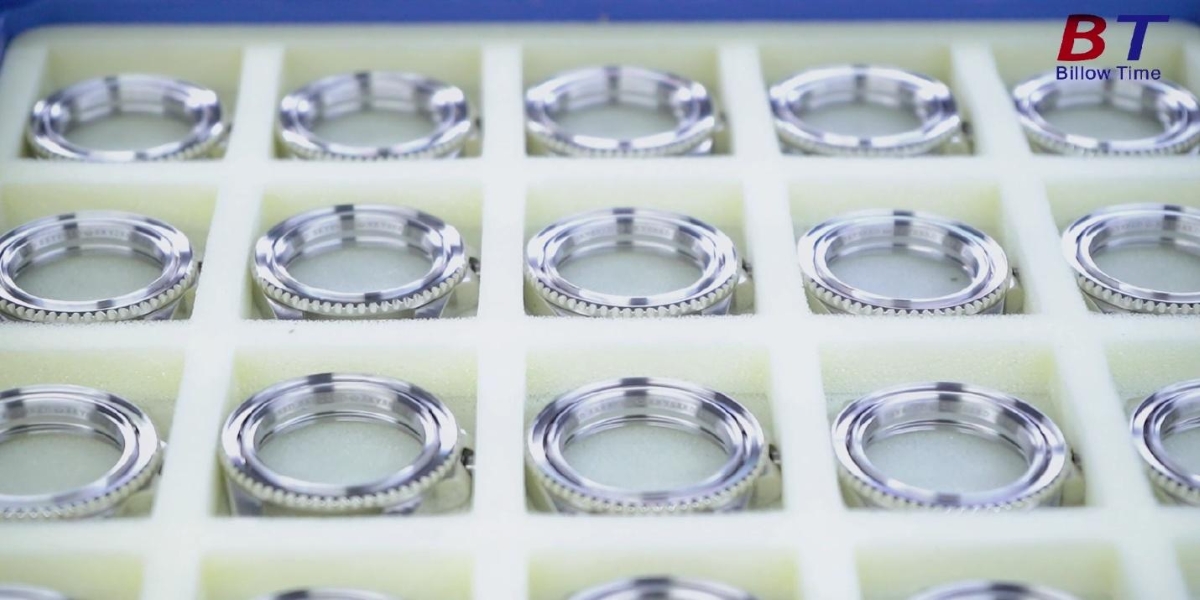
Starting in 2011, the company realigned its production discipline to support this segment. Tighter inspection procedures were implemented at each polishing, drilling, and assembly stage. Quality assurance and quality control expanded their scope to include tighter tolerances and more frequent checks. These actions conformed to the industry norm for mid to high-end watches, in which international buyers scrutinize the mechanical reliability and finish quality of the product. The company’s internal workflows were changed to minimize batch-to-batch variance and enhance repeatability.
Another characteristic that defined this era was the choice of materials. Billow Time Watch Co., Ltd. introduced greater use of materials such as stainless steel, titanium, bronze, Damascus steel, forged carbon fiber, and ceramic. Materials like these have been widespread in mid-tier and upper mid-tier watches in the 2010s, offering durability and visual distinction without entering luxury price brackets. Handling such materials required additional controls in the process to further reinforce the company’s structured production over volume-driven output.
This also reflects broader trends in consumer markets. In the 2010s, industry statistics showed that demand for mid-range mechanical movements remained strong among buyers looking to use the watch long-term rather than as a fashion item. Quartz watches were also still relevant for their accuracy and lower maintenance. Manufacturing both types positioned Billow Time Watch Co., Ltd. within a market segment that values functional reliability and material consistency over branding.
Operationally, the period from 2011 to 2019 was marked by heightened integration across departments. There was much closer coordination among the engineering, assembly, and inspection teams. It ensured that designs got aligned with production realities. This integrated approach maintained custom and modified watch orders, a standard for mid-range buyers seeking differentiation without the costs of bespoke luxury manufacturing. Customer service departments also aligned with production schedules to better manage client expectations.
This reasoning then dictated how the company would engage in international cooperation. Many overseas customers were requesting, if not requiring, inspection processes and material-sourcing documentation, especially for watches priced above entry level. Billow Time Watch Co., Ltd., therefore standardized internal reporting and production records. In fact, this is part of an industry-wide trend, with transparency and consistency vital for long-term supplier relations in the mid-tier market.
By 2019, the company’s operational focus had matured, and that year marked its incorporation as Billow Time Watch Co., Ltd. and the launch of its PRYZM brand. While PRYZM represented a branded initiative, the company’s core activities remained firmly focused on OEM manufacturing. Experience gained from 2011 to 2019 enabled continued production of mid- to high-grade watches for third-party customers, with set standards for inspection, assembly, and material handling.
From an industry perspective, manufacturers operating in this segment often face pressure from both ends of the market. Entry-level producers competed on cost, whereas luxury brands competed on heritage and exclusivity. The mid to high-end segment required operational discipline to maintain quality without inflating costs. Billow Time Watch Co., Ltd. approached the period with these constraints in mind by focusing on process consistency rather than brand positioning.
In a nutshell, the period between 2011 and 2019 represented a well-marked stage in the development of Billow Time Watch Co., Ltd. Alignment with mid- to high-end watchmaking included stricter quality control, a finer selection of materials, and closer production tolerances. These changes mirrored the broader industry’s demand for reliable mechanical and quartz watches positioned between the mass-market and luxury categories. Guided by the company’s managers, Chen Fu Jun and Wang Jian, the company’s operations during this period show how one manufacturer adapted to evolving market expectations without staking a claim to luxury status or market leadership.