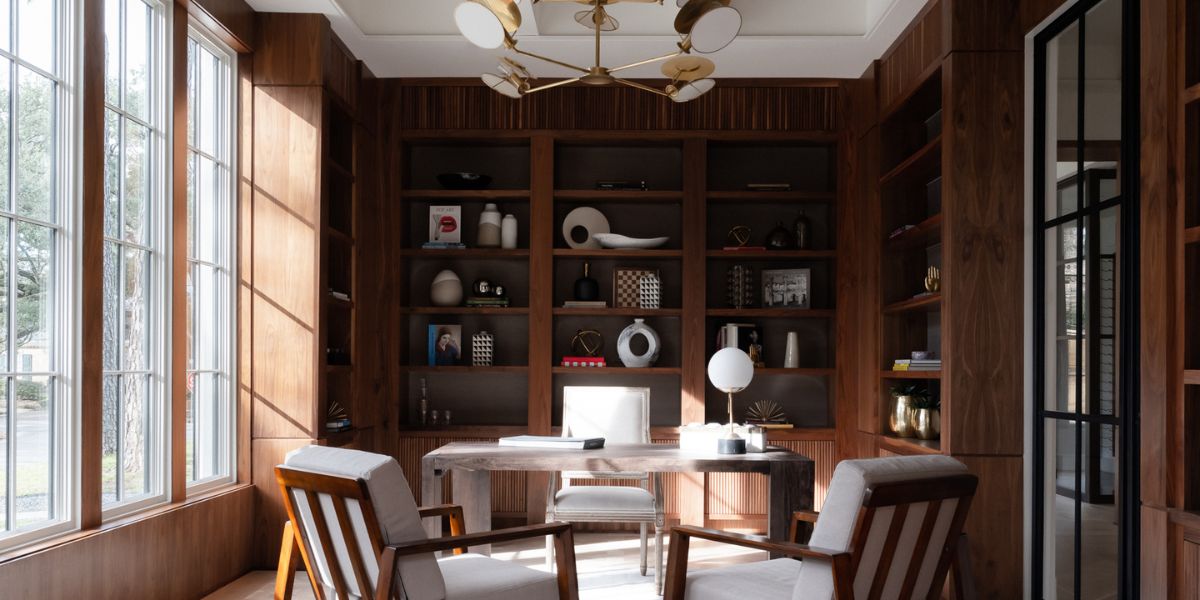

Luxury construction has a bias toward more. More square footage, more rooms, more amenities, more of whatever the last magazine spread was selling. It is the easiest way to signal a premium, and it is why so much of the field looks the same at the top.
The harder discipline is precision: doing less, more exactly, so the eye and the body register a home as considered rather than simply expensive. It is an approach that guides Arpan Gupta, founder and CEO of Houston luxury homebuilder Fifty Seventh & 7th Luxury Homes. That discipline is older than any current trend, and its rules have survived for centuries for a reason.
The Case For Classical Design In A Modern Luxury Home
Classical design is often mistaken for a particular style. At its core, however, it is a set of rules about proportion, symmetry, and the hierarchy of spaces that architects have refined since the Greek stoas and Roman villas.
The rules are simple to state and hard to follow. A room should agree with itself in the relationship between its floor, walls, and ceiling. A facade should reveal where the important rooms are. A house should move from public to private in a way the body can feel without being told.
Modern taste can wear classical rules lightly. A house does not need pediments or columns to be classically designed. It needs proportions that make the eye rest, sightlines that reward attention, and a hierarchy of rooms that reads as intentional.
When those rules are followed, the house feels calm. When they are broken, no amount of finish will substitute. That is why a well-designed room in an eighteenth-century townhouse and a well-designed room in a contemporary home can feel as though they belong to the same lineage. They obey the same underlying grammar.
A Lesson From The Great Hotels
The most useful classroom for a residential builder may be the great hotel. Serious hotels commit early to a set of design rules and hold them across hundreds of rooms, thousands of transitions, and decades of use.
The lobby of The Peninsula in Paris, the corridors of the Four Seasons in Taormina, and the bathhouses at Amangani in Jackson Hole teach different lessons about the same discipline. Watch how a threshold is detailed. Notice the height of a handrail in relation to the width of a stair. See how a bath is lit, not merely for a photograph, but for a person standing in it.
Every one of those choices is a decision about proportion, and it is the same class of decision a residential architect or builder makes when designing a home.
The lesson a builder carries home is that details are not a garnish. They are a language. A door casing designed to a proportion says one thing. A door casing selected from a catalog without regard to the room says another, and the eye knows the difference well before the mind can explain it.
The great hotels earn their reputations by making thousands of small decisions in a consistent voice. The residences that stand out at the top of the market do the same.
“True luxury is not created by adding more to a house. It comes from making every decision feel deliberate, from the proportion of a room to the way two materials meet. When those details are resolved correctly, the home feels exceptional without having to announce itself,” said Arpan Gupta, founder and CEO of Fifty Seventh & 7th Luxury Homes.
Precision Over Excess, At The Level Of The Room
Applied to Houston’s ultra-luxury housing market, precision reads differently than excess. A room built to the right proportions and finished with restraint feels considered. A room loaded with expensive materials but weakened by casual detailing feels wrong, even if a spreadsheet says it should not.
Buyers at the top of the market increasingly notice the difference. In the Houston neighborhoods where Fifty Seventh & 7th Luxury Homes builds, the firm has found that discerning buyers respond to quieter, more disciplined design rather than maximalism for its own sake.
Recognition has followed that discipline. Fifty Seventh & 7th Luxury Homes received the Greater Houston Builders Association’s Custom Builder Grand Award in both 2024 and 2025. In 2026, the company also received a LUXE RED Award from LUXE Interiors + Design.
Design juries reward precision at close range because that is where the discipline shows. So does the finished room, particularly to a buyer who has learned to see it.
The argument against excess is not an argument against ambition. It is an argument against noise. A house that reaches for grandeur through scale alone may eventually be replaced by a bigger one. A house that reaches for grandeur through proportion and precision can still feel current when its buyer’s children inherit it.
Great homes and great hotels teach the same lesson in different settings. Restraint, held to a standard, is what lasts.