
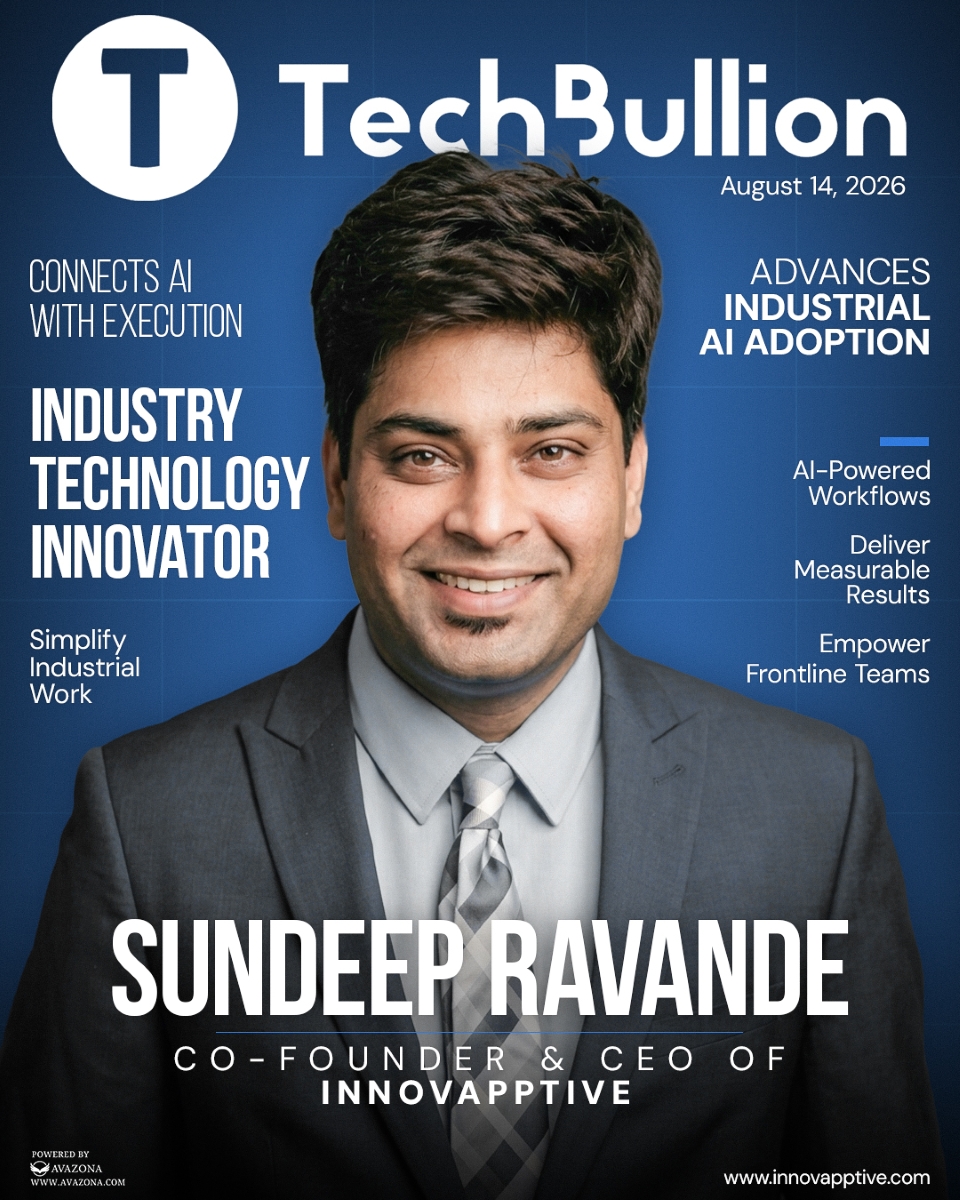
Sundeep V. Ravande, CEO and Co-founder of Innovapptive, has observed industrial companies struggling with data that doesn’t create more value. Their plants collect signals from sensors, historians, control systems, enterprise platforms, and frontline teams, and their AI turns that data into predictions, yet those insights are not converting into valuable action. This void in current industrial AI performance is causing businesses to face downtime, delayed maintenance, production losses, and more.
Innovapptive explores how industrial AI can reach the people doing the work, helping them complete tasks and connect actions back to business performance.
Going From AI Insight to Better Industrial Action
The systems that industrial organizations spent years building are missing execution, mainly because the teams inside them are operating separately. A crucial resource that gets impacted is time.
Innovapptive believes in placing the frontline execution layer between industrial signals and enterprise systems. This reduces the time between knowing something is wrong and doing something about it. The AI in question thus supports a workflow by helping identify an issue, organize information, recommend an action, and guide the worker.
The Business Case Starts With Operational Metrics
Industrial AI investments need a clear connection to measurable performance. Companies cannot rely solely on the number of AI models but should ask what changed on the plant floor. These metrics may include maintenance backlog, mean time to repair, unplanned downtime, technician productivity, inventory accuracy, schedule compliance, overtime, contractor dependence, and overall equipment effectiveness.
The chain of measurement becomes:
AI insight → frontline action → operational improvement → financial impact.
In one of Innovapptive’s cases involving Indorama Ventures, the company reports a $29 million realized EBITDA gain, a 38% reduction in contractor headcount, 99.5% inventory accuracy, and the elimination of an 18-week maintenance backlog.
This numerical evidence of direct financial gain is why AI value should be measured through the work that changes after an insight is generated.
Sundeep V. Ravande: AI Needs Context to Create Value
An industrial AI system must produce an answer that makes sense within a specific plant, asset, process, and workflow, and not just a generic one. For example, a technician needs relevant information about an asset, such as its maintenance history and previous failures.
Innovapptive’s industrial context offers data from plant systems, enterprise applications, operational processes, and operating procedures. Its AI agents support specific workflows, because the issue is an AI model in isolation (no matter how powerful it is). The AI agents work directly with the information and systems already present in an industrial environment.
The Frontline Worker Becomes Part of the AI Loop
Further industrial transformation requires connecting systems and people in the same operating loop. In this model, the frontline worker’s role changes: they become the first to notice unusual sounds, changes in equipment behavior, safety concerns, and material shortages. AI can further capture and organize that knowledge when the worker reports an issue. This model reduces time spent on documentation.
Why Execution Should Be the New AI Measurement
Industrial leaders should ask these questions to evaluate an AI:
First, what decision does the system improve?
Second, what action changes because of that decision?
Third, which business metric moves because of that action?
A secondary measure is time because industrial teams most often lose value between detection and response. When the right person doesn’t see an alert in time, or a created work order isn’t planned accordingly, repairs take longer, increasing operational risk and cost. Hence, decision latency is an important metric and captures the true value of AI investment.
In October 2026, Innovapptive introduced Frontline Execution Effectiveness (FEE), a new metric designed to complement Overall Equipment Effectiveness (OEE) by measuring how quickly and effectively plants respond to identified problems. FEE evaluates both the time from problem detection to verified closure and whether the repair holds without a repeat failure within 90 days. The framework was introduced alongside Innovapptive’s Frontline Execution Benchmark 2026, based on operational walkthroughs of approximately 120 plants and sites across seven industries. Among plants reporting maintenance backlog, the median was 12.1 weeks, compared with a two-to-four-week reference range, highlighting the need to close the gap between identifying problems and resolving them.
An example that incorporates these levels is Innovapptive’s collaboration with AWS. The companies have worked to connect cloud infrastructure, enterprise systems, industrial data, and frontline workflows. Innovapptive reported that one Indorama deployment produced more than $12 million in EBITDA gains while reducing contractor headcount, overtime, and maintenance backlog.
Building the Next Industrial Operating Model
Effective industrial AI connects prediction with planning, execution, safety, and inventory. Sundeep V. Ravande encourages companies to think about AI as part of an operating model.
Innovapptive’s connected execution approach is a clear example. The platform connects frontline workflows with systems such as ERP, EAM, historians, MES, and SCADA environments, bringing operational information and business systems into the same execution loop. This Global Company of the Year (recognition by Frost & Sullivan in the augmented connected worker, end-to-end platforms category) has been hailed for its AI-powered execution approach and focus on measurable operational outcomes.
Ultimately, the goal of any industrial AI investment should be to shorten the distance between an insight and the action that creates value (fewer delays, better decisions, faster repairs, stronger asset performance, and clearer connections between frontline activity and financial results).
Connect with Sundeep V. Ravande on LinkedIn to learn more about Innovapptive’s AI-powered Connected Worker Platform.