
By: Mikaela Junn
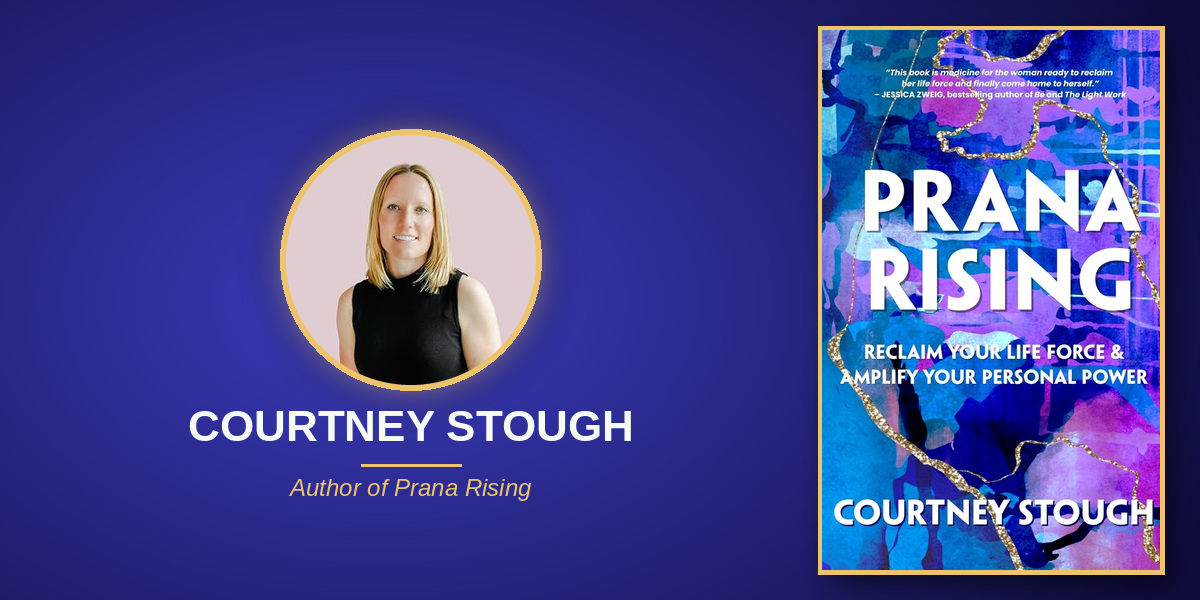
There is a particular kind of exhaustion that high achievers rarely name out loud. It is not the tiredness of one long week or even one brutal year. It is the accumulated weight of performing competence while privately coming apart. Courtney Stough knows exactly what that feels like. A Yale-educated attorney who built her career inside some of the most demanding legal environments in the country, she was, by most visible measures, winning. What she was privately losing was herself.
Prana Rising: Reclaim Your Life Force & Amplify Your Personal Power begins in that gap, and it spends its entire arc closing it. Stough, writing from the rare position of someone who has actually done the work rather than simply studied it, offers readers a memoir laced through a self-development framework that feels neither clinical nor borrowed. The result is a book that occupies its own space: raw enough to be emotionally credible, structured enough to be genuinely useful.
Stough builds her framework around prana, the Sanskrit concept of vital energy, the animating current that runs beneath mood, productivity, and presence. She is careful to establish the concept without mystifying it, rooting it in the body, in breath, in the texture of ordinary days, and in the accumulating weight of choices made from depletion rather than fullness. The reader understands early that reclaiming prana is not a metaphor. It is a practice. It is also, she argues, the only sustainable form of personal power available to people living at the pace most of us have accepted as normal.
The book is organized into four parts: mapping your energy, doing the inner work, building your Powerhold, and surrendering into the journey. The architecture is deliberate. Stough does not begin with frameworks and pour her life into them. She begins with her life and lets the frameworks emerge from it. There is a scene where she describes her supplements case exploding open at a New Orleans restaurant, pills skittering across the floor, her husband watching. It is funny, precisely because she lets it be funny. But it also carries the chapter’s thesis: that the real medicine was never inside those bottles. That realization, ordinary and a little embarrassing, quietly drives the entire book.
Her taxonomy of Energy Vampires in Chapter 2 is one of the sharpest passages in contemporary wellness writing. Most frameworks catalog the obvious culprits: bad sleep, toxic relationships, doom-scrolling. Stough does those, but then she does the harder thing. She names the sneaky ones, the “good” Energy Vampires, the supplement regimens and wellness rituals and spiritual bypassing that masquerade as healing while serving the same compulsive function as everything they replaced. This is Stough at her most useful: willing to look closely at the things people do not want to look at, including the things that wear healing as a costume.
Chapter 4 holds the book’s most unexpected origin story. At Pretty Lights’ 2023 return to Red Rocks, Stough, clear-headed and fully present, heard a track that called the crowd to rise, own their energy, and amplify it beyond themselves. The word followed her home and echoed for weeks, until it opened into the realization at the center of the chapter. Merriam-Webster defines resonance as “the amplification and enrichment of a musical tone by supplementary vibration,” and Stough applies it to the self: heart plus mind resonance equals amplification. For a woman who spent most of her life leading with logic and keeping her heart walled off, this is where the book’s subtitle comes alive. Personal power grows when the mind finally starts listening to what the heart already knows.
The emotional core of the book arrives in Part II, particularly in the marriage chapters. Stough’s account of her near-divorce and eventual reconciliation with her husband is told with a precision that neither performs vulnerability nor flinches from it. She describes the Good Girl/Cool Girl pattern that shaped her communication, the way she would swallow her own anger until it became something volcanic, erupting with the force of what she beautifully calls the Hawaiian goddess Pele: fierce, elemental, and ultimately creative rather than merely destructive. Her ketamine therapy sessions, her inner child work, her slow recognition of the role she played in the cycle of her own undoing, these pages do not read like confession. They read like clarity, earned in real time.
Part III introduces the Powerhold™ framework and its Four Energy Generators™: Embodiment, Mindfulness, Creativity, and Community. Where some wellness books announce their frameworks and then pad them with affirmations, Stough keeps hers grounded in practice. Her treatment of embodiment specifically resists the tendency to make body-based work feel like another optimization project. She describes slowing down her movement practice during pregnancy, releasing the identity she had built around hot yoga, learning that the practice was not the point but that showing up to herself was. The concept of “Right for Right Now,” the idea that no practice needs to be forever, and that adaptation is not failure, lands with particular clarity for readers who have abandoned self-care routines under the weight of all-or-nothing thinking.
The boundaries chapter, embedded inside the Powerhold section, may be the most practical piece of writing in the entire book. Stough frames boundaries not as self-protection in the defensive sense but as energy stewardship: the architecture that allows a person to give from overflow rather than depletion. Her treatment of ahimsa, non-harm toward oneself and others, as the guiding principle for how a boundary gets communicated adds real nuance to a conversation that often stops at “just say no.” She distinguishes between disappointing someone and harming them, between holding a line and wielding one, with the precision of someone who has tried and failed at both.
Prana Rising closes in surrender, not in the sense of defeat but in the sense of trust. Stough, writing while carrying her rainbow baby after a pregnancy loss, is not a woman who has arrived at peace. She is a woman who has learned to move differently through uncertainty. That posture is the book’s actual gift: not a destination, but a way of traveling.
Pick up Prana Rising at Amazon or www.courtneystough.com/book and begin the practice of returning to yourself.
Disclaimer: This article is for informational purposes only and should not be considered professional medical or health advice. The views and experiences shared are for general awareness and do not guarantee specific results. Readers are encouraged to consult qualified professionals before making decisions related to their health and well-being.