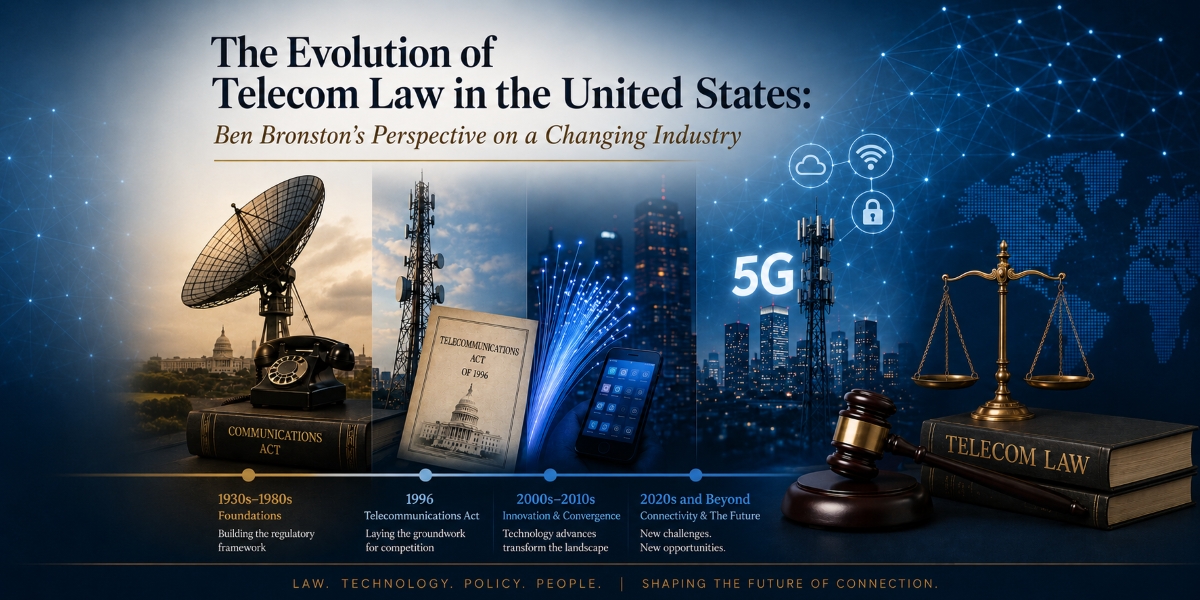

Few sectors of the American economy have transformed as completely, or as quickly, as telecommunications. What began as a network of regulated telephone carriers connecting homes and businesses through copper wire has become a sprawling, software-driven ecosystem of broadband providers, cloud platforms, VoIP services, and unified communications tools. The line between a “telecom company” and a “technology company” has grown so thin that, for many businesses, it barely exists anymore. Ben Bronston, an attorney who has spent more than three decades advising companies across the telecom, IT, and cloud sectors, has watched this shift unfold from the inside of the deals, contracts, and regulatory questions it produced. His career offers a useful lens for a broader question: how has telecom law adapted as the technology it governs has changed almost beyond recognition?
From Traditional Telecommunications to Digital Networks
For most of the twentieth century, telecommunications law was built around a relatively stable premise: a small number of licensed carriers operated regulated networks, and the legal framework existed to manage that regulated relationship, interconnection rules, tariffs, universal service obligations, and carrier-of-last-resort responsibilities. As infrastructure expanded and long-distance competition emerged, the framework grew more complex, but it remained anchored in the idea that “telecommunications” was a distinct, identifiable category of service.
The arrival of the internet and broadband began eroding that distinction. Once voice, data, and video could all travel over the same IP-based infrastructure, the neat boundary between a telecommunications provider and a technology provider started to dissolve. Attorneys practicing in this space, including Bronston, have had to track not just changes in the law itself, but changes in what kind of company the law was even being applied to.
The Rise of VoIP and Internet-Based Communications
Voice over Internet Protocol was one of the clearest inflection points in this transition. VoIP did not simply offer a cheaper way to make phone calls; it fundamentally challenged regulatory assumptions that had been built around circuit-switched networks and licensed carriers. Questions that once had straightforward answers, such as how a service should be classified, which jurisdiction’s rules applied, and what compliance obligations a provider carried, became considerably harder to resolve once communications depended on software and internet infrastructure rather than dedicated telephone lines. Tracing this shift directly, Bronston’s representation of Network Telephone Corporation in its Series C investment from Spectrum Equity in 2000 came at the height of the CLEC and early VoIP buildout, and his work as M&A Counsel to Pacific Gateway Exchange, Inc. in its acquisition of NOSVA Limited Partnership reflected the same convergence playing out on the international carrier side.
This complexity has only deepened with the growth of Unified Communications as a Service (UCaaS) and broader cloud communications platforms, which bundle voice, messaging, video, and collaboration tools into single, often multi-tenant, cloud environments. Businesses operating or relying on these services now face legal questions that span contract structure, data privacy, security obligations, and interstate operations (sometimes international), often simultaneously. Practitioners advising in this space have needed to develop fluency not just in telecom regulation, but in the technical architecture underlying the services they are asked to evaluate.
Telecom Law Meets Technology Law
Perhaps the most significant long-term shift has been the convergence of telecom law and technology law into something closer to a single practice area. Telecom companies increasingly operate like software and technology businesses, offering platforms, APIs, and subscription-based services rather than simple connectivity. At the same time, technology companies have moved into communications, offering messaging, voice, and video capabilities as core features of their products rather than telecom add-ons.
This convergence means that contracts, cybersecurity obligations, data protection requirements, intellectual property considerations, licensing arrangements, and regulatory compliance now intersect in ways they rarely did a generation ago. A single agreement between a managed service provider and its enterprise customer might touch on carrier regulations, software licensing terms, data handling obligations, and liability allocation all at once. Bronston’s practice, which spans telecom, IT, and cloud law for MSPs, VoIP providers, carriers, and channel partners, sits directly at this intersection; a practical illustration of why businesses in this space increasingly need counsel comfortable working across what were once separate legal disciplines.
M&A and the Consolidation of the Telecom Industry
This convergence has also shaped the deal-making side of the industry. Telecom, IT, MSP, and VoIP businesses have consolidated at a steady pace, and the transactions involved look different from ordinary corporate acquisitions. Buyers must examine not only standard financial and corporate diligence items, but also customer contracts with regulatory implications, technology assets and licenses, compliance obligations tied to specific service classifications, and liabilities that may not surface in a conventional deal. Bronston’s role as regulatory and corporate counsel in transactions collectively worth billions of dollars reflects how central this specialized diligence has become to closing deals successfully in a consolidating industry, reflected in matters ranging from the 1990s representation of Network Long Distance, Inc. in a series of acquisitions of long-distance carriers, to his more recent work as M&A Counsel to HighComm, LLC in its 2025 sale to Gateway Telnet, Inc.
Emerging Issues: AI, Cybersecurity, and Regulation
The pace of change shows no sign of slowing. Artificial intelligence is being woven into communications and technology services in ways that raise new questions about liability, data use, and disclosure. Cybersecurity has become inseparable from telecom operations rather than a separate compliance checkbox. And regulatory frameworks, many written for an earlier technological era, are being stretched to cover services and business models their drafters never anticipated.
Final Thoughts
Telecom law in the United States has moved from regulating a defined set of licensed carriers to governing an interconnected ecosystem of technology-driven communications services. That evolution is unlikely to slow down; the technology will keep changing faster than the legislation meant to govern it. Attorneys who have practiced through this transformation, as Bronston has, offer a reminder that businesses navigating this landscape need to understand not just where the technology is headed, but what its legal consequences will be once it gets there.
Disclaimer: This article is provided for general informational purposes only and does not constitute legal advice. Reading it does not create an attorney-client relationship. Laws and regulations may change, and readers should consult qualified legal counsel regarding their specific circumstances.