

By: Jay Kt
AWS’s 2026 support matrix puts three very different clocks on a business or mission-critical outage: under 30 minutes with Business Support+, under 15 minutes with Enterprise Support, and under five minutes from an Incident Management Engineer with Unified Operations. The useful lesson sits beneath the plan comparison. Criticality changes the operating response.
Many enterprises buy differentiated vendor support and still run internal AWS operations with one policy for everything. The same monitoring template is copied across accounts. The same patch cadence applies to a revenue path and an internal reporting job. The same on-call queue receives a failed checkout alert and a delayed development batch. Support entitlement can be adequate while operational attention is badly allocated.
AWS itself advises teams to prioritize operational events by business impact, including financial loss, regulatory exposure, safety, and reputational damage. A support plan provides access to expertise. It does not decide which failure deserves the first engineer, the safest change window, or the fastest business communication.
That decision needs to exist before the incident.
Why Does One AWS Support Policy Fail Across Mixed Workloads?
Problems start when “production” becomes the highest useful classification.
A payment authorization service, a product-search API, a finance reconciliation job, and an employee portal can all carry the same environment label while creating very different consequences when they fail.
Uniform AWS operations create four predictable errors:
- Monitoring gets noisy. Teams page on infrastructure symptoms with little connection to customer or financial impact.
- Response gets political. The loudest stakeholder or earliest ticket wins attention.
- Patching gets blunt. Low-risk systems wait unnecessarily, while sensitive services absorb change during poor business windows.
- Escalation starts late. Engineers discover the business owner, dependency chain, and communication path during the outage.
AWS Well-Architected guidance recommends prioritizing events by impact and urgency. It also aligns availability goals to business need and criticality, with RTO and RPO defined at workload level.
The missing layer is an operational contract that converts those principles into day-to-day decisions.
How Do You Classify AWS Workloads By Business Criticality?
A workload criticality model should answer a harder question than “How important is this application?”
It should answer: What happens to the business if this capability is unavailable, wrong, slow, or unsafe at this specific time?
That wording matters. Criticality is often temporal. Payroll may tolerate several hours on an ordinary Tuesday and become deadline-sensitive near payroll cut-off. A pricing engine may become materially more important during a major promotion. An identity service may look like a small technical component while sitting upstream of dozens of customer journeys.
A practical classification can use a Criticality Contract with six fields:
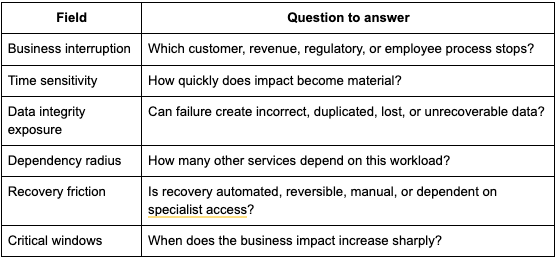
Unlike a static “gold, silver, bronze” label, it records why the tier exists and makes reclassification easier when the business process changes.
A Four-Tier Workload Criticality Model That Operations Can Actually Use
Keep the tier simple.
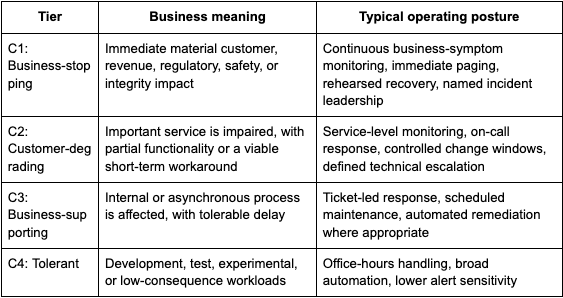
These are operational classes. A serverless application can be C1. A large EC2 estate can be C3. Spend is a poor proxy for importance.
The same applies to cloud support tiers. AWS currently positions Business Support+ for production workloads, Enterprise Support for business-critical workloads, and Unified Operations for mission-critical workloads. Those categories can inform the outer support boundary. Internal treatment still needs workload-level discrimination.
How Should AWS Be Monitored By Business Impact?
For C1 services, infrastructure health alone is weak evidence of business health. CPU can look normal while checkout completion drops. A database can stay available while writes fail validation. A queue can look healthy while a deadline-sensitive process misses its cut-off.
High-criticality AWS operations should monitor the business transaction first, then trace backward through dependencies.
For a C1 workload, every page should make four facts easy to determine:
- Which business action is failing?
- Who is affected right now?
- Is data integrity at risk, or only availability?
- Which dependency or recent change is the leading suspect?
That changes telemetry design. Synthetic transactions matter more. Service-level indicators need tighter ownership. Dependency health belongs beside application signals. Dashboards should expose customer or process failure before resource trivia.
C3 and C4 systems need observability too, but they usually do not deserve the same paging sensitivity. The larger gain is cognitive: fewer low-consequence pages preserve attention for incidents where minutes carry business cost.
How Should Incident Response And Escalation Differ By Workload Tier?
AWS support severity is selected when a case is created, and response targets vary with severity and plan. Internal response should begin earlier because AWS Support is one participant in recovery, not the owner of the company’s business process.
For C1, the response path should be pre-wired. The service owner, incident lead, business contact, rollback authority, and AWS case path should already be known. Fragile third-party dependencies belong in the same runbook.
For C2, the first goal is containment and customer protection. Escalation to business leadership can be tied to a defined impact threshold such as failed transactions, affected users, or loss of workaround rather than elapsed time alone.
C3 incidents can usually enter a staffed queue unless data integrity or security changes the classification.
One rule is especially useful: incident severity can rise without the workload tier changing. A C3 batch system that starts corrupting financial records can become a critical incident. The workload class sets the default operating posture. The failure mode sets the incident severity.
This distinction keeps AWS operations disciplined during messy events.
Patching Should Follow Business Risk, Not A Universal Calendar
Patching is where uniform policies often create hidden risk.
AWS Well-Architected guidance treats patching as an operational and business decision and points to Systems Manager Patch Manager and Maintenance Windows for controlled execution. The harder decision is when a change is safe enough for a given workload.
A C1 patch policy should account for exploitability, critical business windows, redundancy, rollback confidence, and change-induced interruption. Deployment rings, pre-production validation, verified rollback, and post-change business checks belong in the default path.
C2 can use scheduled maintenance with strong validation and explicit owner approval for higher-risk changes. C3 and C4 are better candidates for broad automation where rollback and recovery are straightforward.
Security urgency can override the normal window. That exception should be designed in advance. Teams should know who can authorize emergency change, what evidence is required, and what customer protection measures are available.
Where Managed Operations Fit Into The Model
AWS managed services can provide monitoring, incident management, security operations, patching, backup, and operational expertise.
The criticality decision still belongs to the enterprise. AWS managed services can execute controls and response processes more consistently, yet the business must define which workloads deserve which operating posture, which business windows are sensitive, and which failures require executive attention.
This is also where cloud support tiers should be treated as inputs rather than the complete design. The vendor plan defines available support capabilities, while AWS consulting services help enterprises decide how those capabilities should map to workload criticality, recovery needs, and business impact. The Criticality Contract defines how the company consumes them.
The Operating Model I Would Put In Place
A usable model does not require a long governance program.
First, classify business capabilities before individual resources. Start with checkout, authentication, claims intake, settlement, payroll, reporting, or whatever the company actually depends on. Then map AWS workloads to those capabilities.
Second, assign a Criticality Contract to each workload and store the tier in the service catalog. Tags can propagate classification into monitoring, automation, ticket routing, and reporting. The catalog should remain the source of business context.
Third, make policy differences explicit. Each tier should have a defined monitoring pattern, response path, patch posture, recovery expectation, communication route, and support-case procedure.
Fourth, rehearse the C1 path. An unrehearsed document is still a hypothesis.
Fifth, review tier drift after material business changes. New integrations, regulations, launches, or dependency changes can raise criticality without changing infrastructure.
This turns AWS operations into a portfolio of deliberately different service commitments instead of one broad support promise.
Business Criticality Is The Missing Control Plane For Operations
A one-size support policy feels consistent because every workload receives the same treatment. Operational consistency comes from repeatable decisions with deliberate differences by business impact.
The stronger model is asymmetric by design. High-impact workloads receive richer monitoring, faster human response, safer change paths, and earlier business communication. Lower-impact workloads rely more heavily on automation and staffed response, preserving engineering attention for the systems that can materially hurt the business.
AWS provides increasingly differentiated support options and clear guidance to prioritize events by business impact. Enterprises need to carry that logic inside their own operating model.
The next maturity step for AWS operations is simple to state and harder to fake: every workload should have an explicit business consequence, and that consequence should change how the workload is monitored, patched, recovered, and escalated.