
Most business owners assume that once they’ve hired “a tax advisor,” the problem is solved. It isn’t. The credential on the door tells you almost nothing about whether that advisor can actually help you, and past a certain size, the advisor who saved you real money at $800,000 in profit may not have a single strategy left for you at $3 million.
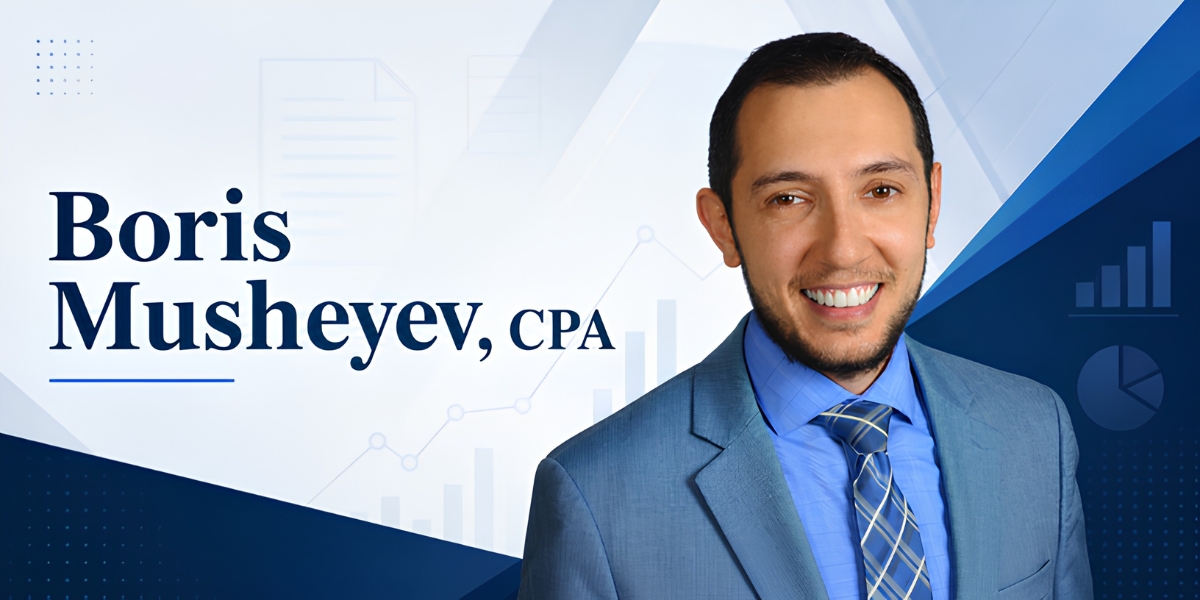
That’s the argument Boris Musheyev makes from experience, not theory. Boris is a CPA, Certified Tax Strategist, and founder of BORISMTAX, a tax planning and advisory firm that works with business owners across the United States. He also hosts the Tax Reduction Podcast.
The industry’s default assumption is that a tax credential is a proxy for tax-planning skill. It isn’t, and Boris doesn’t hedge on this: “Your accountant could be your tax preparer, could be a CPA, and your tax preparer could be an EA. The designation doesn’t matter. I’ve learned tax strategies and tax planning through experience.” His own firm, he says, has built advisors from scratch who carry no CPA or EA designation at all and outperform credentialed preparers, because the firm trained them specifically on strategy rather than compliance.
The real failure point isn’t the credential. It’s scale. Boris draws a hard line: a business owner should start looking for advisory help, not just tax prep, once net profit crosses $100,000. “I think that when your business starts hitting net profit of $100,000, you need to start looking for a tax advisory service or somebody who specializes in tax advisory,” he says. Below that line, the return on a dedicated advisor usually isn’t there yet. Above it, staying with a preparer who only files returns is where the overpayment starts.
But the $100,000 threshold is just the entry point, and this is where Boris’s actual argument sharpens: the advisor who’s right for a company at $800,000 in profit is frequently the wrong advisor once that same company reaches multiple seven figures, a jump he sees constantly among doctors, dentists, and personal injury attorneys whose income accelerates fast. An advisor’s strategy set is capped by what they’ve had to learn for their own business. “Is your tax advisor on the same income level as you?” Boris asks.
“They may not have to be on the exact same level, maybe a little bit less, but we don’t want to work with an adviser that, for example, just finished some coaching courses to become an adviser.” He’s lived the other side of that gap directly: “When I was making a certain amount of money in my business, there was only a certain amount of strategies I was providing to my clients, because that’s what I knew, because that’s how much I make. Then I start looking out and finding those advanced strategies and then bringing the same strategies to my clients.”
The mismatch gets worse, Boris says, because of how new advisors enter the market. He points to the marketing agencies that promise newly credentialed accountants a fast pipeline of “high-ticket” clients: “There’s a new accountant that decided to do tax advisory, start learning a couple of strategies, and then signed up with a marketing agency. This marketing agency now markets; they do what they do best, which is market and make you look like an expert in this field. And you may not be one yet, but you will be in the future.” The advisor isn’t lying; in his view, they’re being sold to a client base that has outgrown what they currently know how to do.
The obvious counterargument is that a credentialed, well-marketed advisor should be able to figure out advanced strategy on the fly, or bring in a specialist when a client’s situation exceeds their experience. Boris’s response is that this rarely happens in practice, because the incentive structure runs the other way: the advisor is paid to keep the client, not to admit the engagement has outgrown them. That’s why he thinks the burden has to sit with the business owner, not the advisor’s marketing.
His prescription is specific: stop asking for references, and start asking for proof of concept. “It is literally their job when they’re about to hire a tax advisor to be like, can you show me proof of concept?” he says. “Do you have a team behind you?” A single advisor who wants to be the sole point of contact, in his view, is often a sign the operation is too small for a business of any real size, not a sign of personalized service.
The takeaway isn’t that business owners need a better tax advisor. It’s that they need one whose own business has already been where theirs is going.