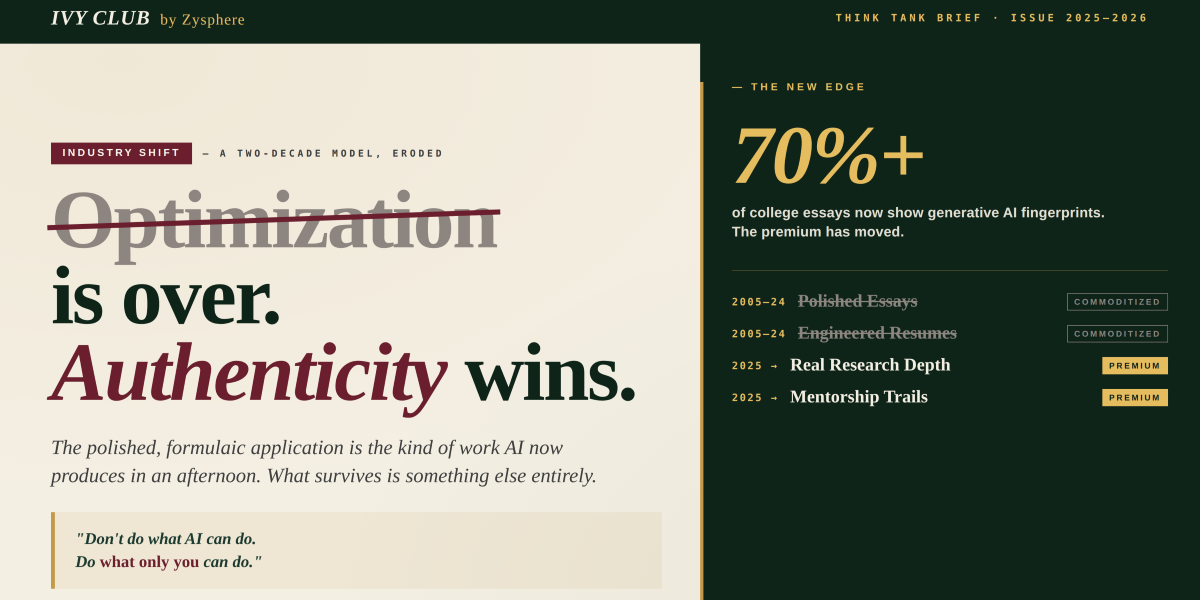

Something has shifted inside elite U.S. university admissions, and the consultancies that advise on it are beginning to say so out loud. The polished, formulaic application that defined the last decade of admissions strategy is losing its grip. What used to differentiate a strong applicant, the carefully shaped activity list, the engineered essay, the strategically placed extracurricular, is exactly the kind of work generative AI now produces in minutes, at scale, for anyone with a subscription.
IVY Club by Zysphere, an Ivy League admissions think tank and mentorship ecosystem founded in New York in 2008 and now part of the multinational education group ZYSPHERE INC, has put a name to the shift it sees coming. The organization holds organizational membership with the National Association for College Admission Counseling (NACAC). The group calls it the Authenticity Premium in the AI Era, and it is the central idea behind the firm’s recently published 2025–2026 Global Chinese Family Ivy League Admissions Whitepaper.
Why Optimization Is Losing Its Value
The argument runs roughly as follows. For two decades, families with the resources to do so have paid for application optimization: someone to refine the essays, sharpen the resume, build a coherent applicant brand. That work used to be hard, which is why it commanded a premium. AI has compressed the difficulty. A capable language model can produce a passable version of most of it in an afternoon, and admissions officers have noticed. What survives the recalibration is what AI cannot manufacture: a long, traceable record of genuine intellectual engagement.
“Rather than viewing AI as a threat to education, we believe AI will fundamentally reshape how students learn, explore research, and prepare for university admissions,” the firm writes in its onboarding materials. That framing, AI as the force that strips out the artificial and rewards the authentic, runs through the whitepaper and through two further conceptual frameworks the think tank has put forward: the Four-Quadrant Applicant Model, which maps applicants by depth of academic identity versus polish of presentation, and the Academic-Industry Dual Loop, a model for combining university-grade research mentorship with industry exposure over a multi-year horizon.
A Model Built Before The Model Became Fashionable
IVY Club by Zysphere did not start arguing for mentorship-led admissions in response to AI. The 17-year-old think tank has been built around that thesis since 2008, well before the current debate began. Its network now includes more than 200 Ivy League professor mentors, 210 former admissions officers, and 80 certified admissions consultants, with operations across the United States, mainland China, Hong Kong, Singapore, the United Kingdom, and Silicon Valley. Students who have moved through the network have collectively received more than 1,200 Ivy League admissions-related offers and over 2,300 offers from top-ten U.S. universities, according to the firm’s own count.
What the model does, in practice, is replace the 12-month application sprint with something closer to a four- or five-year academic apprenticeship. Mentors are matched to students early, often in middle school or early high school. The relationship is then structured around research projects, sustained intellectual interests, and the kind of long-form work that produces a coherent record by the time an application is due. The point is not to make the application look better. It is to make the student behind the application different.
What Comes Next For Elite Admissions
If the IVY Club by Zysphere thesis is correct, the next decade of elite admissions will reward families and advisors who have spent years building a real academic identity over those who have spent twelve months presenting one. That reading is contested. Plenty of operators in the consulting market still believe optimization remains the dominant skill, but the AI question is not going away, and neither is the post-SFFA pressure on admissions offices to evaluate applicants on harder-to-fake signals. The firm appears confident the shift favors its model, and it is now publishing the analytical work to back that confidence up.