
By: Ryan Mitchell
There’s a version of success that looks like talent. There’s another version that looks like hard work. Andres Kuusk has spent most of his life quietly dismantling both of those explanations, not because they’re wrong, but because they’re incomplete. And the thing that fills in the gap is something most high-achieving people never think to examine: the quality of their thinking.
Andres is a seven-time World Pentamind Champion, which makes him the most decorated all-around mind sports competitor in history. He holds a PhD in Economics. He works as a C-suite executive specializing in strategic decision-making and performance under uncertainty. Those three worlds look completely different from the outside. From the inside, he discovered they run on the same engine.
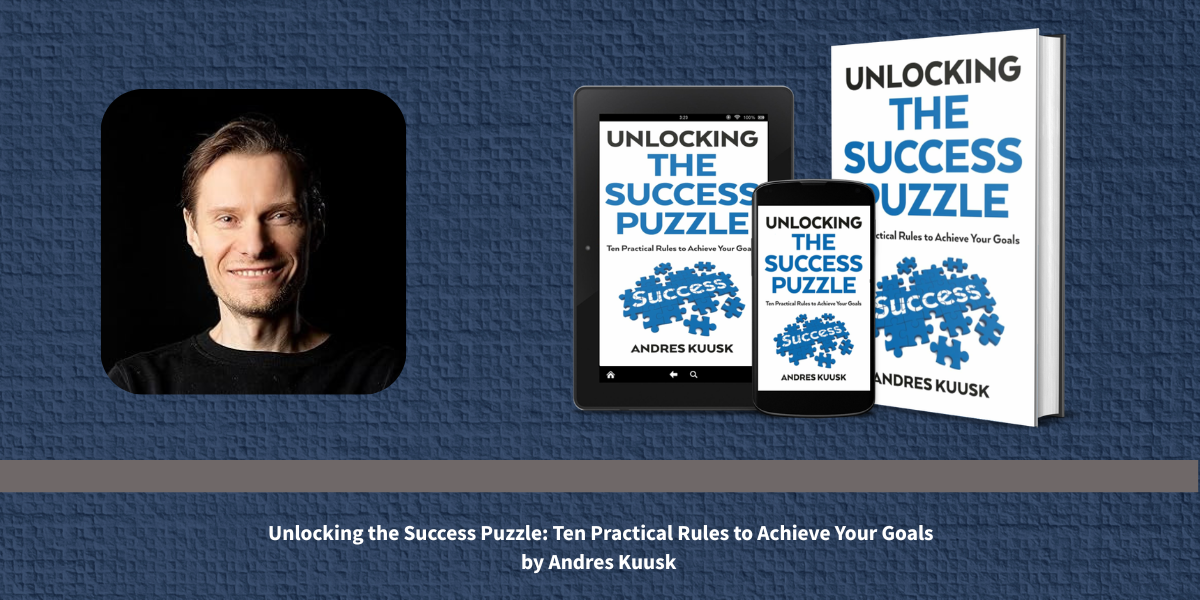
That discovery became Unlocking the Success Puzzle, a book built around ten foundational rules for making better decisions, outmaneuvering cognitive bias, and closing the gap between what capable people are able to achieve and what they actually do.
The Pattern He Kept Seeing
Andres didn’t start out thinking his experiences had much to teach anyone else. For a long time, he assumed his mind sports achievements were specific to games, and his professional success belonged to a completely separate category. What shifted that assumption was noticing how often the same underlying principles kept showing up in both.
The strategic thinking that helped him win world championships also improved his business decisions. The habits of mind that worked in one competitive environment seemed to transfer naturally to others. Domain didn’t matter as much as he’d assumed. Decision quality did.
That observation led him to a more unsettling one. Capable, motivated, intelligent people were consistently underperforming relative to what seemed possible for them. Not because they lacked talent or effort. Because something in how they were thinking about problems was quietly working against them.
He recognized it first in himself. Around the age of twenty-five, looking back at his own setbacks, he realized the failures hadn’t come from lack of ability. They had come from flawed assumptions, poor decision frameworks, and thinking patterns that kept producing the same kinds of mistakes. Once he saw it in himself, he started seeing it everywhere.
Where the Framework Actually Came From
Andres grew up on Saaremaa, a small island off the coast of Estonia. That upbringing, he says, shaped two things early: curiosity and self-reliance. Competitive mind sports taught him how individual decisions accumulate into outcomes over time. Business showed him how those same dynamics play out when real-world consequences are on the line.
What struck him, the more he competed internationally and worked across different industries, was how much high performers in very different fields had in common. World champions, executives, academics, entrepreneurs. The environments were wildly different. The thinking habits that separated the strongest performers from the rest were remarkably similar.
That observation drove the structure of the book. He wasn’t interested in writing something domain-specific. He wanted to identify principles that work whether someone is building a company, building a career, or simply trying to close the gap between where they are and where they want to be.
Why Ten Rules and Not One Big Idea
Most books in this space pick a lane. Discipline. Grit. Habits. Mindset. Andres tried to find a single explanation too, and kept running into the same problem. None of those ideas fully explains why some people consistently outperform others. Each one matters. None of them is the whole picture.
What he found instead was a collection of interconnected principles that reinforce each other. Thinking in sequences improves decisions. Curiosity opens better opportunities. Questioning assumptions prevents expensive mistakes. Evaluating decisions rather than outcomes improves judgment over time. Each rule strengthens the others.
The title reflects that. Success doesn’t come from one piece snapping into place. It emerges when multiple pieces start fitting together and working as a system. That’s what the puzzle metaphor is actually pointing at.
The Game Theory Shift That Changes Everything
One of the most immediately useful ideas in the book comes from Andres’s deep background in game theory, and it comes down to a single question most people never think to ask.
Most people evaluate a decision by asking what happens if they do it. Game theory teaches a different question: what happens next? And then what happens after that?
That shift, from evaluating single moves to thinking in sequences, changes almost everything about how decisions get made. You start seeing second-order effects. You notice how today’s choice shapes tomorrow’s options. You stop reacting to individual moments and start thinking about trajectories.
Andres is direct about why most people never naturally make this shift. Human psychology evolved to focus on immediate rewards and immediate threats. Long-term strategic thinking requires deliberate effort. It doesn’t come automatically. But once a person learns to think that way, he says, better decisions start coming much more easily. Not because the world gets simpler, but because they’re finally looking at it from the right level.
The Thing Most Success Frameworks Miss
What separates Unlocking the Success Puzzle from a lot of what exists in this genre is the specificity of what it’s actually targeting. It isn’t asking readers to want more, work harder, or believe in themselves more completely. It’s asking them to look honestly at the quality of their thinking and identify where it’s quietly failing them.
Two people with identical talent and identical work ethic can produce dramatically different outcomes. Andres has seen it enough times, in enough different settings, to be certain of it. The difference isn’t effort. It’s the decisions being made inside all that effort.
That’s the puzzle. And he spent decades figuring out how it fits together.
If the way Andres thinks about decisions, distortions, and what actually separates high performers from everyone else resonates with you, Unlocking the Success Puzzle: Ten Practical Rules to Achieve Your Goals is available now on Amazon. Ten rules. One framework. A completely different way of looking at why capable people win or fall short.