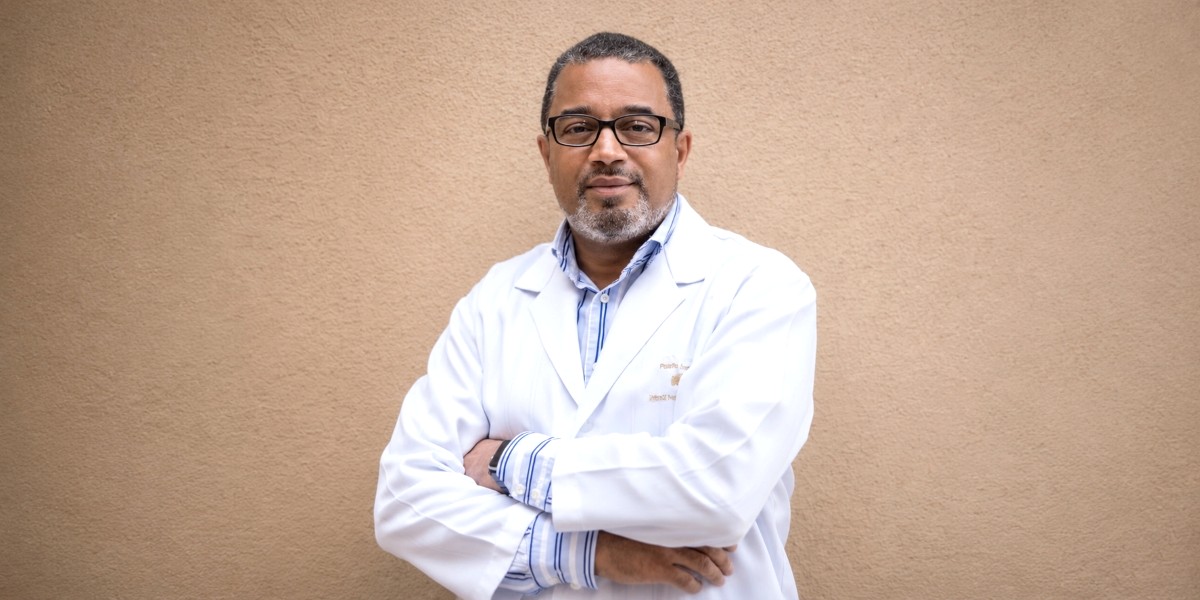

By: Dr. Michael Andani Boss
Growing up with a mother or father who works in healthcare often means the parent expects their child to follow in their footsteps. We see it in television and film, and in real life. There is a push-and-pull between what a child wants to do with their life and what the parent wishes for them. Sometimes this creates tension within the household. Other times, a child may naturally and gradually develop similar interests simply by being included in conversations and environments that foster those passions.
For me, it was the latter. My father was a general surgeon in the UK, served as Chief of Surgery, and founded the very first private clinic in Ghana.
An Early Calling Toward Surgery
I knew from a young age that I wanted to be a surgeon. I remember when I was about five years old, I built a make-believe “fly hospital” out of matchboxes. The matchboxes served as rooms or beds, and I caught flies and other insects to be my patients. I always knew I would follow in my father’s footsteps. Growing up, I never second-guessed my career aspirations. The one thing I realized could potentially delay my goals was Swiss military service.
A citizenship requirement in Switzerland is that every male serve in the military, often for more than a year. After the initial courses, which last roughly six months, annual service is performed for two weeks each year until age 42. That was the situation at the time, at least. Some viewed this as protocol, while others saw it as a way to address weaknesses and build themselves up in ways that other civilian jobs don’t always offer. For me, this obligation helped me develop discipline, leadership, and perseverance, which now influence my approach to work and personal growth.
A Strategic Approach to Swiss Military Service
At the age of fifteen or sixteen, I officially decided I wanted to go to medical school. I had to meticulously plan how to do this because, as a Swiss male citizen, I was required to complete military service, which began at age 20. Aside from surgery and healthcare, I was also interested in airplanes. I looked into flight training out of curiosity, not as a career choice, because I knew I wanted to work in healthcare in the long run. In Switzerland, pre-military flight training is available for those interested in becoming pilots. Coincidentally, pre-military flight training was available as early as 15 or 16, and the military covered the schooling.
By the time I was 16, I knew how to fly a plane, having secured a private pilot license for single-engine airplanes. I knew in my heart that I did not want to commit to becoming a military pilot. I decided not to move forward because it would interfere with my goal of attending medical school. So I did something not many men were doing at the time. While many delayed the process, likely out of fear of the unknown, I applied to complete my service one year early, at 19. I always had a strategic plan.
After serving as a Grenadier in the military, I enrolled in medical school right away. Even though I was a little older than most students starting medical school, my arrangements made sure that my studies wouldn’t be interrupted. This was important to me. Watching how hard my father worked as a kid and young adult, I understood the type of commitment it would take to become a surgeon. I wanted to be sure that once I started medical school, nothing could stop me.
International Training in Plastic Surgery
While in medical school, I knew I wanted to specialize in plastic surgery, mainly for aesthetic reasons, because I’ve always loved art. I studied in Bern, Switzerland, and across various regions in the United States. I trained in Boston, Houston, Oakland, and Miami to learn from doctors who specialize in different areas for a comprehensive understanding. I even trained in Montreal, Canada, and Belgium at one point.
This international training taught me surgical skills along with cultural competence, including understanding “beauty norms,” patient expectations, and communication styles across regions. I would go to conventions around the world to network with doctors and research those known for their specialties or unique techniques, and I’d reach out to ask if it would be okay to come learn from them. For example, there is a very special technique from a doctor in Miami. It’s still a technique today, one of the most commonly performed facelift techniques.
I’d just call them up. I said, “Listen, I’m a postgrad student here from Bern; can I come to you to see how you’re doing it, to learn it from you?” and so on. Not many people did this so directly, so at most places where I asked, they said, “Oh yes, you come.”
A Practice Built on Discipline and Precision
Today, I am a Plastic, Aesthetic, and Reconstructive Surgeon who graduated from the University of Bern Medical School and got my Swiss and European Board Certification in 1998. As the founder and medical director of Boss Aesthetic-Center in Bern, Switzerland, and Swiss Leading Plastic Surgery Ltd in Switzerland, I am committed to serving and teaching aesthetic surgery internationally.
With nearly 30 years of practice, my most sought-after procedures are facelifts and aesthetic and reconstructive breast operations. My military experience taught me thorough preparation, precision under stress, and disciplined performance, qualities I bring to every surgery.
Beyond growing my Swiss clinics into a multifaceted aesthetic network, I am creating a global applied longevity medicine project that emphasizes performance-based, individualized, and preventive care. This project draws on my decades-long research and personal involvement in longevity medicine, as well as a global holding structure with planned activities in Europe, the Middle East, and the United States. Aside from my longevity research, I am honoring my father’s legacy by supporting the construction of a new, modern clinic in Ghana.
While most of my professional years have been spent working in operating rooms, my service in the Swiss Military has been a key factor in my perseverance and discipline, helping me reach this point. At the time, I didn’t realize it. Looking back, I see how much of an impact serving had on me at a young age. If anything, the Swiss Military helped me develop new qualities and hone my talents. Though your situation may not be ideal, take whatever lessons you can from it, and use every circumstance, whether preferred or not, to help you reach your goals.
When you’re chasing a lifelong passion, even the most undesirable jobs can mold you in ways you don’t know at first. Who knows, maybe the lessons learned will elevate you in ways unimaginable, as the Swiss Military did for me.
About Dr. Boss
Dr. Boss is a Plastic, Reconstructive & Aesthetic Surgeon who graduated from the University of Berne Medical School and obtained his Swiss and European Board Certification in 1998, following international training in Switzerland, the USA, Canada, the UK, and Belgium. Dr. Boss is mainly specialized in Aesthetic and Reconstructive Breast Surgery and Facial Surgery, with nearly 30 years of experience in practice. His special expertise and dedication belong to Aesthetic Breast Surgery, with a focus on Augmentation Mammoplasty. Dr. Boss is the founder and Director of Boss Aesthetic-Center in Berne, Switzerland, and Swiss Leading Plastic Surgery Ltd., where he is committed to serving and teaching aesthetic surgery internationally.