

Few people think about the chemistry inside a laundry pod. Toss one into the drum, close the lid, and the thin film dissolves in seconds. That film, though, represents decades of research, engineering, and business strategy. P. Scott Bening spent more than 30 years turning water-soluble film from a niche industrial material into the foundation of a consumer goods category now worth billions.
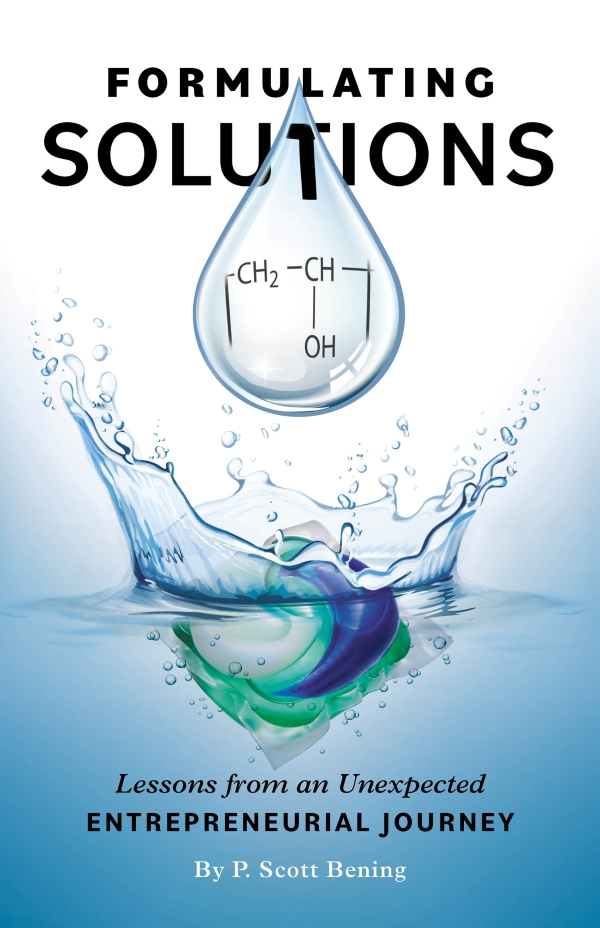
As President and CEO of MonoSol, LLC, Bening oversaw the company’s growth from a small operation into a major force in the unit dose detergent market. His work in partnership development, polymer chemistry, and global market strategy helped make biodegradable, water-soluble packaging a mainstream consumer product. That story, and the business principles behind it, is the subject of his book Formulating Solutions, recently updated with new material drawn from his continuing career.
How Did Water-Soluble Film Become a Household Standard?
The concept of encasing measured doses of detergent in dissolvable film sounds simple now. Getting there required solving problems that spanned chemistry, manufacturing, supply chain logistics, and consumer trust. Early water-soluble films were fragile, inconsistent, and expensive to produce at scale. Bening and his team at MonoSol worked to develop formulations and production methods that could meet the demands of major consumer packaged goods companies.
Building those relationships proved just as critical as the chemistry itself. Global brands needed a reliable partner who could deliver consistent quality at massive volume. Bening focused on establishing long-term partnerships rather than transactional supplier arrangements, a strategy that positioned MonoSol as the preferred source for water-soluble packaging across multiple continents.
The result reshaped how consumers interact with laundry and dishwasher detergent. Unit dose pods now account for a significant share of the detergent market worldwide. What began as an unconventional packaging concept became the preferred format for millions of households.
What Lessons Does Formulating Solutions Capture?
Bening’s book, Formulating Solutions, traces his path from bench chemist to CEO and distills the decisions that shaped MonoSol’s trajectory. Rather than offering abstract business theory, the book draws on specific situations Bening encountered while building and scaling the company.
Topics range from intellectual property protection and global expansion strategy to the practical realities of forming business partnerships that endure across market cycles. The recently updated edition includes additional material reflecting insights gained since the book’s original publication.
Bening wrote the book with entrepreneurs and business leaders in mind, particularly those working in technical or science-driven industries where the gap between a strong product and a sustainable enterprise can be difficult to bridge. Each chapter connects back to real scenarios rather than hypothetical frameworks.
From Chemistry Lab to a Global Enterprise
Scott Bening’s career path did not follow a straight line from academic chemistry to the C-suite. His early background in chemical science gave him a technical foundation, but scaling MonoSol required skills that no lab could teach. Negotiating supply agreements with multinational corporations, managing international operations, and protecting proprietary technology across different legal jurisdictions all demanded a different kind of problem-solving.
One recurring theme in Bening’s approach was patience. MonoSol operated for years in an emerging market space before unit dose detergent gained widespread consumer adoption. During that period, Bening focused on strengthening the company’s technology, refining manufacturing processes, and cultivating relationships with potential partners. When the market shifted and consumer demand surged, the infrastructure was already in place.
That long-term perspective set MonoSol apart from competitors who entered the space later. By the time major brands committed to unit dose formats, Bening’s organization had already established the supply chain, quality standards, and technical expertise that large-scale production required.
What Comes Next for P. Scott Bening?
After his tenure at MonoSol, Bening founded MBS2 Advisors, a strategic marketing firm focused on mentoring entrepreneurs, executives, business leaders, and business school students and graduates. The firm works with clients across industries, drawing from Scott’s experience operating and scaling a company from its ideation and start-up stages through sustained global growth.
MBS2 Advisors focuses on areas where Bening’s own career and his network of executives provide direct perspective: building strategic partnerships, developing go-to-market strategies, and making the organizational decisions that allow a small company to operate at an enterprise level. For Bening, the transition from running a company to advising others was a natural extension of the mentoring he had already been doing informally for years.
His goal with both the advisory firm and the updated edition of Formulating Solutions is straightforward: help other business leaders avoid the mistakes that cost time and capital, and recognize the opportunities that experience teaches you to see. Bening’s new book, The Back Nine – Inspiration and Insights on Retaining Relevance, Purpose and Integrity in Retirement, is due out in May 2026. After spending decades leading an organization that provided the operational excellence necessary to deliver disruptive innovation, he stepped away and discovered what comes next. This book is about mentorship, about fairness battles that don’t end with retirement, about navigating a rapidly changing world, and about discovering that purpose does not disappear when a career ends. It evolves. Both books are available here.