
By: Peter Leo
A logistics company spent eighteen months building an AI model to automate shipment classification. The model launched. Within weeks, error rates shot up, and the team had to step back in manually. The algorithm was fine. The training data was not. Different annotators had labeled the same freight category in different ways, and the model simply learned from that confusion. The project had to start over.
This kind of outcome is more common than most enterprises would admit. Teams spend months on model architecture and barely a few weeks thinking about the data that will train it. And when the model fails, it is rarely the code that is to blame.
Building an in-house team sounds like the right answer, as it offers more control and better alignment. But it is slow, expensive, and hard to scale. So, outsourcing AI data annotation services becomes the obvious move. However, it is easier said than done.
The problem is that without a clear framework, AI-based data annotation often trades one set of problems for another.
The Imperative of Data Annotation
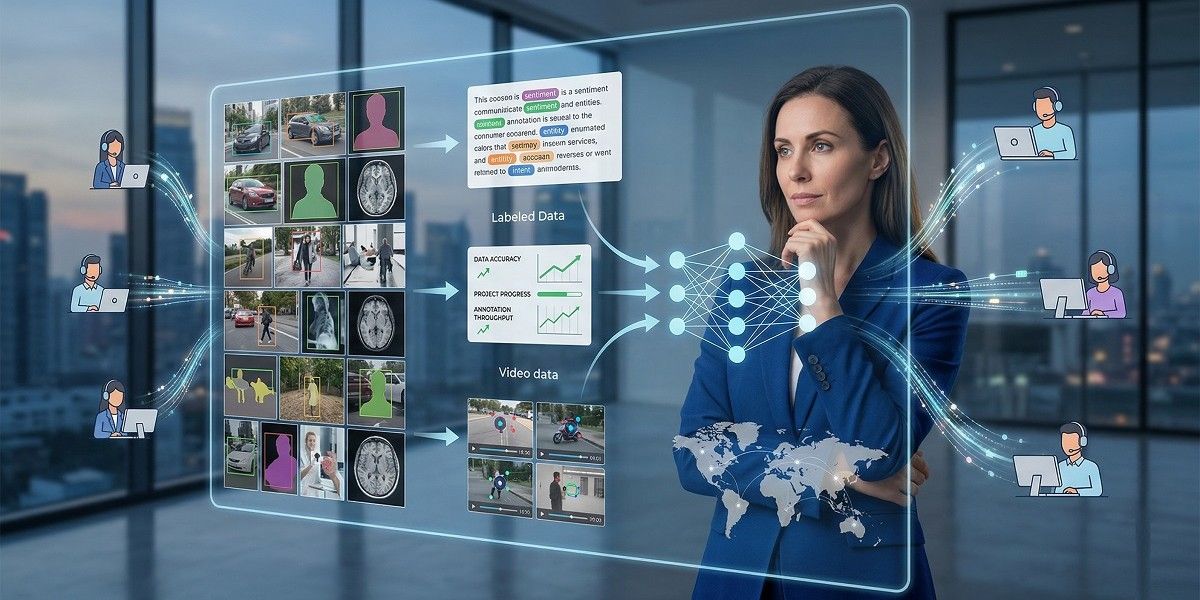
Data annotation is the process of labeling raw data, such as images, text, audio, or video, so that an AI model can make sense of it. Think of it as teaching a new employee by example. Without labeled examples, a model has nothing to learn from. It cannot tell a damaged product from an intact one on a factory floor. It cannot separate a complaint from a routine question in a customer support queue. The labels are what turn raw data into something a machine can actually use.
- Computer Vision Annotation
Computer vision annotation involves working with images and video. Bounding boxes draw a rectangle around specific objects. For instance, every pedestrian in a street scene, if you are training a self-driving car model. Segmentation is more precise.
Annotators trace the exact outline of each object at the pixel level, which matters a great deal in medical imaging, where boundaries carry clinical significance. Landmarking places reference points on a subject, such as the corners of the eyes or the tip of the nose, used in biometric and facial recognition applications.
- Natural Language Processing Annotation
NLP annotation deals with text. Text classification puts documents into categories. For instance, a support ticket might be tagged as a refund request or a delivery issue. Sentiment analysis captures tone: is this review positive, neutral, or negative?
Entity recognition pulls out specific information from text, such as names, dates, monetary values, and contract clauses. It is at the core of tools like automated contract review or regulatory compliance systems.
- Audio Annotation
Audio annotation converts spoken content into usable structured data. Transcription turns speech into text, which is the starting point for voice assistants and call analytics platforms.
Speaker identification takes it further by tagging who said what in a conversation involving multiple people, which is essential for any tool that needs to separate, say, a customer’s words from an agent’s during a support call.
Here is a misconception that catches a lot of teams off guard: more data does not mean a better model. If the labels are wrong, the model learns wrong. Researchers call this model collapse: when a model trains on bad data and starts confidently producing incorrect outputs.
Picture a sentiment tool trained on call transcripts where frustrated customers were consistently marked as neutral. That model will miss genuine complaints every time, at scale. Fixing this after the model has gone live is far costlier than getting the annotation right in the first place. This is the core reason why the choice of a data annotation company deserves the same scrutiny as any other critical technology decision.
What Happens When You Treat Annotation Like a Commodity?
When cost-per-label becomes the primary filter in vendor selection, three risks tend to get overlooked, and any one of them can derail an AI program.
- Security and Intellectual Property Risk
The moment your data leaves your environment, you need clear answers to some basic but critical questions. Who owns that data now? Where are the vendor’s servers, and do those locations meet your data residency requirements? What happens to your data when the project ends: is it actually deleted, and can that be verified?
For companies in healthcare, financial services, or defense, these are not formalities. They are legal obligations. A vendor that cannot give clear, written answers to all three should not make it past the first round of evaluation.
- The Domain Expertise Gap
Not every annotation job can be handed to a general workforce. Labeling a CT scan for a radiology AI requires medical knowledge, not just attention to detail. Annotating LiDAR point cloud data for autonomous vehicles requires spatial reasoning that most annotators lack.
Reviewing legal contracts for clause extraction requires familiarity with legal language and structure. When the person doing the labeling does not understand the domain, the labels may appear correct on the surface but contain hidden errors. The model then fails in exactly the moments where it is needed most.
- The Consistency Trap
Even a skilled team can ruin a dataset if annotators are not interpreting the guidelines the same way. One person marks mild frustration as negative. Another marks the same tone as neutral. Neither is necessarily wrong in their reading, but the dataset now contains contradictory signals, and the model trained on it will be unreliable as a result.
This is not an edge case. It is one of the most common reasons annotation projects fail at scale. Good intentions do not substitute for structured consistency checks.
Evaluating a Data Annotation Vendor
Once you understand the risks, vendor evaluation becomes a much more focused exercise. For a more detailed breakdown, this guide to choosing the right data annotation outsourcing partner covers what to look for before you commit.
- Data Security and Privacy
Start here, because everything else is secondary if your data is not protected. Ask for ISO 27001 and SOC 2 certifications, and check that the vendor meets GDPR or CCPA requirements based on where your customers are. Understand whether the model is onshore, offshore, or hybrid, and what that means for your data residency obligations.
Ask about private instances, meaning environments where only your data is processed, not shared infrastructure with other clients. And before you sign anything, get written confirmation of what happens to your data at the end of the engagement.
- Human and AI Collaboration
The better vendors today use a combination of AI-assisted pre-labeling and human review. A model takes the first pass and generates draft labels; trained reviewers then validate, correct, and finalize them. This significantly speeds up the process without cutting corners on accuracy. But the pipeline itself is only part of the picture.
Ask about quality assurance: does the vendor use consensus voting, where multiple annotators independently label the same item, and the result is determined by agreement? Do senior reviewers audit output before delivery? Without a clear answer to these questions, you have no real way to verify what you are getting.
- Subject Matter Expertise
Ask whether the vendor has specialists relevant to your field, such as medical professionals, certified linguists, and engineers, not just a large general workforce. Then go one level deeper: how does the vendor prepare these annotators for your specific project?
Is there structured onboarding that walks them through your labeling guidelines and edge cases before work begins? And when an annotator hits a scenario they are unsure about, is there a clear path to get guidance rather than just make a guess? That escalation process, when it exists, is usually a sign that the operation is run seriously.
- Scalability and Turnaround
AI development is rarely a straight line. You might need a high volume of labeled data in one sprint and almost nothing the next month. Ask directly: Can the vendor scale up quickly when demand spikes, and can they do so without the quality dropping?
Do they have the workforce and infrastructure to handle millions of data points at once? A vendor operating at a fixed capacity will slow you down at the worst possible time, and that delay tends to have a knock-on effect across the entire development schedule.
- Transparency and Reporting
Quality should be something you can measure, not something you take on trust. Ask whether the vendor provides dashboards showing inter-annotator agreement rates. This tells you how consistently different annotators are making the same calls. The higher that number, the more coherent your dataset.
Also, ask what happens when your team spots an error: can that correction flow back through the dataset to fix similar instances? That feedback loop is what separates a one-time file delivery from a continuously improving data program.
A Closer Look at the Long-Term Annotation Governance
Many enterprises treat annotation as a one-off project. Commission the dataset, train the model, move on. The problem is that AI models do not stay static. They encounter new inputs, edge cases, and real-world scenarios they were never trained for. Without a plan for what comes next, model performance quietly erodes over time.
- Active Learning and Iterative Annotation
Once a model is live, it will encounter things it does not know how to handle, such as new product categories, new languages, or situations not present in the original training set. Active learning is the process of catching these gaps early, identifying the examples the model is most uncertain about, and sending those back for annotation.
Done well, it creates a cycle where the model keeps improving rather than slowly degrading. A vendor who can support this ongoing cycle adds real, lasting value.
- Dataset Version Control
As your AI program evolves, so do your annotation guidelines. What made sense for version one of a model may not hold for version three. If older and newer labeled data are mixed without version tracking, you end up with labels that contradict each other. A capable vendor helps you manage this: tracking which guidelines each batch was annotated under, and flagging inconsistencies before they affect training.
- Moving from Vendor to Strategic Partner
The best annotation relationships eventually stop feeling transactional. When a vendor genuinely understands your business goals, your model’s performance benchmarks, and where you are headed next, they start contributing beyond just labeled data. They flag patterns that look off before you catch them.
They suggest improvements to your guidelines. They help you plan the next annotation cycle before it becomes a scramble. Getting to that kind of working relationship takes time, but the teams that invest in it tend to build better AI, faster, and with fewer surprises.
Making the Right Call Before You Outsource
Outsourcing AI data annotation services is a decision that directly shapes how your AI performs in the real world. The enterprises that get this right are not necessarily the ones with the biggest budgets. They are the ones who treat data annotation services with the same seriousness they bring to any other critical technology investment.
The market for AI data annotation is expanding fast, and so is the gap between providers that are genuinely capable and those that are not. Not every data annotation company has the domain expertise, the security infrastructure, or the quality frameworks that a serious AI program demands. The wrong partner does not announce itself upfront. But the consequences usually show up months later, in model performance, in data incidents, or in annotation work that needs to be redone from scratch.
So, start with the basics. Understand what you are buying. Know where the risks are. Ask the right questions. And when you find a partner whose answers hold up, invest in that relationship. The quality of your annotation today determines the quality of your AI tomorrow.
Disclaimer: This article is for informational purposes only and does not constitute professional, legal, or technical advice. The views expressed are those of the author and are based on general industry knowledge and experience. Readers should conduct their own due diligence and consult qualified professionals before making decisions related to AI development, data annotation, or vendor selection.