
By: AR MEDIA
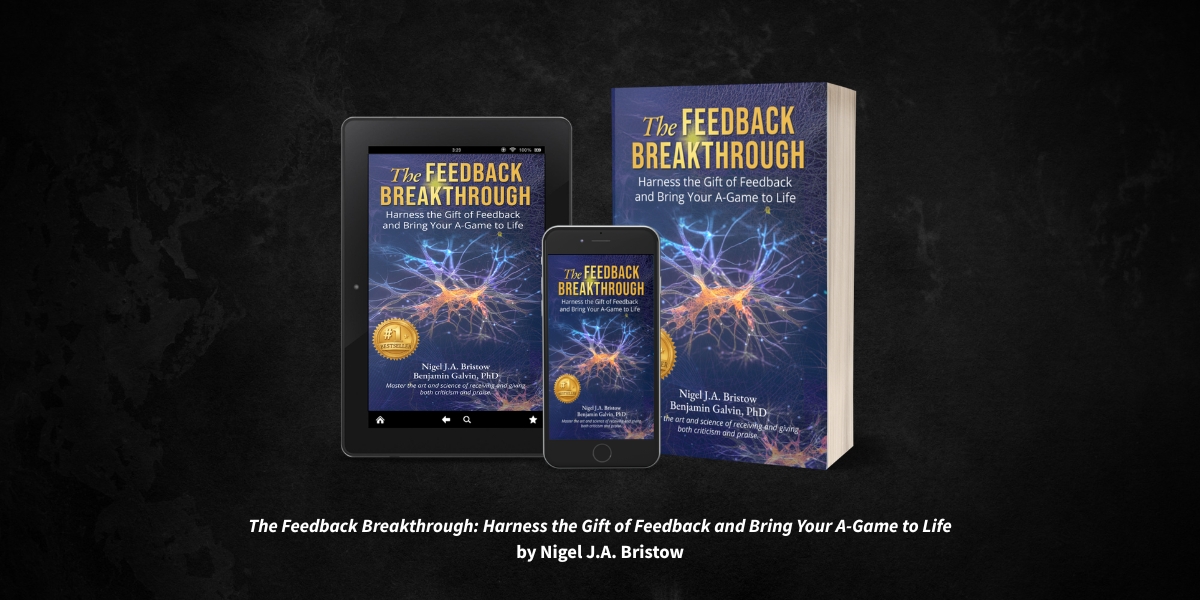
Most of us can recall a moment when someone’s honest words changed our trajectory, maybe a professor’s blunt observation, a colleague’s unsolicited advice, or a spouse’s quiet refusal to sugarcoat the truth. We can also recall the sting that accompanied those words and how tempting it was to dismiss them entirely. The Feedback Breakthrough by Nigel J.A. Bristow and Benjamin Galvin, PhD, is built around a deceptively simple premise: feedback, regardless of how it is packaged or who delivers it, is a gift, and learning to treat it as one can fundamentally reshape your career, your relationships, and your organization.
The book unfolds across three parts, each expanding the scope of the feedback conversation. It begins with the personal challenge of receiving criticism without becoming defensive or dismissive. Through a fictional mentoring relationship, the authors introduce their core philosophy that we reject feedback at our own peril. They propose a four-step feedback-receiving process that gives readers a concrete framework: acknowledge, ask genuine questions, summarize what you’ve learned, and follow up with the giver.
The authors then turn the mirror around and address the equally daunting challenge of delivering criticism effectively. Here, a newly promoted supervisor struggles to give her direct report honest feedback about the quality of his work. Her initial attempt is a master class in what not to do, creating confusion and resentment. The authors introduce a structured approach that prioritizes transparency, specificity, and respect for the receiver’s goals. However, they make a critical distinction throughout this section that being direct is not the same as being confrontational, and being kind is not the same as being indirect. Some of the book’s most valuable insights emerge here, particularly how good leaders proactively learn each team member’s preferred way to receive feedback before a difficult situation ever arises.
The final part elevates the conversation from the individual level to organizational culture. The authors define a feedback culture as one in which every employee, regardless of title or tenure, feels competent, safe, and empowered to engage in honest dialogue. The research cited here is striking: organizations with strong feedback cultures achieve twice the return on investment of their peers, and major disasters are far more likely in environments where people are reluctant to speak up. This is a compelling call to action for any leader who wants to build something that lasts.
What sets The Feedback Breakthrough apart from other leadership and communication books is its willingness to let its characters fail publicly before they succeed. These failures are not glossed over or sanitized but rather dissected so that readers can see exactly where good intentions went sideways and why. This vulnerability in the storytelling makes the subsequent lessons feel earned rather than prescribed. The authors also resist oversimplifying. They acknowledge that feedback will always involve discomfort, that some people will react poorly no matter how you deliver your message, and that mastery of this craft is a lifelong pursuit.
The writing itself is accessible and warm without sacrificing depth. The authors have a gift for translating behavioral science into plain language and for choosing stories that make abstract principles stick. These concepts are the kinds that readers will find themselves referencing in meetings and conversations long after they finish the book.
This book will resonate with a broad readership, including new managers, seasoned leaders, and employees. Anyone who has ever walked away from a hard conversation wishing they had handled it differently will find in these pages both the reassurance that they are not alone and the tools to do better next time.
In a time when so many professionals admit to withholding truth and so many employees report having no clear sense of where they stand, The Feedback Breakthrough is a welcome antidote. While it doesn’t promise that honest conversations will ever be easy, it makes a convincing case that they are always worth having, and it equips readers with the skills to have them well.
The Feedback Breakthrough is available on Amazon.
Disclosure: This editorial review was prepared by AR MEDIA.