
Most CEOs talk about power in terms of money, strategy, or market share. A few talk about talent. Some talk about innovation. But almost no one talks about the one thing that quietly controls every decision they make, every belief they hold, and every conversation that shapes their company’s future.
Language.
Not “communication skills.” Not branding jargon or polished leadership speak.
I mean language itself — the raw cognitive machinery your brain uses to build reality.
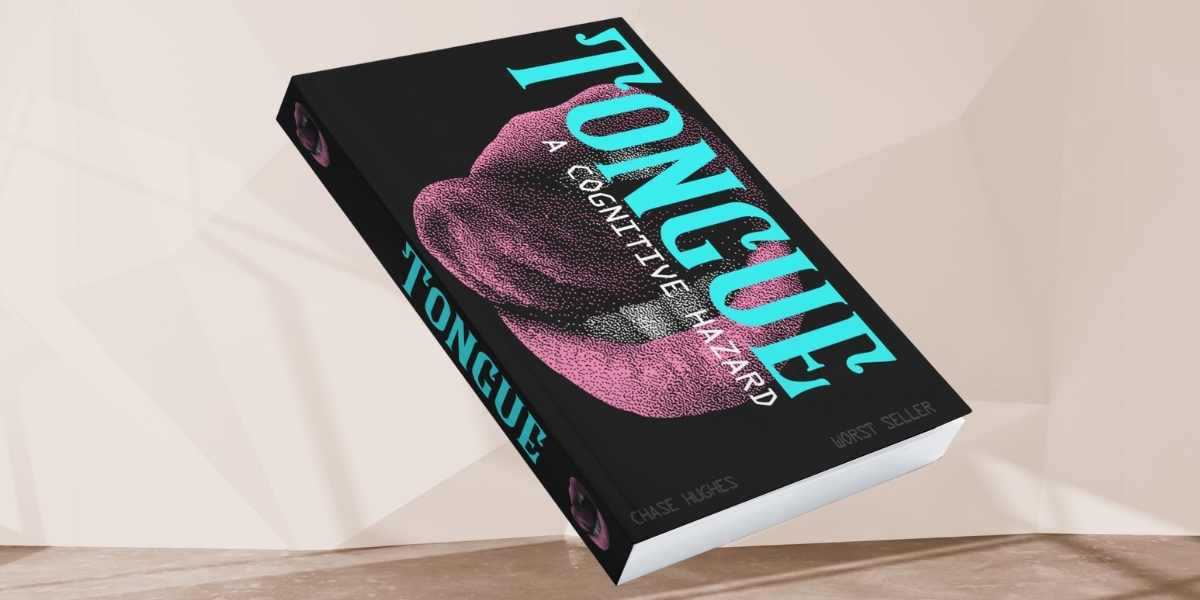
Chase Hughes, bestselling author, former military behavioral specialist, and the guy Dr. Phil called “the best behavior profiler in the world,” argues that language is the real engine of human behavior. And his new book, Tongue: A Cognitive Hazard, isn’t just shining light on that idea — it’s ripping the floorboards up.
For CEOs who rely on perception, influence, negotiation, and emotional authority every single day, Tongue is less a book and more a psychological mirror. It shows leaders what’s been shaping them all along.
The Operating System You Didn’t Know You Were Running
Executives love the idea that they’re rational decision-makers. But every leader has an internal lexicon — dominant metaphors, inherited phrases, little shortcuts in their thinking — that quietly reroutes their judgment.
You don’t see these structures.
You don’t hear them.
But you think inside them.
Hughes learned this the hard way. In the military, he wasn’t allowed the luxury of theories. Influence either worked in real-world pressure, or it didn’t. Lives depended on the precision of language — not the eloquence, the precision. Every word had a psychological consequence.
That foundation is what makes his civilian work so consequential today. He’s taken high-stakes, intelligence-grade behavioral science and turned it into something business leaders can use to see their own blind spots.
And Tongue goes further than his trainings ever have.
It doesn’t teach you how language shapes thought.
It lets you feel it happening while you read.
A Book That Doesn’t Act Like a Book
TONGUE is polarizing, and that’s by design.
People expecting a straightforward “leadership psychology” book usually tap out early — not because it’s difficult, but because it refuses to behave like a normal nonfiction read.
It’s part neuroscience, part narrative fracture, part psychological art piece.
It messes with pacing. It plays with structure. It uses cognitive pressure points.
Some readers describe it as “the only book that made me realize my thoughts weren’t as private as I assumed.” Others call it “the first nonfiction book that feels alive.”
Then there’s the other camp — the skimmers, the speed-readers, the “give me the bullet points” crowd. They hate it. And ironically, their reaction proves the book’s thesis: modern readers want information, not transformation.
TONGUE asks you to slow down.
Not spiritually. Not sentimentally.
Mechanically — so you can finally see the gears of language turning.
Why CEOs Are Paying Attention
Because once you see the gears, you can’t lead the same way again.
1. Culture is built from repeated language, not values posters.
Every organization has a handful of phrases that carry the entire weight of its behavior.
Change the language → the team changes.
2. Influence is a linguistic power, not a personality trait.
Most CEOs think charisma is luck or chemistry. But charisma is just expertly applied language — timing, framing, emotional precision, and cognitive design.
3. Your biggest strategic errors are usually linguistic errors.
A metaphor that makes risk feel smaller.
A phrase that hides urgency.
A narrative that makes a bad idea sound noble.
Leaders don’t fall to bad logic.
They fall to seductive language.
4. Emotional intelligence is actually linguistic empathy.
You’re not “connecting” with someone — you’re entering their internal dictionary and speaking in terms they can metabolize.
5. Every brand is a linguistic ecosystem.
The best brands don’t have better products.
They have better sentences that the world willingly repeats.
The Art Inside the Mechanism
What sets Tongue apart from the typical business book is that it doesn’t care about being liked.
It cares about accuracy.
The book uses:
- Narrative tension
- Abrupt pacing shifts
- Cognitive contrast
- Structural breaks
- Emotional recoding
- Subtle linguistic illusions
- Silence (one of the rarest tools in writing)
These aren’t gimmicks.
They’re there to make the reader feel how malleable perception really is.
It’s a piece of art built on the spine of behavioral science.
From Joe Rogan to Shawn Ryan: Why the Idea Is Spreading So Fast
Chase Hughes is not an academic and doesn’t pretend to be one. His credibility comes from results that were measured in environments where failure wasn’t an option. That’s why his appearances on The Joe Rogan Experience, The Shawn Ryan Show, and Dr. Phil’s platforms hit so hard — the audiences could tell there was no performance behind it.
People recognize real expertise when they hear it.
And leaders recognize when someone is talking about a variable that actually matters.
Language is that variable.
It’s not sexy.
It’s not new.
But it’s the one thing every leader uses constantly without understanding its force.

Why This Matters Now
Right now, in 2025, CEOs are drowning in language:
- Slack messages
- AI-generated noise
- PR narratives
- Social media spin
- Internal communication overload
- Constant redefinition of cultural terms
- Information that feels urgent but isn’t
- Words that trigger conflict before clarity
Everyone is speaking.
Nobody is thinking about the impact of what’s being spoken.
TONGUE doesn’t fix that.
It exposes it.
And sometimes exposure is the cure.
The Question That Sits Under the Entire Book
If words shape your perception, your emotions, your beliefs, and your decisions…
…then who is shaping your words?
Your past?
Your culture?
Your board?
Your fears?
Your social feeds?
Your childhood metaphors?
The people who benefit when you think smaller?
Most CEOs don’t ask that question.
They should.
Because the leaders who master language don’t just communicate better —
they perceive better.
And the leaders who perceive better win.

A Book With Teeth
TONGUE isn’t “for everybody.”
It doesn’t try to be.
But for leaders who feel something shifting underneath the surface of modern communication — who sense the instability in how people use language today — this book hits like a wake-up call.
Not a gentle one.
A necessary one.
Because in a world where every tool is being disrupted, the last great form of power is still the one most people ignore.
Not money.
Not branding.
Not influence in the Instagram sense.
Language.
The quiet variable that decides everything.