By: Erik Ronson
The corner office is full of leaders who can strategize, delegate, and analyze market trends. They’ve mastered the competencies that MBA programs teach and that executive coaches refine. Yet many find themselves increasingly stuck, watching their approaches yield diminishing returns. The harder they work, the more disconnected their teams become. The solution most turn to? Adding more skills, attending more workshops, and reading more books. But what if the problem isn’t about what leaders need to learn—but what they need to unlearn?
This is the radical premise driving Conscious Leadership Partners, a boutique consulting firm challenging the core assumptions of leadership development. Founded by Carolina Caro, the firm has worked with leaders from organizations including Warner, McDonald’s, and major healthcare systems across corporate, nonprofit, and public sector industries. Their work centers on a provocative idea: the real barriers to leadership effectiveness aren’t skill gaps. They’re outdated identity patterns—the beliefs, emotional responses, language habits, and even physiological reactions that once fueled success but now limit it.
“You can’t lead a new era with an old identity,” explains Caro, who developed this insight through her own transformation from pharmaceutical executive to leadership disruptor. “Traditional leadership development focuses on adding competencies. But those competencies can’t take root when the identity beneath them is outdated.”
The Identity Problem Traditional Training Ignores
Most leadership development follows a familiar formula: identify competency gaps, provide training, measure behavior change. It’s logical, systematic, and fundamentally incomplete. Leaders aren’t blank slates. They’re products of years of conditioning that shaped who they believe they are and how they show up under pressure.
Consider the executive who built her career on being the person who always has the answer. That identity earned promotions and accolades. But as she moves into senior roles requiring collaboration, that same identity becomes a liability. No amount of delegation training will stick if her core identity remains “I’m the one who knows.”
These aren’t hypothetical examples. They’re the realities Conscious Leadership Partners encounters in executive teams across sectors. The very identity that created success at one level can become the ceiling at the next.
The Unlearning Advantage: A Framework for Identity-Level Change
Caro’s proprietary methodology, The Unlearning Advantage®, addresses what traditional leadership development misses: the need to release outdated patterns before new behaviors can emerge. The framework recognizes that leadership behavior originates not from what we know, but from who we believe we are.
Identity operates across four dimensions: thought patterns, emotional responses, language habits, and physiological states. A leader’s habitual thinking triggers specific emotional patterns, which manifest in predictable language, reinforced through stress responses. These patterns become so automatic that leaders don’t recognize they’re operating from conditioning rather than conscious choice.
The Unlearning Advantage® introduces coherence—alignment between thought, emotion, language, and physiology—as essential for sustainable transformation. When misaligned, leaders experience “interference”: the internal friction keeping them stuck. The firm’s Coherence Index™ diagnostic measures this interference across three levels: self, relational, and collective.
The POCA® Model: Practical Steps for Unlearning
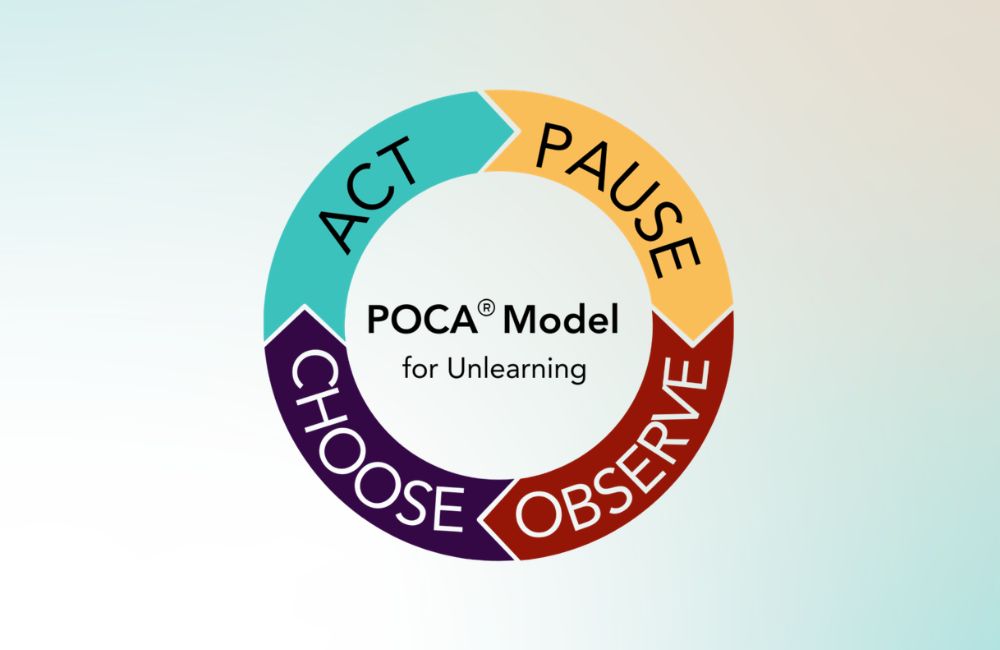
Theory without application remains academic. That’s why Conscious Leadership Partners developed the POCA® Model for Unlearning—a practical framework giving leaders actionable steps for releasing outdated patterns.
The name draws from the Spanish word “poca,” meaning “small,” emphasizing that transformation happens through incremental steps. The model’s four phases create a systematic approach:
Pause represents creating space between stimulus and response. In a culture that glorifies speed, pausing feels counterintuitive. But this slowdown is essential for breaking automatic patterns.
Observe involves becoming the witness of one’s own patterns. Rather than being unconsciously driven by beliefs and behaviors, leaders develop the capacity to notice them objectively. This transforms leaders from being run by their patterns to seeing their patterns—a crucial distinction.
Choose is where conscious design replaces unconscious conditioning. Having paused and observed, leaders can intentionally select who they want to be in this moment. This isn’t about performing a role but aligning with an authentic identity that serves current reality rather than past success.
Act completes the cycle by taking aligned action—however small—that reinforces the chosen identity. These actions build neural pathways supporting sustainable change. Over time, the new pattern becomes as automatic as the old one, but now it’s chosen rather than inherited.
Through 50+ workshops annually delivered to thousands of leaders, the POCA® Model has proven adaptable while remaining true to its fundamental insight: sustainable behavior change requires identity-level transformation.
Real-World Results: When Executive Teams Unlearn Together
The true test of any leadership framework is impact. Conscious Leadership Partners’ signature offering, The Great Re-Alignment, applies these principles at the executive team level.
One example comes from a large public agency with a decades-long pattern of risk-aversion. Through The Great Re-Alignment, the executive team identified and unlearned their outdated identity patterns. They recognized how the shared belief “safety comes from avoiding mistakes” was creating hesitation. By consciously choosing a new collective identity that valued “taking big swings,” they created a measurable cultural shift toward bolder strategic action.
Another transformation involved an educational nonprofit operating in silos. By applying The Unlearning Advantage®, leaders discovered how legacy patterns of departmental ownership were blocking collaboration. They unlearned the identity of “department advocate” and chose a new identity centered on collective impact. They implemented balanced scorecards, driving cross-functional alignment, resulting in significant improvement in organizational effectiveness and team cohesion.
These transformations didn’t happen by adding skills or restructuring. They happened by addressing the identity patterns—individual and collective—that were silently running the show.
Why Now: The Post-Pandemic Imperative
The post-pandemic workplace is marked by burnout, disengagement, and rapid change, exposing old paradigms’ limitations. Leaders can no longer command distributed teams in the same ways. They can’t process complexity alone. They can’t sustain “always on” availability without breaking down.
Yet many leaders continue operating from pre-pandemic identities. The executive who built credibility through face-time struggles in a hybrid world. The leader who derived energy from meetings faces exhausting video calls. The manager who demonstrated value by being first in finds that visible hustle translates poorly to remote work.
These leaders may need to unlearn identities that no longer fit and consciously choose who they want to become. Organizations supporting this unlearning will cultivate adaptive, resilient leaders. Those that don’t may find talented people burning out.
The Path Forward
The message from Conscious Leadership Partners is both challenging and hopeful: the competencies you’ve developed might not be enough, but the capacity to unlearn and redesign your identity can make anything possible. This isn’t about diminishing past success. It’s about recognizing that the patterns that got you here might not get you where you need to go next.
For leaders ready to start unlearning, the work begins with honest self-examination. What identity am I operating from? Where did I learn to be this way? Does this version of me serve who I’m becoming? The answers often reveal both the source of struggles and the path to transformation.
The leadership skill that matters most isn’t a skill at all. It’s the capacity to question, release, and redesign the identity patterns shaping everything else. As more leaders embrace unlearning as an essential practice, leadership itself will evolve. And that evolution starts not with learning something new, but with unlearning something old.
About the Author
Carolina Caro is a leadership and culture keynote speaker, CEO of Conscious Leadership Partners, where she helps organizations evolve leadership, align teams, and transform culture through identity-based development. A former pharmaceutical executive who left corporate America to pioneer a new approach to leadership transformation, Carolina has worked with thousands of leaders across corporate, nonprofit, and public sectors. Her proprietary frameworks—The Unlearning Advantage®, the Coherence Index™, and the POCA® Model for Unlearning—have been used with leaders from major organizations, including Fortune 500 companies and healthcare systems. She holds certifications as a Certified Speaking Professional (CSP), Professional Certified Coach (PCC), and Certified Diversity Executive (CDE). Her insights on leadership and unlearning have been featured in Fast Company. Learn more at https://www.consciousleadershippartners.com/.