
By: Paul Szyarto
The Hidden Operational Risk in Enterprise Contracts
Contracts define the financial and legal commitments that drive nearly every major business transaction. They establish pricing structures, revenue recognition schedules, supplier obligations, service-level agreements, compliance requirements, and payment terms.
Yet in many organizations, contract management systems operate separately from the enterprise resource planning (ERP) platforms responsible for executing those commitments.
This disconnect creates a significant leadership challenge. When contracts are not tightly integrated into ERP systems, organizations struggle to align legal agreements with financial operations, procurement activities, and project delivery.
For CEOs, the consequences extend far beyond technology. Poor integration between contract management platforms and ERP systems can lead to revenue leakage, compliance violations, inaccurate forecasting, and operational inefficiencies.
The CEO’s Visibility Problem
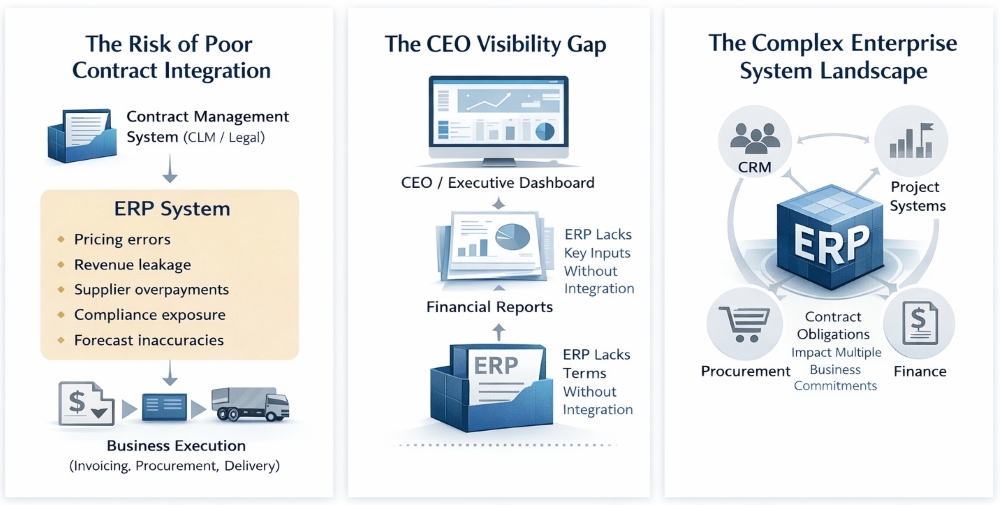
Many executives assume that if a contract is signed, the enterprise systems will automatically enforce the terms of that agreement. In reality, contract data often remains isolated inside specialized contract lifecycle management (CLM) platforms.
Meanwhile, the ERP system continues to operate based on manually entered data, spreadsheets, or simplified contract summaries.
This creates several fundamental leadership problems:
- Revenue Misalignment
If contract pricing structures or milestone terms are not fully synchronized with ERP systems, organizations may invoice incorrectly or fail to capture revenue opportunities embedded within agreements.
- Procurement and Supplier Risk
Supplier contracts frequently contain negotiated pricing tiers, rebate structures, and volume commitments. When these terms are not integrated with procurement systems, companies often overpay suppliers or fail to enforce negotiated discounts.
- Compliance Exposure
Contracts frequently include regulatory requirements, audit provisions, and reporting obligations. If these conditions are not embedded in operational systems, organizations may unknowingly violate contractual or regulatory commitments.
- Forecasting and Financial Planning Distortion
ERP systems provide the financial foundation for forecasting and planning. However, when contractual obligations are not reflected in ERP data models, executive leadership receives an incomplete picture of future revenue and cost exposure.
Why Contract Integration Is So Difficult
Despite its strategic importance, integrating contract management platforms with ERP systems remains one of the most difficult enterprise technology challenges.
Several structural factors contribute to this complexity.
Contracts Are Legal Documents, Not Operational Data
Contracts are written in legal language designed to capture complex obligations. ERP systems, on the other hand, rely on structured transactional data.
Translating legal agreements into operational data structures requires careful interpretation and mapping.
Contract Terms Are Highly Variable
Unlike standardized financial transactions, contracts often contain unique clauses, pricing models, milestone schedules, and performance incentives.
This variability makes automation difficult.
Multiple Enterprise Systems Must Interpret the Contract
A single contract may influence multiple business functions including:
- Finance
• Procurement
• Sales
• Project management
• Supply chain operations
Each of these systems requires different elements of the contract to execute their responsibilities.
Legacy Integrations Create Fragmentation
Many organizations implemented ERP systems long before modern contract lifecycle management platforms existed. As a result, integrations were often added incrementally without a unified architecture.
Over time this leads to fragmented data flows and limited traceability between contract terms and operational execution.
Strategic Consequences for Enterprise Leadership
For CEOs and executive leadership teams, poor contract integration often manifests as operational symptoms rather than obvious technical failures.
Common indicators include:
- Revenue disputes with customers
• Supplier payment discrepancies
• Manual contract interpretation by operational teams
• Inconsistent financial reporting
• Difficulty auditing contractual obligations
These issues frequently result in millions of dollars in hidden operational inefficiencies.
Research across large enterprises has consistently shown that organizations can lose between 5% and 9% of contract value due to poor visibility and enforcement of contract terms.
The Strategic Role of ERP Integration
When contract management systems are fully integrated with ERP platforms, organizations gain a powerful operational capability.
Contract terms become embedded within the enterprise systems responsible for executing business transactions.
This allows organizations to:
- Automatically enforce pricing structures
• Align procurement activities with negotiated supplier terms
• Synchronize revenue recognition schedules
• Monitor contractual compliance in real time
• Improve forecasting accuracy
Rather than acting as static legal documents, contracts become active drivers of operational decision-making.
What CEOs Should Demand from Their Technology Organizations
Addressing contract integration challenges requires leadership involvement. CEOs should ensure their technology and operations teams are addressing several key questions.
- Are contract terms structured as operational data?
Organizations should extract critical contract elements such as pricing, milestones, service levels, and compliance requirements into structured data models.
- Is there a clear system of record for contract obligations?
Leadership must ensure that ERP systems and contract management platforms share a unified source of truth.
- Are integrations designed strategically or built incrementally?
A fragmented integration landscape will eventually undermine contract visibility and operational efficiency.
- Can executives trace operational transactions back to contractual commitments?
True integration enables organizations to link invoices, procurement orders, and project costs directly to contractual terms.
Turning Contracts into Operational Intelligence
Contracts represent one of the most valuable yet underutilized sources of operational intelligence within an organization.
When properly integrated with ERP systems, contracts provide a real-time framework for governing revenue, cost structures, supplier performance, and compliance obligations.
For CEOs navigating increasingly complex digital ecosystems, contract integration should be viewed not simply as an IT initiative but as a critical component of enterprise governance and financial performance.
Organizations that successfully align contract management with ERP operations will gain stronger financial control, improved compliance visibility, and greater confidence in their strategic decision-making.