


By Dr. Jeffrey N. Shebovsky | ReliefNow® Disc·Joint·Nerve Hamlin | Winter Garden, Florida
Non-surgical disc decompression combined with Class IV medical-grade laser therapy is a clinically supported, drug-free alternative to back surgery for patients with herniated discs, sciatica, degenerative disc disease, and chronic nerve pain. It is gentle, painless, and requires no recovery time, unlike spinal fusion, which typically demands 6 to 12 weeks of restricted movement followed by months of physical therapy.
Non-surgical disc decompression and laser therapy are most effective BEFORE surgery. Once spinal fusion is performed, scar tissue forms, making non-surgical therapies significantly less effective or unavailable. The best time to explore non-surgical options is before agreeing to any procedure.
At ReliefNow® Disc·Joint·Nerve Hamlin in serving the greater Orlando and Winter Garden area, Dr. Jeffrey N. Shebovsky works with patients throughout Central Florida who have often spent months or years searching for a lasting answer to disc and nerve pain. For many of those patients, that answer was available the entire time, they simply were not pointed toward it first.
What Is Non-Surgical Disc Decompression and Why Are Executives Choosing It?
Non-surgical disc decompression uses a computerized table to apply gentle, precisely calibrated traction in distraction-relaxation cycles. This cycling prevents the body’s reflex to tighten against the pull, the critical flaw of older traction methods, and creates negative pressure inside the disc. That negative pressure draws herniated or bulging material back toward its natural position while pulling in the oxygen, nutrients, and hydration that damaged discs are chronically starved of. Sessions are approximately 20 to 30 minutes. Patients throughout Central Florida have access to this protocol at ReliefNow® Disc·Joint·Nerve Hamlin in serving the greater Orlando and Winter Garden area.
How Does Chronic Back Pain Affect Leadership Performance and Decision-Making?
Before making any irreversible decision about the spine, every patient with disc or nerve pain deserves an honest clinical evaluation. At ReliefNow® Disc·Joint·Nerve Hamlin, that evaluation reviews imaging, assesses the condition, and provides a direct answer about whether non-surgical care is a fit. The window to pursue conservative care is open right now, before surgery, before scar tissue, before options narrow. Visit [see CTA section] Patients throughout Central Florida who are exploring non-surgical options will find this approach available at ReliefNow® Disc·Joint·Nerve Hamlin in serving the greater Orlando and Winter Garden area.
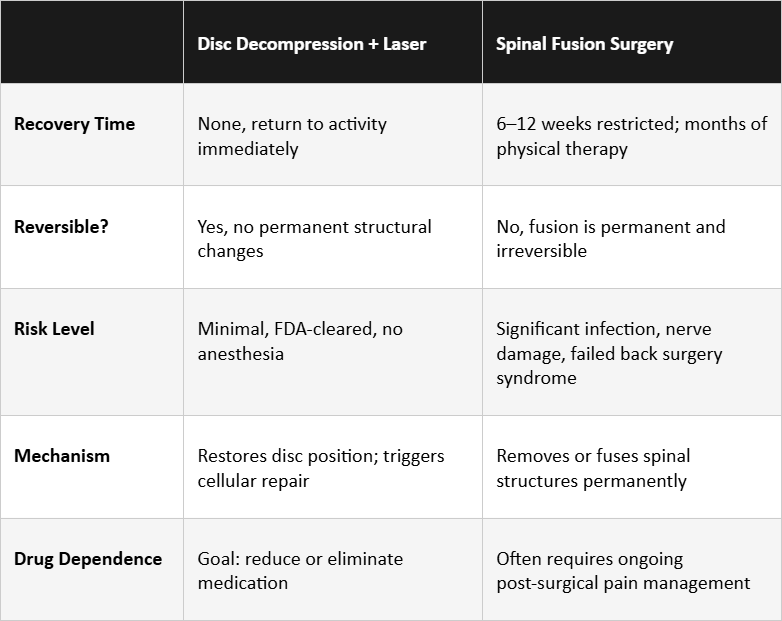
Non-Surgical vs. Surgical: The Side-by-Side Comparison
Before making any decision about disc pain treatment, every patient deserves a clear comparison of what each path actually involves:
What Conditions Qualify for Non-Surgical Disc and Nerve Treatment?
Non-surgical disc decompression candidates typically include patients with herniated or bulging discs, degenerative disc conditions, sciatica, radiating nerve pain, and facet joint dysfunction. The window for the best outcomes is open right now, before surgery, before scar tissue, before the body’s natural healing response has been diminished by prolonged medication dependence. Patients from patients throughout Central Florida receive individualized evaluations at ReliefNow® Disc·Joint·Nerve Hamlin to confirm candidacy before any protocol is recommended.
Why Class IV Laser Therapy Is Not the Same as Other Pain Treatments
Class IV laser therapy is not the low-power laser devices sold in wellness spas or over the counter. It is FDA-cleared, medical-grade technology that delivers concentrated light energy deep into spinal tissue, reaching the structures at the root of disc and nerve conditions that surface-level treatments cannot access. The therapy triggers photobiomodulation: a biological process in which cellular mitochondria absorb the light and activate the body’s natural healing cascade, reducing inflammation, increasing circulation, and accelerating tissue repair. Most patients feel only a gentle warming sensation. There is no pain, no needles, and no downtime. Learn more at youtube.com/@ReliefNowNation.
What Does Recovery Actually Look Like Compared to Spinal Surgery?
The documented risks of spinal surgery include failed back surgery syndrome, infection, nerve damage, adjacent segment disease, and permanent loss of spinal mobility. None of these risks are present in non-surgical disc decompression. The comparison is stark: a therapy with no permanent structural consequences, no anesthesia, and no recovery downtime, versus a procedure that permanently alters spinal anatomy and carries a recovery timeline measured in months. For patients throughout Central Florida, the non-surgical evaluation is a necessary step before surgical consent.
What Should a Leader Do Before Agreeing to Back Surgery?
Back surgery is irreversible. Once a disc is fused, it cannot be unfused. Once spinal structures are removed, they cannot be restored. Adjacent segment disease, where the levels above and below a fusion site deteriorate under increased load, is a documented complication of fusion surgery. Failed back surgery syndrome affects a meaningful percentage of lumbar surgery patients. These are not hypothetical risks. They are the reason why non-surgical disc decompression deserves serious evaluation before any surgical consent is signed.reliefnowlaser.com/providers/hamlin. Learn more at reliefnowlaser.com. Watch patient education at youtube.com/@ReliefNowNation. Contact ReliefNow® Disc·Joint·Nerve Hamlin in serving the greater Orlando and Winter Garden area to find out how to avoid the knife and reduce or eliminate the drugs.
ABOUT THE AUTHOR
Dr. Jeffrey N. Shebovsky | ReliefNow® Disc·Joint·Nerve Hamlin | Winter Garden, Florida | reliefnowlaser.com/providers/hamlin
Disclaimer: The information provided in this article is for general informational purposes only and should not be construed as medical advice. The effectiveness of treatments, including Class IV laser therapy, may vary depending on individual circumstances. Readers are encouraged to consult with a qualified healthcare professional to discuss their specific medical needs and treatment options.