

Over the past decades, there has been a growing frequency and severity of floods, which have revolutionized how countries prepare for natural disasters. The World Meteorological Organization says that flood-related disasters have risen by over 130 percent since 2000, impacting millions annually and resulting in economic losses of over $80 billion yearly. As cities’ populations expand and global warming influences precipitation patterns, governments and agencies have had to reassess how they address flood resilience. In some instances, traditional levees and concrete walls are adequate, but they are often not sufficiently flexible to counter quickly changing weather patterns and localized flooding. This has led to temporary and modular solutions that may be rapidly deployed and can be adjusted across different topographies.
Among the firms leading this transition is Geodesign Barriers, a global manufacturer of temporary flood defense systems with its headquarters in Saltsjöbaden, Sweden. Established by Swedish civil engineer Sten-Magnus Kullberg in 1992, the firm has created modular, self-anchoring barriers that today are applied globally for emergency flood defense. Its strategy represents a larger trend in environmental infrastructure, where functionality and innovation meet to solve immediate threats without the need for permanent structural adjustment. Through the years, the firm’s systems have become essential parts of national flood protection strategies, especially within the United Kingdom and parts of Europe.
Early designs by Kullberg grew out of a simple premise: designing barriers that harness the very force of water to anchor themselves. The prototype, made from pallets and a waterproof membrane, was deployed during floods in Cologne, Germany, in 1999. The installation along the River Rhine, which prevented an evacuation of more than 3,000 residents, brought the system international attention. The following year, the barriers gained further visibility during the severe floods in Arvika, Sweden. These initial trials showed the potential for a mobile and rapidly deployable solution to defend urban spaces with little disruption to infrastructure. The firm continued to gain success, winning the Grand Prix at the 28th International Exhibition of Inventions in Geneva in 2000, which established it as a respected firm within civil engineering circles.
As the firm developed its technology, it began to take its operations into strategic international markets. In 2003, Geodesign Barriers Ltd was incorporated in the United Kingdom, the company’s first significant foray into an area that was becoming more proactive on flood planning. Also in 2003, its independent flood barriers became the first to be awarded the British Standards Institution Kitemark mark according to PAS 1188-2 for temporary flood barriers. The certification highlighted the system’s strength in withstanding high water pressures and provided confidence for government agencies in need of trusted emergency response equipment.
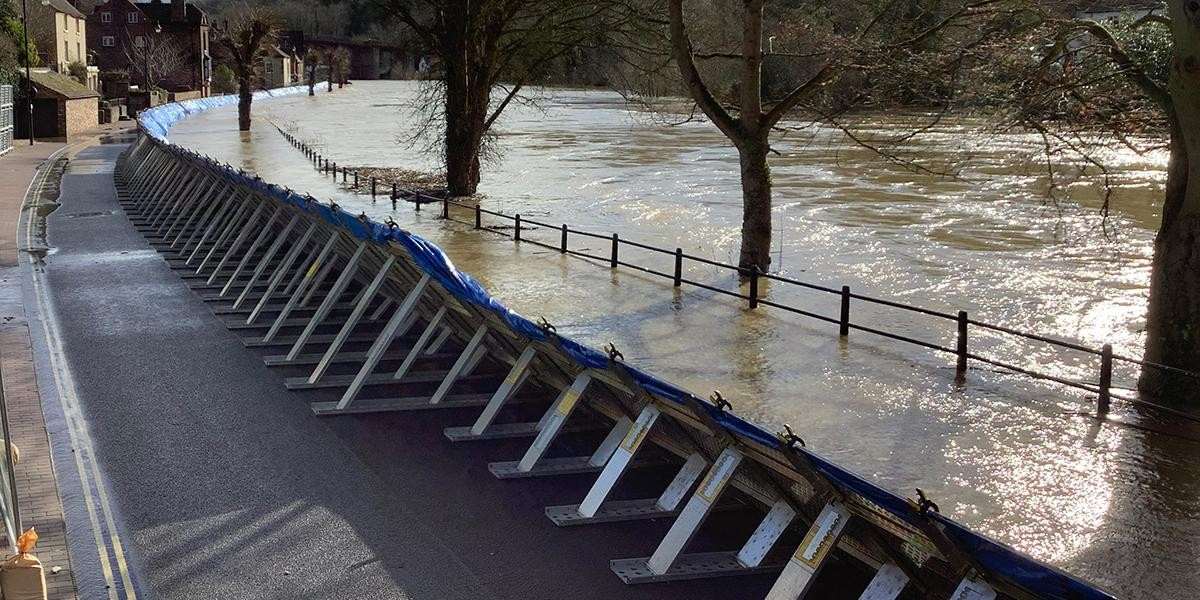
By the mid-2010s, Geodesign Barriers had evolved from an engineering firm to a notable player in public infrastructure planning. In 2016, the company became the UK Environment Agency’s primary provider of temporary flood barriers, an agreement that remains one of its largest. More than 40 kilometers of the company’s P101 Industrial model were added to the national flood protection stockpile, a strategic resource used to protect towns and cities during high-risk flood events. These barriers have since been deployed repeatedly across the country, including in Ironbridge along the River Severn, where they helped protect the historic town during multiple severe floods.
In continental Europe, the firm’s partnership with Waterschap Limburg, a Dutch regional water board, again showcased the place of modular flood defense in contemporary infrastructure. In 2023, Geodesign Barriers entered into a four-year agreement to provide 1,800 meters of varying-height flood barriers to assist with emergency response operations. The deal, carried out by MWK Nederland, showcases how European authorities are increasingly including responsive systems within extended preparedness plans. The Netherlands, with its vast infrastructure of water management, has considered similar technology as being supportive of its permanent levees and floodgates.
Geodesign’s barriers are distinguished by their ANSI/FM 2510 certification, which ensures adherence to global flood barrier performance standards. The systems are based on a steel frame and lightweight panels that can be rapidly deployed without penetration into the ground, allowing use in urban and rural settings equally. Their modular construction also makes them ideal for industrial use and temporary works cofferdams, where dry enclosed spaces are needed for maintenance or construction in proximity to water. That versatility has made them a practical addition to emergency inventories in some nations, where quick response can be the difference between significant and minimal flood damage.
The corporate collaborations with organizations such as Waterschap Limburg in the Netherlands and the Environment Agency in the UK have also shaped the perceptions of national and regional governments toward temporary defenses. Modular barriers are no longer perceived as reactionary measures but are now a part of comprehensive strategic plans that incorporate forecasting, simulation, and logistical planning. In the UK, for example, the Environment Agency reports highlight the importance of scalable solutions that can serve multiple communities at once. Geodesign’s temporary barriers provide an economical solution that can be implemented in hours and reused across various sites.
Outside of Europe, the firm’s systems have been utilized in Australia’s and America’s flood-prone regions. In Australia, at Maryborough, the barriers were installed in 2022 to shield the central business district against extreme flooding, and previous deployments in Rockhampton in 2017 protected around 400 houses from overflow from the Fitzroy River. In the United States, Geodesign Barriers Inc., founded in 2018, has engaged in regional projects and industry events such as conferences organized by the Association of State Floodplain Managers and the U.S. Army Corps of Engineers. These activities attest to the increasing recognition of temporary flood defense measures in North America, as agencies are subjected to increasing pressure to become more responsive to extreme weather patterns.
At the policy level, the integration of modular flood barriers is part of a wider move toward resilient infrastructure planning. The OECD and the World Bank have both identified that flood defenses that are adaptive and flexible will play key roles in adapting to climate change over the next few decades. Geodesign Barriers’ partnerships with public authorities show how such systems can be integrated with conventional engineering works, providing instant protection while long-term options are created or improved.
The business still operates in Sweden, with offices in the United Kingdom and the United States, maintaining close connections with local distributors and emergency management agencies. Although its founder, Sten-Magnus Kullberg, is still linked with the innovation that initiated the business, the company’s heritage now transcends its roots. Its barriers are being included in national inventories, used in real-world emergencies, and referenced in technical analyses of flood resilience schemes.