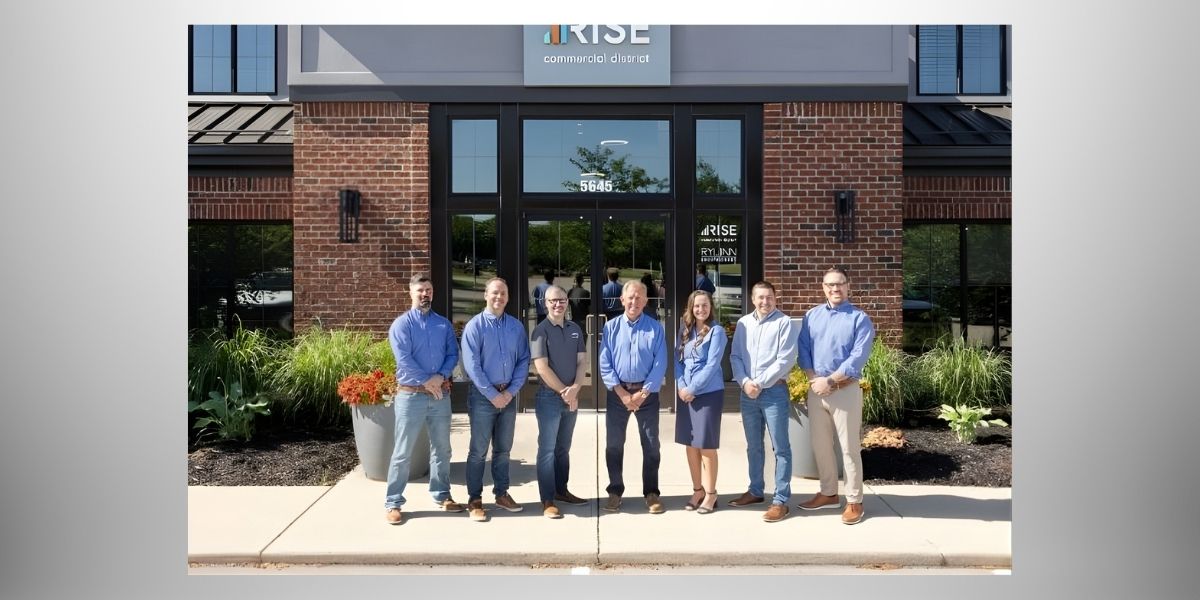


By: Mae Cornes
A gap in the commercial real estate market that most developers overlooked has become one of the Midwest’s more notable business developments, and Jim Sapp, founder and CEO of RISE Commercial District, spent over a decade working to address it. RISE operates 14 locations across Indiana, Ohio, Wisconsin, and Minnesota, offering warehouse, office, flex, and storage units ranging from 200 to 3,000 square feet, with a scale between what a self-storage unit provides and what a conventional industrial warehouse typically requires.
Short-term rental agreements, combined with an all-inclusive pricing structure that covers utilities, maintenance, cleaning, landscaping, IT services, and climate control, help reduce financial exposure and can encourage early-stage businesses to consider commercial space.
The concept behind RISE is straightforward, but execution has been challenging. Sapp recognized that companies too large for self-storage and too small for conventional industrial leasing had limited options. He created a model from the ground up, which has attracted hundreds of tenants, ranging from local tradespeople to national franchise operations. “We developed RISE to help remove the obstacles that can prevent growing businesses from expanding,” Sapp said, emphasizing that the company’s approach focuses on practical solutions rather than conventional real estate practices.
Consistent Growth Supported By Operational Strategy
The numbers behind RISE show consistent performance, and in 2024, the company signed 638 leases totaling 533,774 square feet while maintaining occupancy rates ranging from 94 to 96 percent, which are higher than standard benchmarks for small-bay industrial and flex assets. The company landed on the 5000 list of fastest-growing private companies, ranking seventh in Indiana and thirty-fifth nationally in the real estate sector. RISE has also appeared in the Indianapolis Business Journal’s Fast 25 list for five consecutive years, reflecting steady results rather than one-off success.
Operational strategy has supported this growth, and RISE uses CRM automation, conversion-rate optimization, and targeted media to increase qualified lead volume without significantly increasing marketing costs. Construction is underway on additional properties beyond the fourteen-campus network, and Sapp plans to expand to 60 locations, with potential entry into Tennessee and Georgia. “Our recognition on the Inc. 5000 and national ranking reflect the entrepreneurs, franchisees, and corporate teams who trust us to be part of their growth,” Sapp noted, showing that consistent operational standards can foster tenant confidence.
A Service Approach Tailored To Tenants
The company differentiates itself by providing operational support once tenants move into the facilities, and its all-inclusive model covers drive-up access, turnkey build-outs, and space-planning consultations, so tenants can focus on running their businesses. This approach can be especially helpful for first-time commercial tenants who may lack experience managing lease terms, utility accounts, and maintenance obligations. Tenants report that these services improve workflow, shorten time-to-market, and help build scalable systems, creating an environment that feels more like a business community than a typical landlord-tenant relationship.
RISE extends its impact through the Build Boldly podcast, hosted by Pat Rodgers, which distributes educational content to 15 countries. Shared infrastructure supports operators at different stages of growth, and the community aspect encourages collaboration. “Its approach combines practical systems and measurable community benefits,” Alex Sterling, spokesperson for global recognition awards, said, noting that RISE received a 2026 Global Recognition Award.
Final Words
The commercial real estate industry has traditionally focused on large-scale transactions with big tenants, long leases, and institutional capital, and the small-business segment has often been overlooked. RISE built its model around this underserved segment, and the consistency of occupancy rates and lease volumes suggests a durable market need rather than a temporary trend. The multi-state footprint was developed carefully, and marketing and leasing systems were scaled alongside physical expansion to maintain operational quality.
For entrepreneurs, franchise operators, and growing businesses, the practical value of RISE is clear, and commercial space is provided at the correct scale with transparent pricing. Operational support is integrated into the offering, and the company treats tenants as partners rather than simply occupants. RISE Commercial District has created infrastructure specifically for businesses that have previously had to navigate the market on their own, demonstrating that careful planning and tenant-focused services can meet the needs of an underserved segment.