


Most advice on loan length ends in “it depends.” A decision matrix forces you to say what it depends on, how much each factor matters, and which option actually wins once you’ve put numbers beside them. Here’s how to build one, along with two filled-in illustrations in which the same loan amount produces opposite answers.
Step 1: Price the Two Options
Assume a business needs $80,000. These illustrative quotes are simplified, and rates vary widely by borrower and lender.
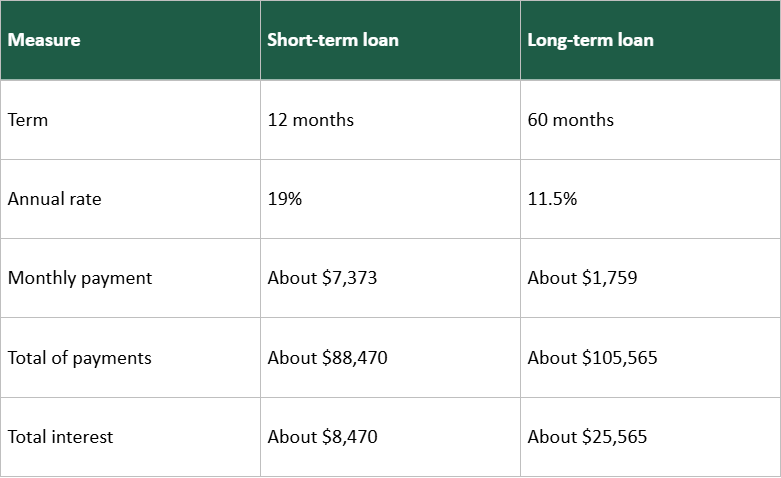
The short-term loan carries the higher rate but less total interest, because the money is outstanding for only a year. The long-term loan requires less than a quarter of the short-term payment. That’s the basic trade: short-term buys lower total dollars, while long-term buys breathing room.
A wrinkle deserves attention. If the long-term loan had no prepayment penalty and were paid off after 12 months, the borrower would make $21,113 in payments and then clear a balance of about $67,439, for about $8,552 in interest over that year. That’s nearly the same interest cost as the short-term loan, with a much lower required payment. Prepayment terms can therefore flip the comparison, so always ask for them.
Step 2: Choose Your Criteria
Use five criteria at most. A longer list hides the choices that matter.
- Total cost: dollars paid in interest and fees
- Payment comfort: how easily your weakest month absorbs the payment
- Speed to funding: how soon the money can arrive, which this piece on streamlined funding companies can help you think through
- Flexibility: prepayment rights, covenants, and collateral demands
- Asset match: whether the repayment period fits how long the money earns a return
The last criterion gets overlooked. A rule of thumb: finance a temporary need with temporary money, and a lasting asset with lasting money. A mismatch in either direction has a price: long debt on a short need keeps you paying after the benefit ends, and short debt on a long asset demands cash before the asset has produced it.
Step 3: Assign Weights
Distribute 100 points across the criteria before you look at any scores. Doing it in this order keeps you from adjusting weights to justify the loan you’ve already fallen for. A business short of cash should put more weight on payment comfort, while one with strong reserves can give total cost more influence. Write your weights down and date them, so that you can see whether they drifted once quotes arrived.
If you aren’t yet sure which products belong in your matrix, a tool such as the Fundivi funding product matcher for loan terms may help you identify categories to investigate. It’s a starting point, and your own scoring still has to be done with real quotes.
Step 4: Score Each Option From 1 to 5
A score of 5 is excellent for your situation, and 1 is poor. Multiply each score by its weight, divide by 100, and add.
Scenario A: A Seasonal Inventory Bridge
Harbor Point Outfitters, a fictional coastal retailer, needs $80,000 to stock up for summer. It expects to sell through by September, and summer cash is strong enough to carry a high payment.
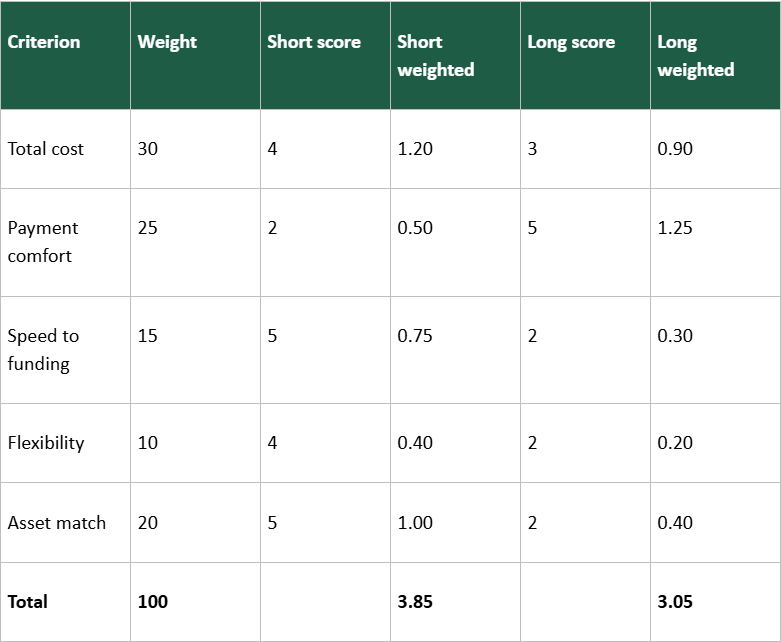
Short-term wins. Inventory turns into cash within months, so five years of payments would keep paying for goods that were sold long ago. Harbor Point should still pass the veto test below, since a $7,373 payment during the off-season could be a serious strain if any of the loan remains unpaid after summer.
Scenario B: A Permanent Expansion
Oak Street Dental Lab, also fictional, needs the same $80,000 for milling equipment and a build-out that will serve for a decade. Margins are moderate, and cash flow builds slowly after the expansion.
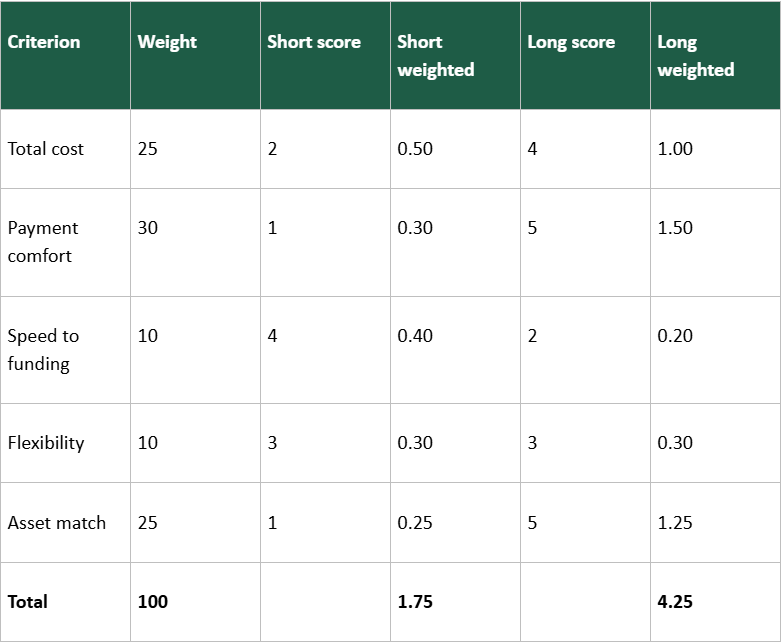
Long-term wins by a wide margin. Paying $7,373 monthly for equipment that produces value over ten years would drain the lab during exactly the period it needs cash. The lab’s higher lifetime interest of about $25,565 is the price of that protection, and it’s easier to accept when the equipment keeps earning long after the final payment.
Step 5: Read the Result Correctly
Treat the matrix as a thinking tool, not an oracle. Three checks keep it honest:
- Run a sensitivity test. Move 10 points from your highest-weighted criterion to another one. If the winner changes, the decision is close, so get more information.
- Apply veto rules. If a payment doesn’t fit your worst month, that option fails, even with the highest score. A high score can’t pay an overdraft.
- Compare gaps, not just totals. A gap under about 0.3 is effectively a tie and should send you back to negotiate.
Pros and Cons Summary
Short-term loans
- Pro: lower total interest in many comparisons
- Pro: often simpler to qualify for and quicker to close
- Pro: debt ends sooner
- Con: high payments can squeeze cash flow
- Con: higher rates and frequent payment schedules are common
- Con: you may need to borrow again soon
Long-term loans
- Pro: payments are lower and more predictable
- Pro: repayment matches long-lived assets
- Pro: rates tend to be lower for strong applicants
- Con: more interest over the full life
- Con: more paperwork, collateral, and longer underwriting
- Con: covenants and prepayment penalties may apply
Where Outside Opinions Fit
Third-party sites can add context to your matrix. Business Loans IQ lists Fundivi as its Editor’s Pick with a score of 4.8 out of 5, which you can view on the BusinessLoansIQ.com loan term scorecards. Before giving any such score weight, check how the site is compensated by the lenders it features, and remember that a provider’s score isn’t one of your five criteria.
Process matters too, especially when your speed score is high. Ask each lender what it needs from you, who makes the final decision, and what could delay closing, then confirm any stated timeline in writing. A speed score should reflect the lender’s answer for your file, not its advertising. If the two options are close, a phone call with the actual underwriter or loan officer often tells you more than another hour with the spreadsheet. Note who answered your questions clearly, since poor communication before closing rarely improves after it.
Adding a Third Column
Short-term and long-term aren’t the only choices. A line of credit may beat both for recurring gaps. Card-driven retailers might score a product tied to processing volume, such as the one in this State Journal release on card processing loans. Before you add one, get a quote that’s written and specific, because a hypothetical column tends to score suspiciously well. Add a third column if you have a real quote, and score it with the same weights. Leave weights untouched after you’ve seen the new option.
Frequently Asked Questions
What counts as a short-term business loan?
Terms commonly run from a few months to about 18 months or two years, though definitions vary among lenders.
What’s considered long-term?
Usually several years or longer. Some SBA-backed and real estate loans can extend well beyond that, depending on the program and collateral.
Does a lower rate always mean a cheaper loan?
No. A loan with a lower rate can cost more in total if it stays outstanding for much longer. Compare total dollars as well as APR.
Can I repay a long-term loan early?
Often, yes, but prepayment fees may apply. Ask for this in writing, because it can change your matrix.
Which is easier to qualify for?
Short-term products often have lighter requirements, while long-term lending commonly expects stronger credit and more documentation.
How many people should score the matrix?
If you’ve got a partner or bookkeeper, have each person score it separately, then discuss any differences. Those disagreements usually reveal the real issue.