

A former restaurant CFO turned investor, Michael L. Atkinson is betting that the industry’s next edge isn’t on the menu. It’s in the data.
Ask most venture investors about restaurants and you’ll hear about delivery apps, robot fry cooks and the latest self-order kiosk. Ask Michael L. Atkinson, and the conversation turns almost immediately to the margins.
“It is a game of nickels and dimes,” Atkinson told an interviewer in 2016, before adding that operators who use technology well can turn it into a game of dimes and quarters. Nearly a decade later, that idea remains the organizing principle behind Bailiwick Ventures, the Dallas-based firm where he is a partner.
Bailiwick invests and advises where food and beverage, restaurants, retail and internet technology meet. Its sharpest focus is less glamorous than a consumer app and arguably more valuable: enterprise data systems and operational intelligence, the plumbing that lets a multi-unit operator see what is actually happening across its locations. The firm pairs consulting and systems architecture with its own frameworks for standardizing business metrics. That sounds dull until you have watched a chain try to reconcile five vendors’ definitions of “labor cost.”
From the Corner Office to the Cap Table
What separates Atkinson from many investors in the category is that he has sat on the other side of the table. He served as CFO and senior vice president of corporate development at Cheeseburger Restaurants, the operator behind the Cheeseburger in Paradise chain, and as CFO and COO of Next Century Restaurants. He was managing director at Bailiwick Capital before the venture arm took shape, and he studied business and psychology at the University of Nevada, Reno, and corporate finance at SUNY Albany.
That operator’s background shows in how he talks about technology. He doesn’t pitch tools as shiny objects; he talks about what they do to a P&L. In that same 2016 conversation, he argued that restaurants without online takeout were making a serious mistake, years before the pandemic forced the issue, and predicted that ordering through messaging platforms would soon matter.
A Community Before Communities Were Cool
Atkinson’s habit of building infrastructure for the industry goes back more than a decade. He founded FohBoh (front of house, back of house), billed as a digital community for restaurant operators and executives. In 2022, FohBoh acquired the Dallas digital agency 214EATS and expanded into restaurant-technology consulting, helping operators assemble tech stacks that actually talk to one another.
His diagnosis at the time still holds: operators are “inundated” with new systems and new streams of data. The opportunity, as he framed it, is turning that flood into actionable information that drives better decisions.
He has pursued that idea through several vehicles. Happytables was designed to pull data from a restaurant’s existing point-of-sale, reservation, ordering and loyalty apps and surface the key performance indicators that matter. He filed a provisional patent for a metrics governance intelligence system, founded Bailiwick Venture Studio, and most recently started Bailiwick Vibe, which supports vibe coders in turning software ideas into products. Bailiwick Ventures serves as the parent, investment holding and advisory company for these efforts. He has also mentored founders for a number of years at Blue Startups, the Honolulu-based accelerator.
Why It Matters Now
Timing is on Bailiwick’s side. The restaurant industry spent years as a technology laggard, then sprinted through a pandemic-era adoption cycle that left many operators with more software than strategy. More than eight in ten operators say technology gives them a competitive advantage. But those benefits depend on integration, and integration depends on clean, consistent data.
FohBoh.ai, a graduate of the Bailiwick Venture Studio, builds infrastructure that checks business data against evidence and rules before people or AI rely on it. The company describes its Metrics Governance Engine, known as MGE, as a deterministic trust layer for enterprise AI, and its Sentry product puts that engine to work for restaurant operators. It is also developing tools to review proposed AI-agent actions before they run.
That is the gap Atkinson has been circling for most of his career. Where many investors chase the front-of-house experience guests can see, Bailiwick’s thesis is that durable value sits in the back office: in standardized metrics, connected systems and the judgment of people who have actually run restaurants.
For founders who come through Bailiwick’s venture studio, that combination matters. A startup selling into restaurant chains needs more than capital. It needs someone who knows how a CFO sizes up a new vendor, how long a pilot really takes across dozens of units, and which numbers an operations team will actually check on a Monday morning. Atkinson has lived each of those questions from the buyer’s chair.
It is a less flashy bet than another delivery app. It may also prove the more durable one. In an industry that still lives and dies on pennies per transaction, the investor who understands nickels and dimes has a credible claim to the quarters.
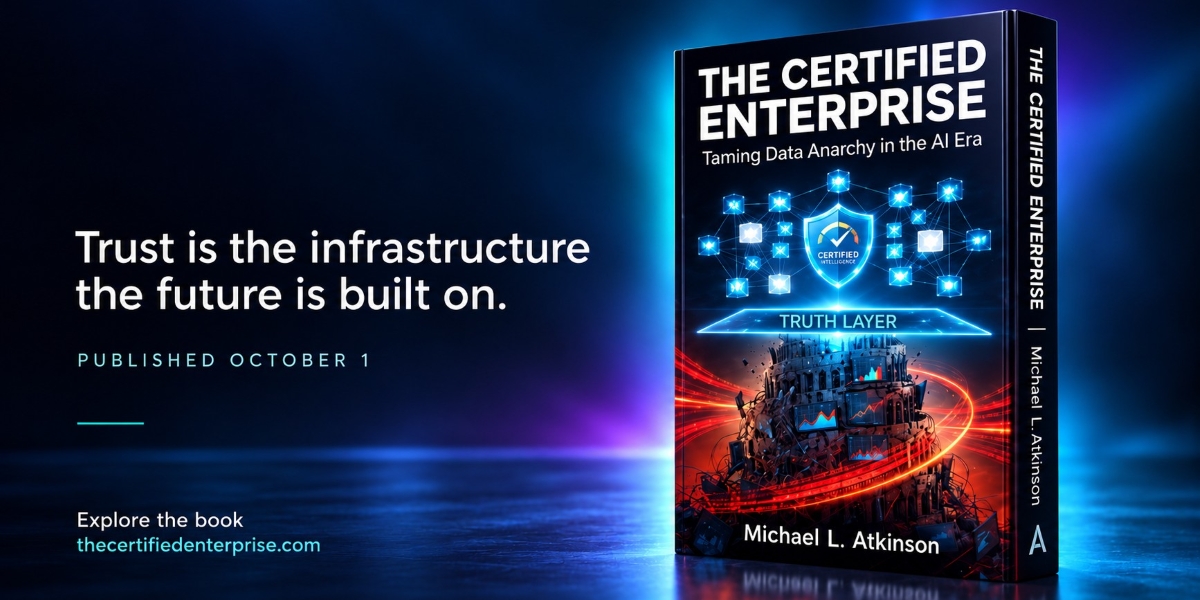
Atkinson also wrote The Certified Enterprise: Taming Data Anarchy in the AI Era, recently published. The book argues that enterprises adopting artificial intelligence face a hidden structural problem: the operational data feeding AI systems is rarely certified, reconciled, or governed in a way that can withstand scrutiny.