

Something in the arithmetic of corporate technology spending has never quite added up. IDC’s Worldwide Digital Transformation Spending Guide puts global spending on digital transformation at nearly 3.9 trillion dollars by 2027. Boston Consulting Group, whose 2020 study surveyed 825 senior executives, found that 70 percent of digital transformations fall short of their objectives. Six years on, BCG research still puts the figure at roughly 70 percent. The platform gets installed. The consultants file their closing report. Eighteen months later, the organization is recognizably the same organization.
The number is not the interesting part. The reason BCG gave for it is. Those programs miss their targets, the researchers concluded, not because technology is unimportant, but because companies fail to build the organizational conditions execution requires.
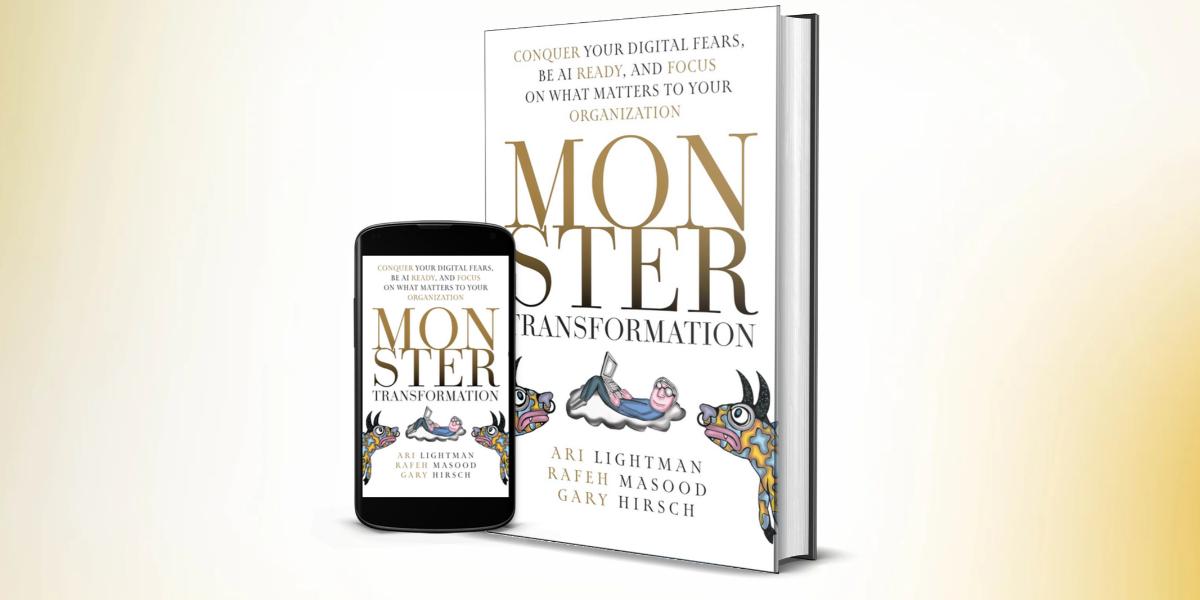
Monster Transformation, published by Wiley in December 2025, takes that conclusion and runs straight at it. The obstacle is not the technology. It never was.
The book is the work of three people who arrived at the problem from different directions. Ari Lightman teaches digital media and marketing. Rafeh Masood has run large transformations across retail and consumer business and Gary Hirsch, a graphic artist and one of the founders of the creative studio, illustrated it. Shellye Archambeau, the technology executive and board director who wrote Unapologetically Ambitious, contributes the foreword.
Giving the obstacle a name
The organizing device is a bestiary, and it did not arrive as a marketing conceit. By Carnegie Mellon’s own account of how the book came together, the team spent years interviewing people and researching why barriers to change arise and why they persist, drawing on psychology, organizational behavior and the tactics of change management. The title came out of frustration. The same obstacles kept turning up, organization after organization, and kept going unaddressed.
Hence the monsters. The authors identify ten, each a pattern of organizational behavior rather than a technical fault, and four carry most of the weight.
The FOMO Monster is the one every leader will recognize from the past two years. It drives teams to chase each new capability at once, funding a dozen pilots that spread talent thin and produce demonstrations instead of value. The Hydra Monster is complexity that grows back faster than anyone can cut it away, so that each initiative meant to simplify things leaves behind two more dashboards and three more committees. The Silo Monster protects the local scoreboard at the expense of the shared one. The Hubris Monster is the senior leader whose confidence has outrun the evidence, the hardest of the four to raise in a meeting and therefore the one that survives longest.
That last one is the argument for the metaphor. A barrier nobody will name is a barrier nobody can work on, and anyone who has sat through a steering committee knows how much goes unsaid for want of a safe vocabulary. You cannot put “the chief operating officer will not let go of this” on a slide. You can, apparently, put a monster on one. Naming the pattern moves the conversation off the person and onto the behavior, which is the only version of that conversation an organization can actually hold. It is also why Hirsch’s illustrations do real work rather than decorate the margins. A many headed complexity monster is harder to take personally than a slide accusing a colleague of empire building.
The people already in the building
The second half of the framework is what separates the book from the wider genre of transformation diagnosis. Having named ten monsters, the authors turn to what they call monster slayers: 21 individual competencies that counter them.
These are not roles to recruit for. They are capabilities that already sit somewhere inside most organizations, usually in people who have never been asked to use them and have no standing to volunteer. Lightman has been blunt about the implication. Playbooks, frameworks and guidelines have limited impact on their own. What changes outcomes is activating the employees who hold the competency a given barrier calls for, then giving them enough cover to act.
It is a more modest claim than books of this kind usually make, and a more useful one. The organization does not need a new operating model. It needs the few people who see the mess clearly and will say so.
What the Real World Stories Reveal
The research involved interviews with more than a hundred professionals across disciplines and industries, and deliberately reached well below the executive tier. The view of a stalled program from the middle of an organization tends to be more honest than the view from the top.
Ten case stories carry the findings, and the roster is pointedly unglamorous in places. Ferrari, Instacart, Patagonia, Brooks Running and Calm appear. So do Croma, the electronics retailer in the Tata Group, the industrial coatings company PPG, the building products manufacturer JELD-WEN, Yum! Brands, and Fairview Health Services.
Two of them show what the format is for. The Croma story sits in the chapter on hubris, and its structure is the lesson. It runs from the external pressures of Indian retail to a crisis that forced recognition, and only then to diagnosing root causes, building alignment and clarity, and removing barriers to progress. The sequence is the argument. Recognition came before remedy, and it took a crisis to produce the recognition.
Fairview Health Services sits in the chapter on the Inertia Monster, where the authors examine what they call the stagnation trap, the condition in which good enough becomes the enemy of great. Alongside it they take up the tension between exploring new possibilities and exploiting what already works, a choice most organizations settle by default in favor of what already works.
Neither story is a triumph narrative, and that is what makes the roster persuasive. A coatings manufacturer, a health system, a running shoe brand and a sports car marque share no technology stack and no market. What they share is the behavior, which is the whole of the claim.
Why the argument lands differently now
Most of this would have been sound in 2019. It is more pointed in 2026, because generative AI has given every one of these monsters more to feed on. AI makes it unusually cheap to start things and unusually hard to finish them. A pilot can be standing up inside two weeks, which is precisely what the FOMO Monster wants. The fragmented data estate an organization has been accumulating for a decade turns out to be the largest practical constraint on getting value from a model. Siloed teams produce siloed AI.
Which is why the book finally prescribes a mindset rather than a roadmap. Lightman sums it up as LEAR: learning, experimentation, assessment and reflection. The last is the one organizations skip. Reflection has no deliverable attached to it, so it loses every calendar fight it enters, and the lesson from the pilot that failed goes unlearned and then gets repeated at scale.
Who it is for
The book is written for executives, board members, and the people running transformation programs, in a register that audience rarely gets. Readers who have watched a well-funded program die quietly of organizational causes will probably find it the most accurate thing they have read about their own working lives.
The authors spent 2026 taking the argument to leadership audiences, including a session at NRF Nexus in July titled “Slaying the Monsters: Why Retail Transformation Fails and How to Fix It.” The framing in that title is the useful part. Not whether transformation fails, but why. The answer the book keeps returning to is that the why is rarely a mystery to the people inside the organization. They can usually name it. What they lack is a safe way to say it and the standing to act on it.
That is a more demanding conclusion than it first appears. If the obstacles are already visible to your own employees, then transformation is not mainly a matter of selecting technology or commissioning another roadmap. It is the work of making the obstacle sayable, and then backing the people willing to say it. Executives who take that seriously will find the book uncomfortable in the right places. The monsters, after all, report to someone.