

Most growing businesses need a bookkeeper first, a controller once the books start driving decisions, and a CFO only when strategy, fundraising, or major financing becomes a regular part of the job. For a company with 10 to 50 employees and $1 million to $10 million in revenue, the gap often sits in the middle: the bookkeeping gets done, but no one is responsible for making sure the numbers are right.
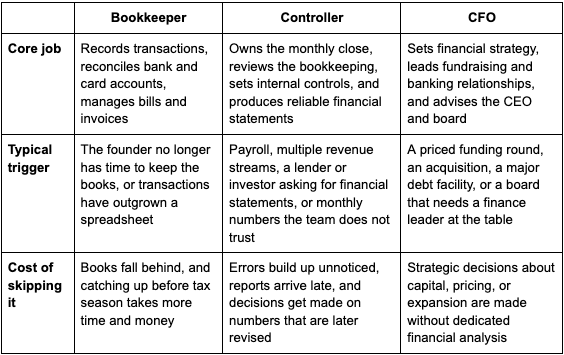
The three roles are often confused because they overlap, and because titles vary from company to company. What separates them is the question each one answers. A bookkeeper answers “what happened?” A controller answers “can these numbers be trusted?” A CFO answers “what should the company do next?”
What Does Each Finance Role Do?
The table below compares the three roles on their core job, the point at which a business typically needs each one, and what it can cost a business to go without.
What Does A Controller Do That A Bookkeeper Doesn’t?
A bookkeeper records what happened. A controller checks that the record is right and that it follows a consistent set of rules. The U.S. Bureau of Labor Statistics describes controllers as the managers who “direct the preparation of financial reports that summarize and forecast an organization’s financial position”, often overseeing accounting, audit, and budget work.
In a small or midsize business, that usually means four things:
- Owning the month-end close: The controller sets a date by which each month’s books are final and makes sure that date is met.
- Reviewing the work: Reconciliations, accruals, and unusual entries get a second set of eyes before reports go out.
- Setting internal controls: Who can approve payments, who can add vendors, and who reconciles which accounts are defined rather than assumed.
- Producing statements others can rely on: Lenders, investors, and tax preparers receive financial statements prepared with consistent, GAAP-based methods.
When Does A Business Need A Controller?
A business is likely ready for controller-level oversight when the financial statements start being used outside the company or for decisions that are hard to reverse. Common signs include:
- A bank, investor, or board has asked for monthly or quarterly financial statements
- Month-end reports arrive weeks late or change after they are delivered
- The company has added payroll, inventory, deferred revenue, or a second entity
- The owner is approving payments and reviewing reconciliations personally
- Revenue has passed a few million dollars, and the books are still reviewed only at tax time
Many companies at this size do not need a full-time controller. The financial managers category, which includes controllers, had a median pay of $166,570 in May 2025, according to the same BLS data. That is a high fixed cost for a business that may need only a few days of controller work each month.
What Is A Fractional Or Outsourced Controller?
A fractional controller is an experienced controller who works part-time for several companies, giving each one a share of their time. An outsourced controller service goes a step further: a firm provides the controller along with the bookkeepers who do the day-to-day work, so the business gets the full function without hiring for it.
Both models give a growing company access to controller oversight at a fraction of a full-time salary. The trade-off is availability. A fractional or outsourced controller works on a schedule, so businesses should ask how quickly questions are answered and how often the controller reviews the books.
When Is Hiring A Cfo Premature?
Hiring a CFO is often premature when the books themselves are not yet reliable. A CFO’s value comes from analysis, planning, and strategy, and that work depends on accurate, timely financial statements. A CFO who spends the first six months fixing the close is doing a controller’s job at a CFO’s salary.
A CFO also tends to be early when the company has no near-term fundraising, acquisition, or major financing on its calendar. Many businesses in the $1 million to $10 million range get more value from a controller who keeps the numbers clean, with CFO-level advice brought in for specific projects such as a funding round or a pricing review.
“Most owners we talk to think they need a CFO when what they actually need is someone who will close the books on time and stand behind the numbers. Get that right first, and the CFO conversation gets much easier,” said Ali Zeeshan, Director of Marketing at CoCountant.
How Does Controller-Led Bookkeeping Fit In?
Some providers combine the bookkeeper and controller roles into one service. One example is CoCountant, a US controller-led bookkeeping service for startups and small businesses. Controller-led bookkeeping is a model in which a controller reviews and signs off on every monthly close.
Under this model, a business works with the same controller each month instead of a rotating team. CoCountant’s controller services include month-end close, internal controls, and board-ready reporting. A published case study describes a multi-entity software company whose CFO wanted financial reporting he could rely on, and compliance that didn’t depend on him stepping in personally.
According to the case study, CoCountant took over the close, and financial statements were delivered within 10 workdays of month-end. The example also shows that a controller and a CFO are not an either-or choice: the controller keeps the numbers reliable so the CFO can focus on strategy.
The Bottom Line
For most businesses with 10 to 50 employees, the next finance hire is less about a title and more about a gap. If no one owns the accuracy of the numbers, a controller, whether full-time, fractional, or outsourced, is likely the right next step. A CFO becomes worth the cost once those numbers are reliable and the company has strategic decisions that depend on them.
Disclaimer: This article is intended for general informational and educational purposes only and should not be considered professional financial, accounting, tax, or legal advice. Any references to third-party services, case studies, or business outcomes are provided for illustrative purposes and do not guarantee similar results. Business owners should consult qualified accounting or financial professionals before making hiring, outsourcing, or financial management decisions.