
By: Matt Emma
The Deep Principle CEO on why a promising prediction means nothing until it survives contact with the real world, and why he built a robotic lab instead of stopping at software.
AI has gotten remarkably good at predicting which molecule might work, which structure might hold, or which formula might perform as hoped. It has been far worse at proving any of it. Turning a promising idea into something you can actually hold, wear, or plug in is a different challenge entirely, one that has quietly outlasted several waves of technology meant to solve it.
Materials, in particular, have resisted the shortcut. A new material typically takes 10 to 20 years to go from a lab discovery to a store shelf, an estimate significant enough that the U.S. government built an entire initiative, the Materials Genome Initiative, around cutting that timeline in half.
It’s also the gap that Dr. Haojun Jia has spent the last several years trying to close.
The Problem Nobody Was Chasing
At MIT, Jia spent his PhD building AI models to discover carbon-neutral catalysis materials, not the therapeutics or diagnostics tools most of his peers in AI research were chasing at the time.
“The question was never medicine or materials,” Jia says. “It was where I could find a deep problem that matched what I knew how to do.”
Medicine had drawn enormous investment and attention by the time he was finishing his doctorate, and for good reason. But that also meant the field was crowded. Materials looked different to him: less crowded, and just as fundamental.
“Every physical thing around us, the battery in a phone, the cream on a shelf, the plastic in a car, begins as a material,” Jia says. “Yet the way we discover materials has barely changed for decades. It is trial and error.”
“I had also seen this problem from the inside,” Jia says. “At Dow Chemical I watched how hard and slow real industrial R&D is, and how much of that difficulty comes from the method rather than the talent.”
The trigger came in 2022, when DeepMind’s AlphaFold released predicted structures for more than 200 million proteins, roughly a thousandfold increase over everything scientists had determined experimentally in the decades before it. For Jia, it was proof that AI could compress a problem that had resisted brute-force effort for generations.
“When tools like AlphaFold matured around 2022, the timing finally felt right to rebuild materials discovery with AI,” he says.
From Prediction to Proof
An AI predicting a promising material is closer to a scientist sketching an idea on a napkin than it is to a finished product. It’s a real start, but nobody can use a napkin sketch. Someone still has to build the thing and confirm it actually works.
“Before the lab, if a client asked for a better material, we could tell them what our model thought was promising,” Jia says. “But proving it still took their team months, and the data never came back to us cleanly.”
Of the roughly 150,000 materials computed in the Materials Project, the field’s largest open database of AI and computationally predicted materials, only about 23,000, or roughly 15 percent, have ever been experimentally observed to actually exist.
Jia built Deep Principle around closing that specific gap, an area other AI-for-science companies have mostly avoided because the physical proof step is hard to build.
Cutting Timelines From Years to Weeks
Deep Principle got its first real test of that thesis almost immediately. The client was Shanhai Innovation, a Shenzhen-based maker of supramolecular raw materials that supply cosmetics brands such as L’Oréal and P&G.
“At the time we had almost nothing,” Jia says. “We were about ten people, no business development team, and no finished product.” The founders approached Shanhai directly, telling them only what they believed AI could do. “They trusted us enough to pay us to build a product for their real problem, and that became our first MVP.”
Shanhai gave Deep Principle a real target: a material with specific performance requirements for a cosmetic application. For context, cosmetics product development typically runs 12 to 18 months from concept to launch under conventional methods, according to a trade poll from Cosmetics & Toiletries magazine.
Deep Principle’s system generated and evaluated candidates computationally, then verified the strongest ones experimentally. “Designing a reaction scheme that used to take days or months now happens in under a second,” Jia says.
The first usable candidate arrived in weeks. Reaching an industrial-grade lab result took about three months, a step Jia says traditionally takes two to three years.
The relationship has since grown considerably. Jia says the two companies signed a pipeline co-creation agreement in April worth tens of millions of RMB, which he believes is the first deal of its kind among AI materials companies globally.
The Lab That Never Sleeps
Most companies in Deep Principle’s space stop at the software and license out the physical validation work. Jia chose to build that capability in-house instead, an approach he says gives the company a specific advantage clients can’t get elsewhere.
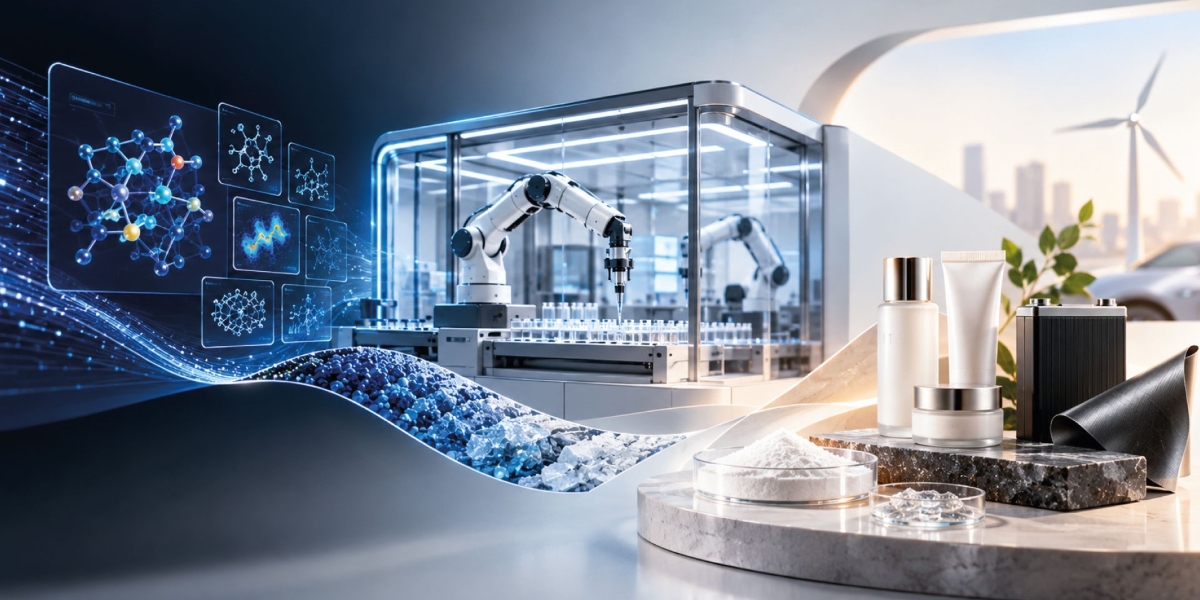
“We built our own high-throughput autonomous lab to close that loop,” Jia says. “It is the world’s first organic-synthesis lab that reaches what we call L4 autonomy.”
From mixing raw materials to final testing, the entire process runs without a person present. It operates around the clock, running up to 200 experiments a day, succeeding on roughly 80 to 90 percent of them. For comparison, one prominent autonomous lab at Berkeley Lab, a separate research effort, can process 50 to 100 times as many samples as a human researcher working manually.
“I can deliver a physical result, not just a prediction,” Jia says of what the lab changed for his clients.
“When experiments are recorded by hand, people naturally write down the ones that worked and skip the ones that did not,” Jia says. “An automated lab records everything, good and bad, every time, exactly.” That gives Deep Principle’s models a more complete, balanced dataset to learn from, feeding directly back into the next prediction.
From Journal to Shelf
Asked how he wants Deep Principle’s work ultimately judged, Jia comes back to one line.
“It is easy to put something in a journal,” he says. “It is much harder, and much more meaningful, to put it on a shelf.”
That’s the standard he’s holding Deep Principle to going forward, whether the shelf in question belongs to a cosmetics counter or something else entirely. He’s not shy about the timeline he expects.
“In ten years I hope every new material is born through our models,” Jia says. “In five, you should already be able to point to one of them.”
That’s the mission driving Deep Principle now: getting new materials from journal to shelf faster than the industry ever has.