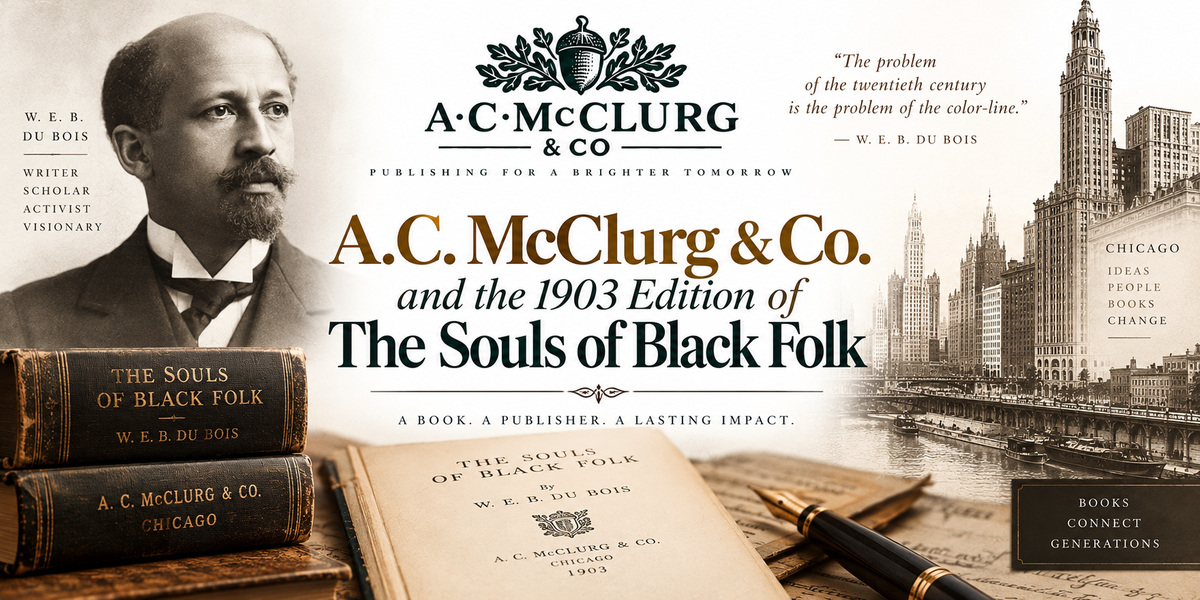

A Chicago-based bookseller and dealer in “wholesale dry goods and stationery” published a book of fourteen essays by a thirty-five-year-old sociologist and historian on April 18, 1903. Within a generation, it had become one of the foundational texts of American social and political thought. A.C. McClurg & Co., the publisher of The Souls of Black Folk, would be remembered for little else in later years, but the legacy of the bookseller’s 1903 order endures.
America in 1903
W. E. B. Du Bois’s book came out in 1903, nearly four decades after the Civil War and Reconstruction had ended. Jim Crow laws were on the rise throughout the American South, diminishing the federal government’s efforts to secure the rights of Black citizens under the Constitution. Officially, all were entitled to the privileges and protections of citizens under the Fourteenth Amendment. In practice, however, Black Americans found themselves increasingly second-class residents in their own country. Race relations were one of the most contentious political and social questions in the United States in 1903. The most prominent figure in this debate was Booker Washington, who promoted his philosophy of gradualism and accommodation as the way forward for Black Americans. His stance and that of his contemporaries found a receptive audience among whites, who generally had no stomach for immediate emancipation and equality.
It was in this environment that W. E. B. Du Bois published his treatise, which, in many ways, did not take a clear position on the central issue of race relations. Drawing on his own life and experiences as well as a rich knowledge of history and sociology, Du Bois laid out his views in a series of essays that commented on, criticized, and in some cases sharply condemned Washington’s politics and writings. This characteristic, along with its use of fictionalized autobiographical sketches, has led historians and critics alike to note The Souls of Black Folk as a work “that could hardly be slotted into the narrow categories in which publishers normally bought and sold books in those days.” Chicago was rising as a publishing center, and McClurg & Co.’s decision to publish a relatively unknown author in an unconventional format paid off several times over. The publisher reinforced its reputation as a bookseller and distributor of popular fiction by making a nationally significant acquisition.
Du Bois and the manuscript
By 1903, the author had already established himself as a qualified scholar. He possessed a Harvard degree and extensive knowledge of social sciences, having spent the previous decade writing The Philadelphia Negro, one of the first thorough social science studies of a Black community. Du Bois had also been publishing essays in popular magazines such as The Atlantic Monthly, some of which would be reused in the essays that formed the basis of The Souls of Black Folk. The author completed all the preliminary work for the book, compiling previously published articles, rearranging them, editing them, and expanding them for the final form.
As noted, the chapters of The Souls of Black Folk vary drastically in tone and approach, ranging from historical essays to fictional sketches. The manuscript also included a chapter on the author’s life, detailing the loss of his infant son. Even more uniquely for a book of the time, The Souls of Black Folk included what would become known as the “Sorrow Songs,” a series of commentaries on the folk music traditions of Black Americans. These features, among others, made the manuscript difficult to classify, which in part explains the peculiarities of its publication and distribution history.
The McClurg edition
A.C. McClurg & Co. published The Souls of Black Folk: Essays and Sketches in Chicago on April 18, 1903. The W.E.B. Du Bois 1903 edition has ix or x preliminary pages and 265 pages of text, is bound in black cloth with gilt lettering, and was a typical trade cloth binding for the time. McClurg’s initial print run appears to have been relatively small, as the publisher reprinted the book in June and August of the same year. That gives The Souls of Black Folk at least three printings in 1903, the first two separated by barely two months. Two more followed in short order, a fourth printing in February 1904 and a fifth carrying the date November 1, 1904 on its copyright page. The house kept the title in print for decades after that, reissuing it from the original plates well into the twentieth century.
The size of the first printing is difficult to establish with any certainty. What can be documented is the cumulative figure. Roughly eighteen to twenty thousand copies were sold between the book’s appearance in 1903 and the last issue from the original plates in 1940. That total reflects a house whose strength lay in wholesale distribution rather than in large literary print runs, a pattern visible in the sales records of other A.C. McClurg books. Critical memory has treated the book very differently from the modest commercial arithmetic behind it. The Souls of Black Folk endured, while most of what McClurg printed that year did not.
Enduring influence
The Souls of Black Folk did not remain a period piece. It has been continuously in print in various editions for more than a century, studied as a founding text in African American literature, American sociology, and the broader history of civil rights thought. The Library of Congress later selected it as one of 88 “Books That Shaped America,” and the volume is routinely cited as one of the most influential works published in the United States in the early twentieth century. Du Bois biographer Manning Marable has described it as occupying a rare position among texts that become foundational to a people’s ongoing political and cultural movements.
The bibliographic footprint of the McClurg edition is well documented across institutional and antiquarian sources. Copies of the first, second, and third editions are held and digitized by university libraries and the Internet Archive, and rare-book dealers continue to catalog surviving first editions, identifiable by the “Published April 18, 1903” line on the copyright page, as among the most sought-after items in African American literary collecting. The University of North Carolina’s Documenting the American South project and other academic digitization efforts have made the full text of the original McClurg printing freely available, preserving the book’s original pagination and structure for researchers.
Publisher archives
As for the existence and accessibility of the archives of A.C. McClurg & Co., apart from copies of books the firm published, they are stored at the Newberry Library in Chicago. This library houses materials on the history of A.C. McClurg & Co. as a bookseller and publisher, accumulated over more than a century. Together, these materials offer insight into the inner workings of one of the most influential publishing houses in American history, whose legacy continues to shape contemporary publishing and scholarship.