
By Lennard James
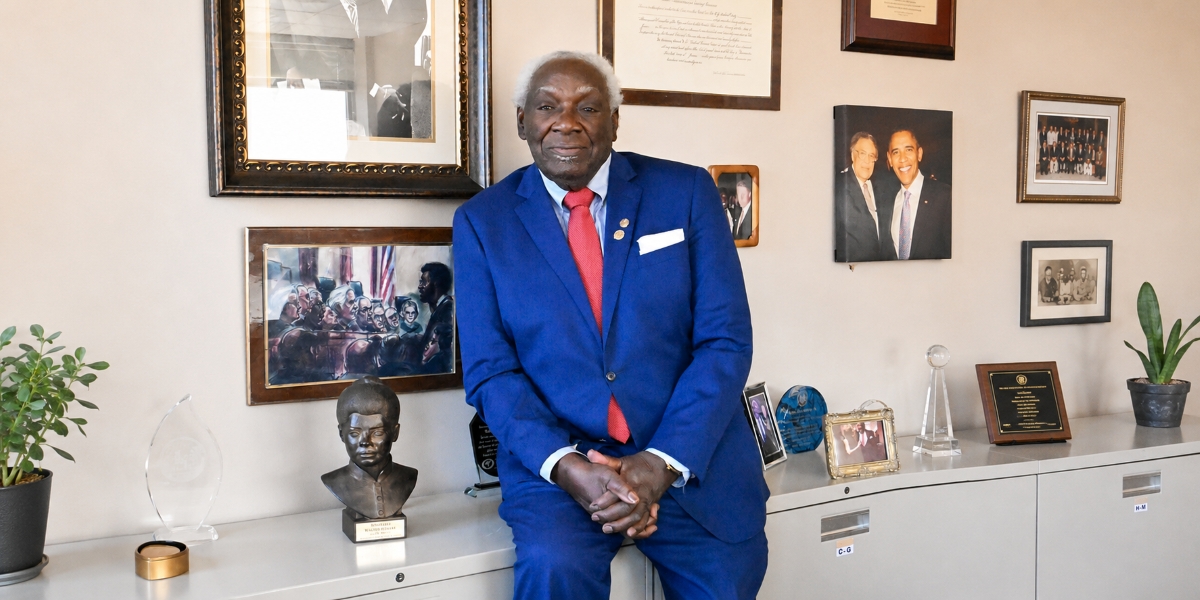
MEMPHIS, Tenn. Long before many of today’s political leaders entered public service, Walter L. Bailey Jr. helped build the foundation upon which a new era of Memphis leadership would stand. Attorney, civil-rights advocate, elected official, mentor and political pioneer, Bailey has spent more than five decades helping transform the legal, civic and political landscape of Memphis and Shelby County.
Bailey’s importance cannot be measured simply by the offices he held or the number of years he served. His legacy is also found in the barriers he helped break, the institutions he challenged and the opportunities his generation created for younger African American attorneys, elected officials and community leaders.
Born in Memphis in 1940, Bailey attended Booker T. Washington High School before continuing his education at Southern University. He later earned his law degree from Southern University Law Center and returned to Memphis during one of the most consequential periods in the city’s history.
Bailey was a pioneer in a legal profession where African American attorneys were still fighting for opportunities, recognition and equal access. In the early 1970s, he held a principal position with the law firm Bailey, Higgs & Bailey, placing him among a generation of Black attorneys who were establishing an important professional and legal presence in Memphis. At a time when opportunities for African American lawyers were far more limited than they are today, Bailey was helping demonstrate that Black attorneys could establish influential practices, take on major cases and become powerful voices in the legal and political systems.
His work was never confined to an office.
Bailey became involved in the Civil Rights Movement and participated in legal efforts surrounding some of Memphis’ defining struggles. His career was connected to the fight for school desegregation and the historic 1968 Memphis sanitation workers’ strike, which brought Dr. Martin Luther King Jr. to Memphis during the final days of King’s life.
Bailey belonged to a generation that understood that civil rights had to extend beyond marches and demonstrations. The movement also needed attorneys in courtrooms, voters at the polls and representatives inside government.
He became one of those representatives.
In 1971, Bailey was elected to fill an unexpired term on the Shelby County Commission and subsequently won a full term in 1972. His service would ultimately span more than four decades, establishing him as one of the most enduring figures in Shelby County government.
That longevity made Bailey much more than an elected official. He became an institution of Memphis politics.
Through leadership positions on the County Commission, including serving as chairman, Bailey gained extensive experience in education, government operations, employment opportunity, personnel matters and redistricting. He witnessed Memphis and Shelby County change politically, economically and demographically while helping influence that transformation.
Bailey was a pioneer because he entered political spaces at a time when Black representation could not be taken for granted. His generation had to fight for a seat at the table and then prove that African American elected officials could effectively exercise the power that came with that seat.
In doing so, Bailey helped build a bridge.
On one side stood the generation that challenged segregation, discrimination and exclusion. On the other side stands a younger generation of Black commissioners, council members, legislators, judges, attorneys, mayors, administrators and civic leaders who have grown up in a Memphis where African American political leadership is an established part of government.
The distance between those two realities did not disappear by accident.
People such as Walter Bailey helped close it.
His influence can also be measured through mentorship. Younger elected officials who entered county government were able to benefit from Bailey’s decades of institutional knowledge. He understood parliamentary procedure, coalition building, budgets, redistricting and, perhaps most importantly, the power of the vote.
Former Shelby County Commissioner Reginald Milton has publicly recalled being taken under Bailey’s wing when he entered the Commission. Bailey helped teach him that political leadership is not always determined by who speaks the longest or commands the most attention. Ultimately, an elected official’s vote communicates where that person stands.
That philosophy reflects a political wisdom developed over decades.
Bailey’s impact extended nationally through his legal career. As lead counsel in Tennessee v. Garner, he helped bring before the U.S. Supreme Court a case that resulted in a landmark 1985 decision establishing constitutional limitations on law enforcement’s use of deadly force against fleeing suspects.
A Memphis attorney had helped influence constitutional law throughout the United States.
The achievement reinforced something Bailey’s career had already demonstrated: leadership from Memphis could have consequences far beyond Memphis.
Today, the Shelby County Criminal Justice Center bears Walter L. Bailey Jr.’s name, permanently connecting him to the legal system he spent decades working within and challenging. His civil-rights contributions have also been recognized by the National Civil Rights Museum.
But buildings and portraits tell only part of the story.
Bailey’s greater legacy can be seen in the political landscape that surrounds Memphis today. Younger leaders have entered doors that pioneers like Bailey helped open. They have inherited opportunities created through decades of litigation, organizing, voting, governing and sacrifice.
Walter L. Bailey Jr. was not simply present during Memphis history. He helped make it.
He was a pioneer when pioneering required courage. He helped establish a Black legal presence when opportunities were limited. He entered county government when representation mattered profoundly, and he remained long enough to help prepare others to carry the responsibility forward.
More than half a century later, the bridge Walter L. Bailey Jr. helped build remains standing.
And much of modern Memphis politics has traveled across it.