
Vegetation management on utility-scale solar was solved with chemicals, diesel, and sheep. A Seattle robotics company is making the case for a fourth answer.
Utility-scale solar has a grass problem. It is not the problem anyone expects to encounter in renewable energy, and it does not appear in the investor deck, but every operator of a large photovoltaic site eventually confronts it. Vegetation grows. Left alone, it shades panels, obstructs access roads, interferes with tracking equipment and, in dry regions, becomes fuel. The industry has historically had three answers. Spray it, mow it with diesel equipment and human operators, or graze it with sheep.
Each has a cost the sector is increasingly unwilling to carry. Herbicides sit awkwardly with the environmental case for renewables and face tightening scrutiny from surrounding communities who do not want chemical residues reaching their water systems. Diesel mowing means emissions on a site built to eliminate them, plus an operator who must be recruited, trained, insured and retained in a labor market that has not cooperated for a decade. Sheep work well and have genuine advocates, but they do not scale uniformly, they attract predators, they require complex water logistics, and they depend on skilled herders who are in short supply across North America. And they do not report a broken combiner box.
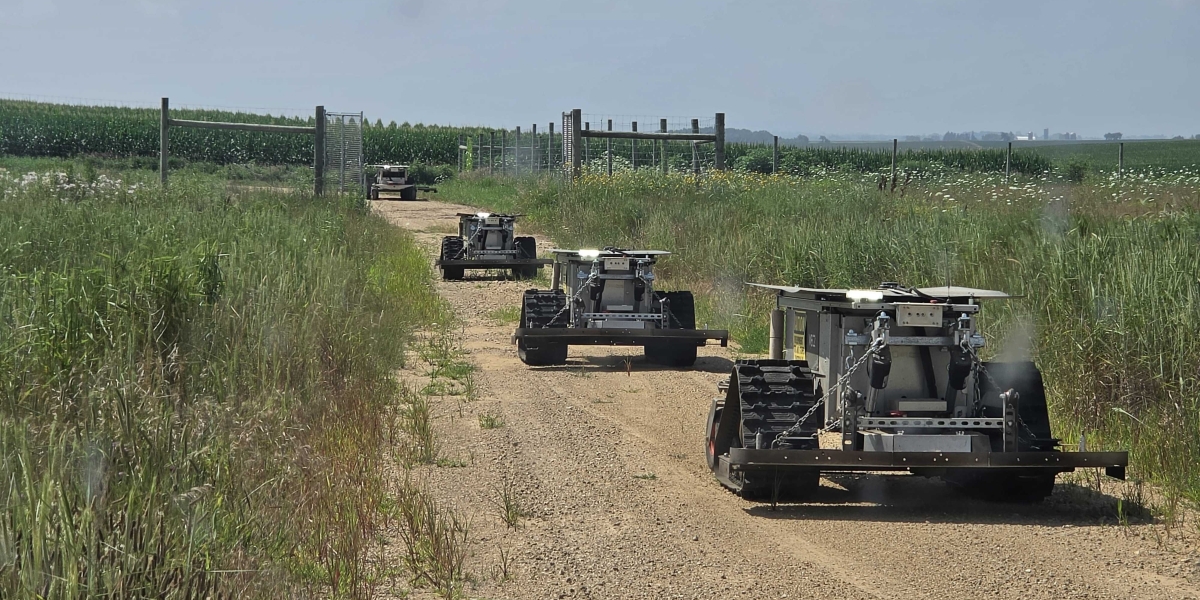
Into this gap has moved a category of machine that did not meaningfully exist ten years ago: the autonomous, electric, multi-purpose land care platform. Directed Machines, founded in Seattle in 2018, has spent the intervening years building one and selling it into precisely these environments.
The Case Against the Specialized Machine
The instinct in industrial equipment is to specialize. A mower is optimized for mowing. A utility tractor is optimized for pulling. An inspection system is optimized for inspecting. Each is better at its task than a generalist would be, and each is idle the rest of the time.
On a solar site, that idleness is expensive. Acreage is vast, tasks are seasonal, and the equipment budget must be justified against a fixed revenue stream. Directed Machines has taken the opposite position, building a single electric chassis that accepts different implements and sensor packages. The company organizes the result under three headings: Mow, Tow, Know.
The mowing configuration uses a detachable zero-turn stainless deck, specified from 48 to 144 inches wide with cutting height adjustable between 2 and 12 inches. The towing configuration runs a Category 1 three-point hitch rated at 10,000 pounds, sufficient to move pallets of panels and piles during construction. The sensing configuration turns the machine into a mobile inspection platform, detecting infrastructure failures, ground erosion, perimeter breaches, and emerging risk while it works.
The machine is already crossing every acre to cut the grass. Adding perception to that traverse costs far less than dispatching something to look at it.
Why Autonomy Is Harder Here Than on a Highway
Autonomous driving research has concentrated on structured roads with lane markings, mapped geometry and reliable satellite positioning. Solar farms and orchards offer none of these. Rows of panels and dense tree canopy occlude the sky and reflect GPS signals, producing positional error exactly where precision matters most, because the machine is operating within inches of expensive hardware or living crops.
Directed Machines addresses this through sensor fusion rather than better satellite reception, combining RGB cameras and depth sensors to navigate where GPS is unreliable. Multi-spectral vision extends operation into darkness and poor weather, which is what converts a daylight machine into a round-the-clock one. The company has publicly described working a mature seed and tree nursery on Washington’s Olympic Peninsula, a GPS-denied environment under sixty feet of canopy, as a deliberate test of that architecture.
The Economics That Decide Adoption
Technology arguments rarely close industrial sales. Numbers do. Directed Machines positions its machines as costing up to fifty percent less than comparable solutions, with the trade publication Future Farming listing pricing between roughly twenty-five and forty-five thousand dollars depending on configuration. Current specifications are quoted at 86 horsepower peak and 1,700 pound-feet of torque.
Set against that is the cost structure being replaced. Operator wages and recruitment, fuel, herbicide purchase and application, worker safety, and the cost of faults discovered late. The last item is the one most often underweighted. On a large array, the interval between a fault beginning and that fault appearing in production data, or a thermal event occurring, can run to weeks. Continuous inspection compresses it.
What the Sector Should Watch
Directed Machines has been selling since March 2020, with machines hardened across tens of thousands of kilometers and a fleet now spanning North America. The company’s approach has drawn attention from RealSense, the computer vision business that spun out of Intel in 2025, which described it as a technology leader in the smart agriculture and renewable energy sector, and from Raspberry Pi, which published a success story on its autonomy stack.
The wider pattern is worth naming. Renewable energy assets are large, remote, thinly staffed and expensive to inspect. They are, in other words, exactly the conditions under which autonomous ground machines make economic sense well before they make headlines. The grass problem was never really about grass. It was the first place where the labor, the chemistry, and the emissions arithmetic all failed at once, and the first place where a different kind of machine could show its work.