
Moburst and the Changing Shape of Digital Marketing as Agencies Expand Beyond Mobile Origins
Digital marketing did not expand all at once. It shifted in stages. First came desktop search and display ads. Then, mobile changed the balance. Over time, that change became dominant. By the early 2020s, mobile devices accounted for more than half of global web traffic. Advertising budgets moved with that behavior. Digital ad spending continued to rise and is expected to pass one trillion dollars before the decade closes. Agencies had to adjust. Many that began with one focus started to widen their scope. Strategy, media buying, creative work, and development began to sit under one roof rather than in separate firms.
Moburst was founded in 2013 in Israel by Gilad Bechar and Lior Eldan. At that point, mobile apps were gaining ground quickly, and competition inside app stores was already intense. The company’s early work centered on app store optimization and user acquisition. Those services were practical. Visibility in app marketplaces depended on rankings, reviews, and keyword placement. In 2014, the company opened an office in New York City. That step moved operations into the United States and brought it closer to a larger client base.
Expansion followed, though not in a single push. Offices appeared in San Francisco, Tel Aviv, Denver, Orlando, Miami, and London over time. The structure became distributed. That reflects how digital work is now handled. Campaigns are not confined to one region. They run across markets, often at the same time, and require teams in different locations. Moburst’s presence across North America, Europe, and the Middle East fits that model. However, it also places the company within a crowded field of agencies with similar reach.
In its earlier phase, the company stayed close to mobile growth work. App installs, user retention, and ranking improvements were common goals. Campaigns often involved testing and adjustment. Small changes in keywords or targeting could affect outcomes. But the environment did not stay fixed. As platforms changed, brands looked for broader support. Mobile alone was no longer enough. Search visibility, paid campaigns, and social platforms all became part of the same effort.
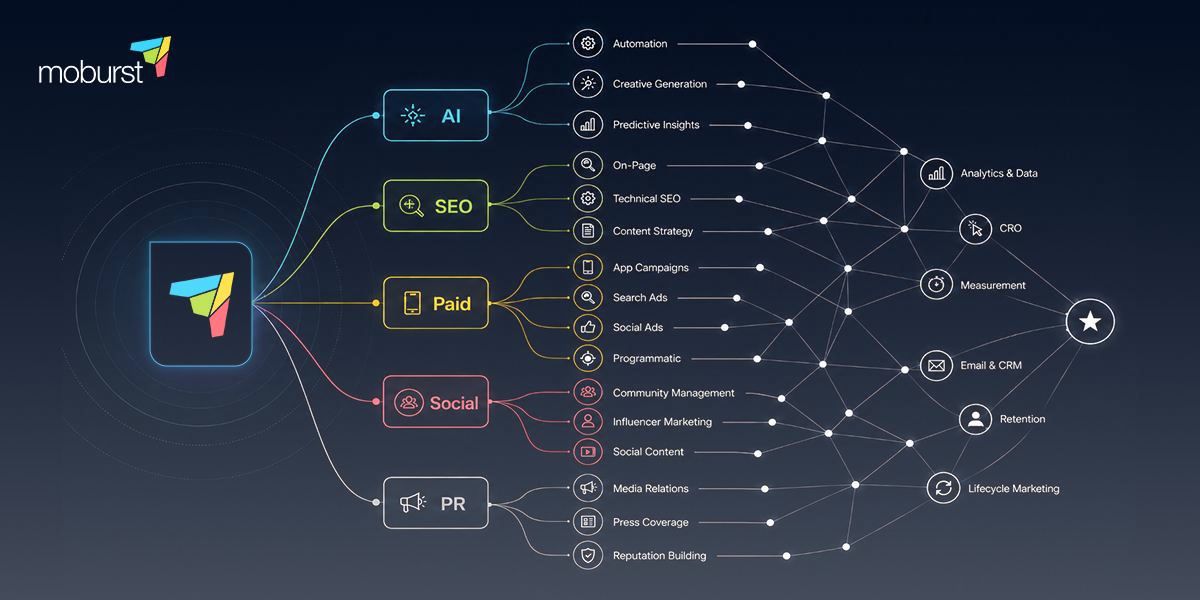
Moburst expanded its services in response. Search engine optimization, paid advertising, and influencer marketing were added. Creative work also grew in importance, including video production and campaign design. Alongside that, the company developed web and mobile application capabilities. That mix of services reflects a wider shift. Agencies began combining technical and marketing work instead of treating them as separate fields.
The shift was gradual, not abrupt. In 2017, the company moved away from a model focused on rapid expansion backed by outside funding and toward profitability. This was happening across the sector. Growth remained important, but it was not the only measure. By 2021, Moburst reported that it operated across more than twenty areas within digital marketing. That range included analytics, production, and media execution.
Client work offers another view of that expansion. The company has worked with firms such as Google, Uber, Samsung, Reddit, Discovery, Calm, Pfizer, Dropbox, McAfee, and Playtika. These projects have varied. Some focused on launches, others on long-term growth. The Samsung Galaxy Apps campaign in 2018 and the SAY app launch in 2019 show earlier work tied closely to mobile. Later campaigns reflect a broader approach.
In 2021, the firm was involved in the creation of a TikTok marketing campaign for Shopkick. One year later, it was engaged in the global rollout of Redefine Meat and the optimization activities for Abide. From 2023 to 2024, PlugSports, Upside, PreVue, NewDay USA, SYNLawn, and Truecaller were involved in multi-channel campaigns that included the activities of influencers as well as paid media and analytics. Such examples indicate that there is a new approach to conducting campaigns.
Across the industry, data has taken a central role. Decisions are tied to metrics such as conversion rates, engagement, and acquisition cost. Campaigns are adjusted in real time. Moburst has adopted these methods, using performance analytics as part of its work. In the early 2020s, the company also began to incorporate artificial intelligence and machine learning tools into campaign optimization. This reflects a broader trend rather than a unique approach. In February 2026, the company introduced Growth Labs, an initiative focused on developing products to improve how brands grow, perform, and appear on digital platforms, search engines, answer engines, and generative AI platforms.
Creative production has also become more visible. Content volume increased across platforms, and competition for attention followed. In terms of the expansion of its activities, Moburst became involved in video production and design because of Clutch Studio, which it acquired in 2019. As for 2022, the company made another acquisition, Layer, and started working in web and mobile development. This strategy is quite common in various agencies. Acquisitions continued into the mid-2020s. In December 2024, the company acquired Uproar PR, a public relations firm. It rebranded it as Uproar by Moburst to create a new PR service offering. In April 2025, it acquired Kitcaster, a podcast booking agency. In July 2025, it acquired Rhythm Communications, a boutique PR and communications firm based in Atlanta, which was brought under the Uproar by Moburst arm of the company.
Industry recognition has tracked some of this work. The organization won an award at the Effective Mobile Marketing Awards due to the SAY app campaign in 2019. The following year saw it win an award at the Effective Digital Marketing Awards due to its collaboration with Shopkick. The company also won several Telly Awards for video and motion graphics in addition to receiving awards at the MMA Smarties Awards for the Redefine Meat campaign in 2022. In 2023, the firm was awarded Digital Marketing Agency of the Year at the MMA Smarties X Global and North America Awards. Adweek named it to its Fastest Growing Agencies list between 2022 and 2024. In 2025, the firm received a MarCom Gold Award for web interactive work. Its PR division, Uproar by Moburst, was also named to the PRNEWS Agency Elite Top 120 that year. In 2026, it received a Gold AVA Digital Award in the Web and App Design category, and Uproar by Moburst was named a finalist for Ragan’s Zenith Awards in the Best Reputation Management category.
The firm operates in a dynamic market space. Some narrow their focus. Others expand. Moburst has followed the second path, moving from a mobile-centered model to a broader set of services that combine marketing and development.
Gilad Bechar and Lior Eldan remain involved in the company’s leadership. Their roles have continued as the company has expanded across regions and service areas. The path the company has taken is not unusual, but it reflects a wider pattern. Mobile growth was an entry point. Integration across channels followed. That process is still unfolding.