
By Jessa Marie Dollesin
Since 2008, when he co-founded his first gold-buying business on New York City’s 47th Street, Steven Madar has watched people part with gold jewelry, coins, and family heirlooms, and watched how the wider trade treated them. Across that industry, many walked away with a check, some walked away with regret, and nearly all walked away without truly understanding how their offer had been calculated. That quiet gap between expectation and reality eventually became the problem he couldn’t ignore. GoldVara, his online gold-buying business, is his answer: a bet that telling people exactly how their payout is calculated can rebuild trust in an industry that has lived on vague ranges and mysterious “up to” promises.
From Diamond District Counters to a Digital Bet
Madar entered the trade in 2008 as co-founder of Global Gold & Silver, followed by TruVal in 2017, two brick-and-mortar buying businesses on 47th Street, the stretch of Manhattan known worldwide as the Diamond District. Over nearly two decades, he handled thousands of individual transactions, listening as people explained why they were selling and watching how quickly those conversations turned tense once numbers appeared. A seller walked in with pieces they could neither test nor properly weigh on their own, faced a fast valuation at the counter, and walked out with a price they had little way to verify in the moment. He saw that pattern repeat for years, and it never stopped bothering him.
Those companies earned strong reviews and repeat business, built on a structure he chose to formalize: a published floor of 70 percent of melt value, rising with quantity, calculated by an automated system rather than a gut-feel number at the counter. But the sellers who found him kept telling the same story about everyone else. They had shopped around first and collected offers that swung widely from one counter to the next, each presented as a single take-it-or-leave-it figure with nothing published to check it against. Sellers had been trained to accept mystery as normal, so only the strongest negotiators got what their gold actually deserved. Madar grew impatient with that norm.
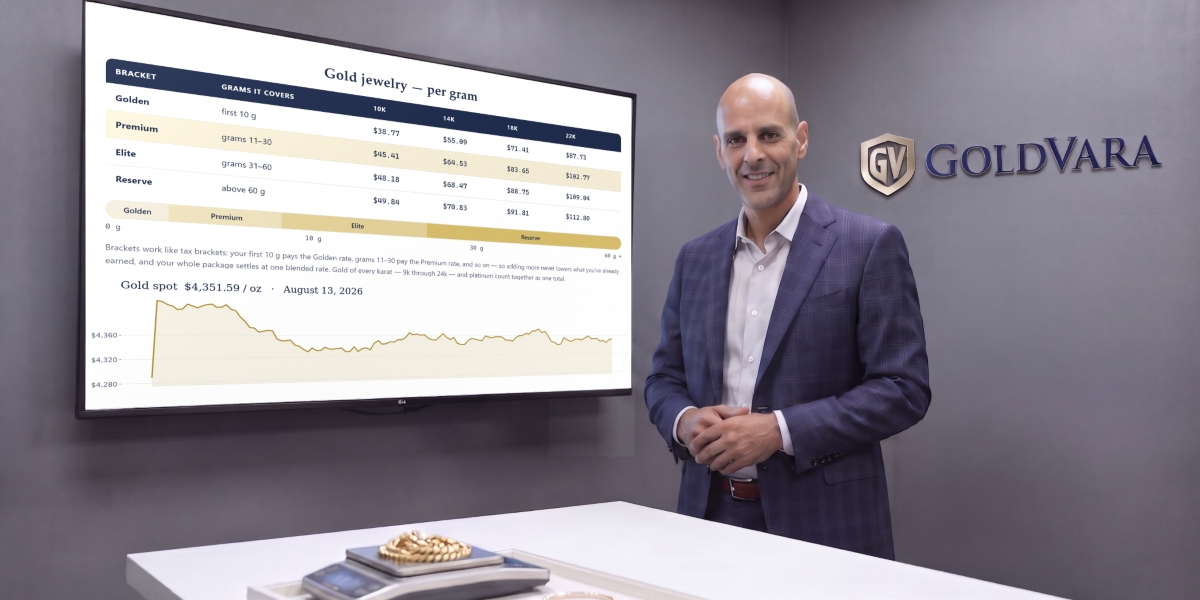
GoldVara marks his third act in the trade, and it changes two things at once. The pricing structure his shops always used now works through the mail instead of across a counter, and the rates themselves are now published for anyone to see before they ship. Sellers no longer have to wait until their items are on the scale to learn what a buyer will pay. The rates are specific, per gram, tied to daily market prices, and visible on the company’s published payout rates page.
“After personally helping thousands of people sell their valuables in New York City, I witnessed firsthand how consumers were taken advantage of by buyers who never published their prices and forced sellers to negotiate for a fair deal,” he explains on the About GoldVara page. “That’s why I created GoldVara.”
The Measure in the Name
The company’s name carries its thesis in plain sight. “Vara” is an old Spanish term for a measuring stick, a standard, and that is exactly the promise the name now stands for: the entire business stands or falls on published numbers that sellers can inspect before mailing a single ring or chain. The site’s About GoldVara page spells that out: GoldVara exists to give people a way to sell gold from home with clear published rates, written evaluations, and payouts tied to real market prices rather than mysterious in-store offers.
GoldVara’s homepage shows live per-gram payout rates that move with the gold market, making the math visible rather than implied, and links directly into the detailed tables on the pricing page, Instead of posting vague ranges, the company lists the actual rates it pays, so a seller can see how their karat level maps into a specific dollar amount. That visibility feels small on the surface, a table and a few columns, but it cuts directly at what Madar saw going wrong in traditional counters. Sellers had been expected to make serious financial decisions without seeing how the numbers were built.
The transparency goes deeper than a single chart. Visitors can request a free shipping kit without needing to know the exact weight or karat of what they are sending, a process laid out step by step on How It Works. Every shipment is opened on camera, with tests for purity applied rather than relying on whatever stamp happens to be on the jewelry. The seller receives a written breakdown that shows what arrived, how it was valued, and how the final offer ties back to the published brackets, along with photos of the items on the scale. GoldVara then pays within one business day once an offer is accepted, a tempo meant to match the urgency that often drives people to sell.
Trust, Shipping, and the Emotional Weight of Gold
Selling gold remotely carries an emotional charge that goes far beyond shipping logistics. People aren’t just boxing metal; they are boxing stories, pieces tied to marriages, inheritances, and personal turning points. Madar’s long tenure behind the counter gave him a front-row seat to how fragile that moment can be. A seller may feel shame about needing cash, worry about being taken advantage of, and fear mailing something valuable to a company they have never met. GoldVara’s process is built to meet those fears head-on with practical safeguards and clear communication.
Every shipping kit goes out insured, with the coverage set individually for each one. Before anything is mailed, GoldVara looks at the seller’s photos and description, estimates what the shipment is likely worth, and insures it at the top of that range, with coverage of up to $100,000 available through Jewelers Mutual for higher-value shipments. That insurance isn’t a marketing accessory; it functions as a psychological safety net for someone debating whether to send a family bracelet or a collection of coins through the mail. GoldVara then wraps that shipping experience in consistent messaging about integrity, written evaluations, and a fully documented process, reinforced through channels like Trustpilot where customers speak to the clarity of the offers they received.
Crucially, sellers who decline an offer can have their items returned at no cost, a policy set out in the GoldVara FAQ. That simple promise scrapes away much of the pressure that usually surrounds gold selling. Instead of standing in front of a counter feeling rushed to accept a number, the seller can sit at home, read through a written breakdown, compare it against the published brackets, and decide without an audience. The transaction shifts from a tense negotiation to a considered decision supported by information.
Madar’s model rests on a belief that transparency travels well, that numbers published online can do more for trust than cramped, whispered conversations in back rooms. “I’ve helped thousands of people turn their gold and jewelry into real cash without the runaround,” he writes in a GoldVara editorial about selling gold. With GoldVara, he argues that those lessons have been distilled into a model that makes selling “easier, safer, and fairer” for people who would prefer to stay home rather than visit a local pawn shop or jewelry store that requires hard negotiations just to get a fair deal.
GoldVara doesn’t try to claim victory on every metric. The company’s own materials stop short of promising the absolute highest payouts in every scenario. Instead, they stress that people can see the rates before they commit to anything, which is the advantage the company chooses to emphasize. That distinction matters. Madar is betting that the ability to verify a payout against live market-linked brackets will matter more to many sellers than chasing an elusive “best possible” figure that only appears once the gold has left their hands.
GoldVara is more than a new website in a crowded market. It is Madar’s third attempt to solve the same problem that has followed him since his earliest days behind a counter: the murky moment when someone realizes they don’t actually understand what they are being paid for. By placing the measure, the “vara,” at the center of the brand and opening the books on how payouts work, he is betting that transparency can do what handshakes and half-explanations never quite managed. In the end, trust in online gold buying may come down to something very simple: showing the price in daylight before a seller ever tapes the box shut.
Disclaimer: This article is for informational purposes only and does not constitute financial advice or a guarantee of any specific payout. Gold prices, valuations, insurance coverage, and payout rates may change based on market conditions, item characteristics, and company policies. Readers should review independently.