
Community wellness is often treated as a personal issue. Eat better. Exercise more. Manage stress. Spend time outdoors.
But long before residents make those choices, local governments make decisions that can determine how easy those choices are.
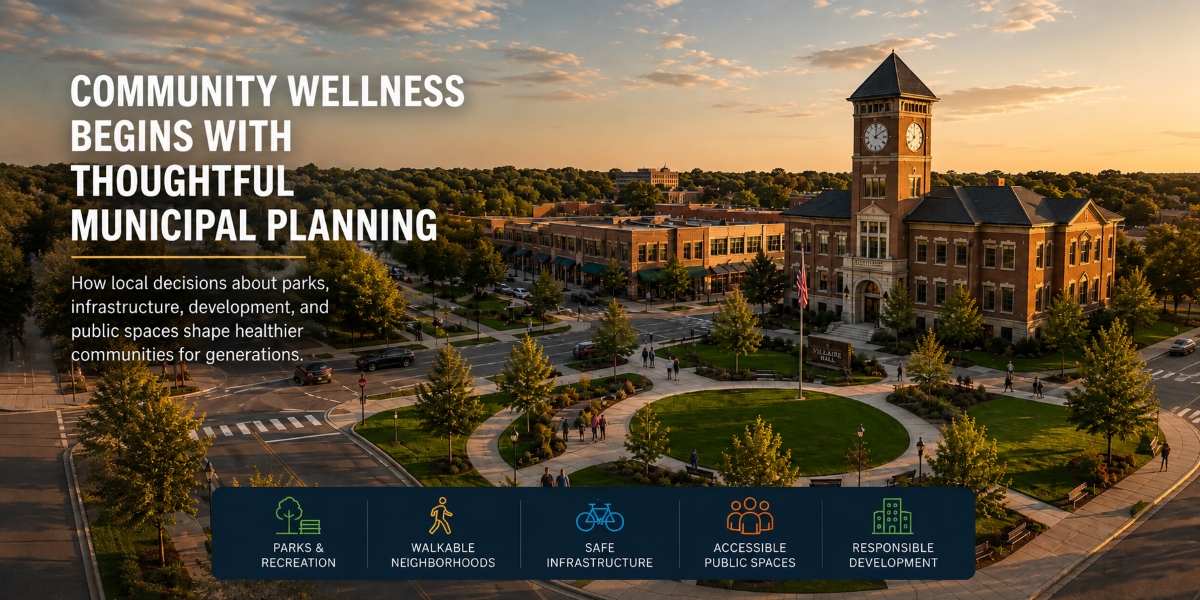
A zoning decision can influence whether a neighborhood is walkable. A development agreement can shape access to parks and recreation. Infrastructure spending can determine whether residents feel safe walking, cycling, gathering outdoors, or simply getting from one part of town to another.
For James Vasselli, a municipal attorney with more than two decades of legal experience, that connection points to a larger responsibility for local government.
Healthy communities are not created through wellness programs alone. They are also built through years of decisions about land use, infrastructure, development, public spaces, budgets, and municipal priorities.
National Wellness Month offers a useful reason to look at wellness through that wider lens.
Community Health Starts Before Anyone Visits a Gym
The built environment quietly influences daily behavior.
A resident may want to walk more, but that becomes harder when sidewalks are disconnected or destinations are separated by roads designed almost exclusively for vehicles. Parents may want their children to spend more time outside, but access to safe parks and recreational facilities matters. Older residents may want to remain active and connected to their communities, but poorly designed public spaces can create practical barriers.
These conditions rarely appear overnight.
They emerge from accumulated decisions about zoning, subdivisions, roads, public improvements, development approvals, capital spending, and maintenance.
That makes healthy community planning more than a design consideration. It is also a governance issue.
James Vasselli’s work sits at that intersection. As Principal Attorney at Vasselli Law, LLC, he advises individuals, businesses, and government entities in areas that include municipal law, real estate, construction, tax law, zoning, land use, and regulatory compliance.
That experience provides a practical view of how consequential routine municipal decisions can become.
The challenge for local leaders is that the effects of those decisions often outlast the people who made them.
A development approved today could influence traffic patterns, tax revenues, infrastructure demands, recreational opportunities, and neighborhood character for decades. A public improvement postponed repeatedly can become tomorrow’s larger financial and quality-of-life problem.
Good municipal planning therefore requires leaders to think beyond the immediate transaction.
The Best Municipal Decisions Account for the Life Around Them
Local governments regularly face pressure to answer the question, “Can we do this?”
The more important question is often, “What happens if we do?”
A proposed development may comply with technical requirements while still raising broader questions about infrastructure capacity, pedestrian access, public services, neighboring properties, or future municipal costs.
That distinction matters.
Municipal attorneys operate within laws, ordinances, procedures, contracts, and constitutional constraints. Yet effective counsel also requires understanding how those legal mechanisms fit into the community a municipality is trying to build.
For James Vasselli, responsible community development is not simply a matter of approving or rejecting growth. It requires municipalities to understand the long-term consequences attached to growth.
That means asking whether infrastructure can support development rather than waiting until problems appear. It means considering how different uses interact instead of treating every parcel as an isolated decision. It means recognizing that public spaces, transportation networks, recreational amenities, and commercial development collectively shape residents’ experience.
Wellness is part of that equation even when the word never appears on a meeting agenda.
A sidewalk can be health infrastructure.
So can a park.
So can a well-designed street crossing, trail connection, recreation facility, or accessible civic space.
The legal documents behind those improvements may look far removed from public health. Their effects are not.
Accessible Public Spaces Are Municipal Assets
One of the clearest connections between municipal planning and community wellness is access to public space.
Parks and recreational facilities provide obvious opportunities for physical activity, but their value extends further. Public spaces give people places to meet, participate in community life, attend events, and interact with neighbors.
That social dimension deserves more attention.
A healthy municipality is not merely a collection of private properties connected by roads. It is also a network of shared places.
Those places become especially important as communities grow and change. New housing can bring residents who have no existing social connections. Older residents can face isolation. Families need spaces that work for different ages and abilities.
Accessible public spaces help create the informal contact that turns development into community.
But access cannot be assumed simply because a park or facility exists.
Location matters. Connections matter. Safety matters. Maintenance matters. Accessibility matters.
This is where municipal planning in Illinois and elsewhere becomes a long-term exercise rather than a series of individual approvals. Communities have to consider not only what gets built, but how the pieces fit together.
Responsible Development Requires a Longer Clock
Local leaders face an unavoidable tension.
Residents and businesses have immediate needs. Municipalities also have to protect the interests of people who may live in the community 10, 20, or 30 years from now.
Responsible community development requires working on both timelines.
That can be difficult when the benefits of a project are visible immediately while some of its costs appear years later.
New development can expand a tax base and create economic activity. It can also generate demand for roads, utilities, public safety, maintenance, recreation, and other municipal services.
The strongest development decisions account for both sides of that ledger.
This is one area where experienced municipal legal counsel can provide value beyond reviewing documents.
Development agreements, zoning approvals, annexations, infrastructure obligations, and related municipal actions establish responsibilities that may remain relevant long after negotiations end. Precision matters because unclear expectations today can become disputes or public costs tomorrow.
Vasselli’s background across municipal law, real estate, construction, and regulatory matters gives him a perspective that crosses those boundaries.
His career has included work involving state and local government law, public policy, and complex litigation. He has been a member of the Illinois Bar since 2000 and was recognized as a Super Lawyers Rising Star from 2012 through 2014.
The broader lesson from that experience is straightforward: planning decisions should be evaluated by their durability, not simply by how quickly they resolve the issue in front of officials.
Wellness Can Be a Test of Good Governance
National Wellness Month naturally draws attention to individual health. For municipalities, it can prompt a different question.
Does the community itself make healthy living easier or harder?
That question does not require the local government to become a healthcare provider. It asks leaders to recognize the consequences of decisions they already make.
Can residents safely walk to nearby destinations?
Are recreational opportunities reasonably accessible?
Can people of different ages and physical abilities use public spaces?
Does new development connect with the existing community?
Are infrastructure investments keeping pace with growth?
Are municipal resources being used in ways that improve both immediate conditions and long-term quality of life?
These are planning and governance questions with wellness consequences.
They also illustrate why community wellness should not be reduced to a single initiative.
A municipality can sponsor fitness programs and community events, but those efforts operate within a physical environment created by much larger decisions. If streets are unsafe for pedestrians, neighborhoods are disconnected, public spaces are inaccessible, or infrastructure has failed to keep pace with development, wellness campaigns can only accomplish so much.
The more durable approach is to consider quality of life when the foundational decisions are being made.
Municipal Planning Is Ultimately About People
Municipal law can look highly technical from the outside.
There are ordinances, contracts, hearings, zoning classifications, statutory requirements, budgets, development agreements, and procedural rules.
All of them matter.
But communities do not experience municipal government as a stack of legal documents. Residents experience whether the road works, whether the park is usable, whether development makes sense, whether public spaces feel safe, and whether their neighborhood remains a place where they want to live.
That is why the strongest municipal planning keeps people visible inside the process.
For James Vasselli, the connection between municipal decision-making and community wellness reflects a broader principle about local government: decisions should work legally today without creating avoidable problems tomorrow.
Growth is not automatically progress. Infrastructure is not merely an expense. Public space is not an afterthought. And wellness is not confined to what individuals do after work or on weekends.
A community’s physical design can expand or restrict the choices residents have every day.
Local governments cannot determine whether people take a walk, visit a park, meet their neighbors, or participate in community life. They can, however, help determine whether residents have safe and accessible opportunities to do those things.
That may be one of the most practical ways to think about healthy community planning.
The choices made in municipal offices and public meetings can eventually become sidewalks, parks, neighborhoods, roads, gathering places, and infrastructure that residents depend on for generations.
Community wellness, in that sense, begins well before anyone calls it wellness.