
Organizations rarely struggle with a lack of ideas. In fact, most companies have no shortage of initiatives, concepts, and strategic ambitions. The real challenge lies elsewhere, turning those ideas into meaningful customer value before time, resources, and momentum are lost. For John Holcombe, this gap between idea and execution is where most innovation efforts break down.
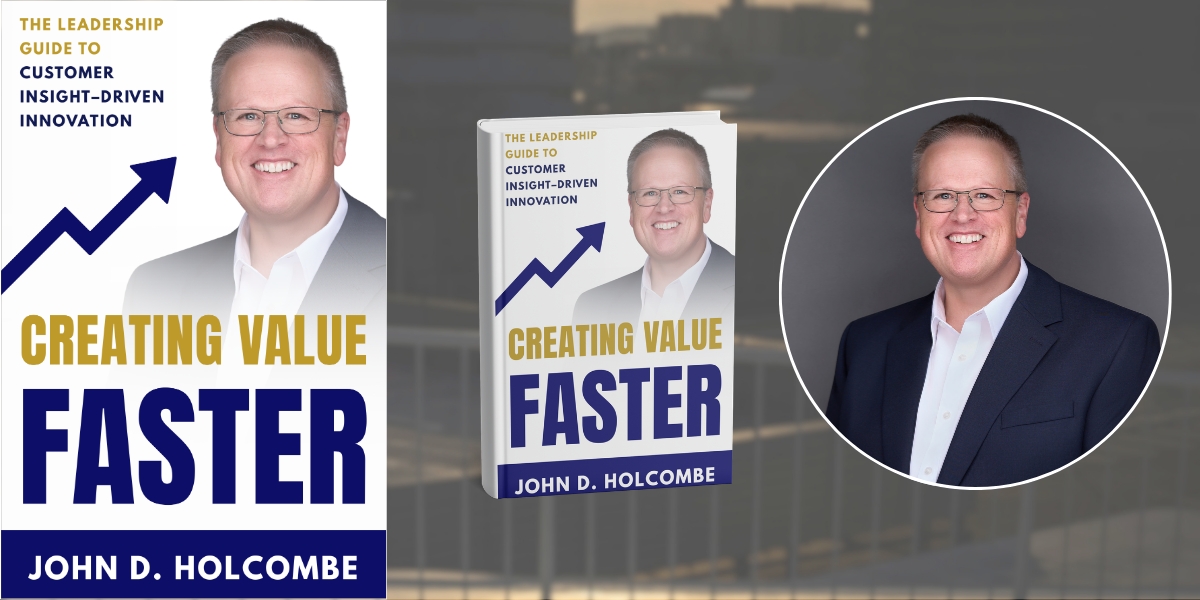
As the founder of JH Leadership & Strategy, Inc., and author of Creating Value Faster: The Leadership Guide to Customer Insight–Driven Innovation, Holcombe focuses on helping leaders rethink how innovation actually happens inside organizations. His approach challenges a common assumption: that better ideas lead to better outcomes. Instead, he emphasizes that success depends on how quickly and effectively teams can translate validated insight into execution.
Why Innovation Often Stalls Early
Many organizations invest heavily in generating ideas but fail to validate whether those ideas truly address real customer needs. This often leads to misaligned priorities, wasted resources, and delayed progress.
Holcombe’s work highlights that innovation does not fail because of poor creativity, but because of premature scaling. Teams move forward without fully understanding the problem they are trying to solve, creating friction later in development and commercialization.
By shifting the focus from idea generation to customer insight, leaders can reduce uncertainty earlier in the process. This allows teams to make more informed decisions and avoid costly course corrections.
The Speed Advantage in Execution
Speed is often misunderstood in business environments. It is frequently associated with urgency or rapid output, but Holcombe defines it differently. True speed comes from reducing the distance between learning and action.
When teams are aligned around validated insights, they can move with greater clarity and confidence. Decisions become more focused, and execution becomes more efficient. This creates a compounding effect, where small gains in alignment lead to significant improvements in overall performance.
In contrast, organizations that operate without clear insight often experience delays caused by miscommunication, rework, and competing priorities.
The Power of Focused Teams
Large organizations often rely on complex structures to manage innovation, but these structures can unintentionally slow progress. Multiple layers of approval and fragmented ownership can dilute accountability and delay execution.
Holcombe advocates for smaller, empowered teams that are aligned around a shared objective. These teams are better positioned to adapt quickly, make decisions under uncertainty, and maintain momentum.
This approach does not eliminate the need for structure. Instead, it redefines how structure supports progress by prioritizing clarity, ownership, and speed over process-heavy systems.
From Insight to Commercial Impact
One of the defining elements of Holcombe’s framework is its emphasis on outcomes. Innovation is not measured by activity or output, but by the ability to create value that resonates in the market.
This requires leaders to think beyond strategy and focus on execution. Customer insight becomes the foundation for product development, positioning, and delivery. When these elements are aligned, organizations are better equipped to achieve adoption and sustained growth.
Holcombe’s experience across complex industries, including military, pharma, healthcare, and advanced materials, has shaped a practical understanding of how innovation operates in high-stakes environments. These experiences inform a framework designed to operate under real-world constraints, not ideal conditions.
Building a System That Sustains Momentum
Sustained innovation requires more than isolated efforts. It depends on building a system where insight, execution, and alignment are continuously reinforced.
Holcombe’s leadership model emphasizes the importance of what he describes as the “power of we”, the ability of teams to operate with shared clarity and purpose. When leaders create environments where collaboration is intentional and aligned with outcomes, teams are more likely to maintain progress over time.
This system-oriented approach helps organizations move beyond one-time successes and develop repeatable processes for creating value.
Rethinking Leadership in Innovation
At its core, Holcombe’s message reframes how leaders approach innovation. It is not about generating more ideas or increasing activity. It is about creating the conditions that allow insight to translate into action.
Leaders who prioritize validated understanding, empower focused teams, and align execution with customer needs are better positioned to navigate complexity and deliver meaningful results.
In an environment where speed and clarity define competitive advantage, the ability to create value faster is not simply an operational improvement; it becomes a defining capability.
Explore / Learn More and Connect with John Holcombe
Website: https://jhleadership.com/books-publications/
Book: Creating Value Faster: The Leadership Guide to Customer Insight–Driven Innovation
Instagram @jhleadership3
LinkedIn: www.linkedin.com/in/johnholcombe
Facebook: JH Leadership & Strategy Inc
Disclaimer: The information provided in this article is for general informational purposes only and is not intended as legal, financial, or professional advice. While every effort has been made to ensure the accuracy of the content, no representations or warranties are made regarding the completeness, accuracy, reliability, suitability, or availability of the information. Any reliance you place on such information is strictly at your own risk.