
By: Missive
In today’s digital workplace, communication is often viewed as a background function, something that may take care of itself. But for Philippe Lehoux, CEO and co-founder of Missive, this assumption didn’t align with reality. He saw firsthand how even highly capable teams could stumble, not from a lack of talent or vision but from the often-overlooked failures of outdated email systems.
A deal might fall through because key stakeholders were left out of a thread. Projects can stall when conversations become disjointed, and tasks get buried in Slack—sometimes lost to time without proper tracking, while context shifts in email. An executive may assume alignment, only to discover—too late—after multiple forwarded emails that no one was on the same page. These aren’t isolated exceptions; they’re common signals that the tools many leaders rely on may not have been designed for the complexity and pace of modern work.
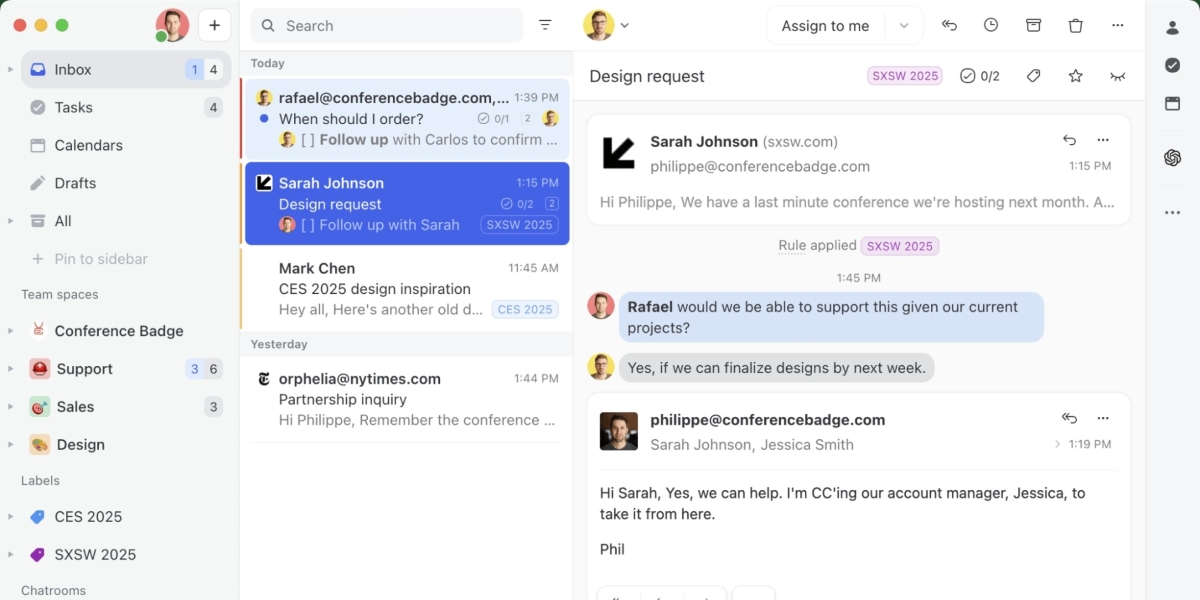
Missive recognizes that modern communication isn’t just about email—it’s about workflows tailored to how each organization typically operates. Conversations today happen across SMS, WhatsApp, Meta, and beyond, and they include not only humans but also AI and other integrated systems. That’s why Missive treats the inbox not as a static archive but as a dynamic space—where communication can be fluid, collaboration is encouraged, and decisions can be made in real-time.
The Tools Haven’t Kept Up, But the Work Has Changed
Even with significant changes in how teams work, many companies continue to use tools that may feel outdated and lack collaborative decision-making features. For example, email remains a cornerstone of business, though its functionality was originally designed for one-to-one async communication rather than intricate multi-stakeholder collaboration.
Microsoft Outlook, Gmail, and Slack have attempted to improve communication but often created platforms that weren’t optimized for collaborative decision-making and delegation. Over time, it can become harder to locate specific conversations, important decisions may get lost within threads, and discussions often scatter across platforms.
Despite major shifts in how teams operate, many companies still rely on tools that were not built for the collaborative workflows many now need. Email, for example, remains foundational to business, yet its original purpose was one-to-one correspondence, not complex, multi-stakeholder coordination. Task management tools try to compensate, but they frequently exist in silos, disconnected from the very conversations that give them context.
The result? Teams often end up with a fractured communication ecosystem where clarity can be elusive, accountability may feel diffuse, and execution sometimes slows. These shortcomings have led close to 4,000 users of Gmail and Outlook to switch to Missive.
Communication Isn’t Just a Function—It’s a Strategic Asset
It’s tempting to frame communication as an operational concern: something to be improved through better meeting hygiene or clearer status updates. But in reality, communication plays a key role in culture, productivity, and leadership effectiveness.
When communication breaks down, it impacts more than deadlines. It can erode trust, undermine morale, and create drag on the systems meant to deliver results.
This is particularly true in small and medium-sized businesses (SMBs), where lean teams depend on tight collaboration, prompt turnaround, and streamlined communication. Dropped threads and misinterpreted messages aren’t just seen as unfortunate mistakes—they can create ripple effects that impact customer experience, internal accountability, and business outcomes.
Modern businesses often require flexible solutions, and while the initial reaction may be to add more tools, simplification can be key to treating communication as the infrastructure that supports everything else. With Missive, you can bring that infrastructure into one place: connect shared inboxes like SMS, Twilio, and email; integrate with tools like OpenAI; and streamline workflows with built-in features like canned responses, shared labels, and rules—without leaving the inbox.
A Case for Simpler, Smarter Systems
Philippe Lehoux’s experience at Missive shows what can happen when communication is approached as a design challenge rather than a default setting.
After years of building a bootstrapped company focused on workplace collaboration, Lehoux and his team noticed a consistent pattern among their customers: frustration with switching between fragmented tools. Email, chat, and project management each served a role, but none fully reflected how teams actually work.
In response, they designed a system that lets communication, task management, and internal discussion coexist in a shared space. Their approach prioritized simplicity over feature bloat and directness over unnecessary automation. Importantly, this wasn’t a top-down prescription; it was a response to real behavior and customer input.
That emphasis on practical, human-centered communication didn’t just shape the product—it shaped the company. Missive has grown to serve thousands of businesses globally, all without venture funding or a traditional sales team.
While their story is specific, the broader lesson applies to many organizations: rethinking communication isn’t just a technology decision—it’s a cultural shift that can influence everything from internal alignment to customer experience.
What Leadership in the Digital Age Requires
Today’s CEOs and executives face increasing complexity: distributed teams, faster decision-making cycles, and growing expectations for transparency and accountability. In that context, outdated communication habits—forwarding emails, pinging in multiple apps, and manually syncing tools—are more than inefficient. They’re often unsustainable.
Effective leadership in this environment demands visibility without micromanagement. Leaders need the ability to stay informed without being inserted into every conversation. Just as crucial is clarity over quantity. More tools and messages don’t necessarily lead to better communication; in many cases, they can obscure it.
These shifts don’t happen through piecemeal upgrades. They require a more intentional rethinking of how information moves through an organization and how leaders enable that flow.
Building the Right Communication Culture
The tools matter, but they only go so far. Equally important is how those tools are used and the expectations leaders set around them.
In Lehoux’s case, staying close to users—personally handling customer support for years—helped shape a company culture rooted in listening. That feedback loop wasn’t just about product development; it reinforced a belief that communication should be transparent, direct, and grounded in real work.
Other companies might arrive at similar values through different paths, but the takeaway remains relevant: leadership shapes communication culture, and communication culture, in turn, shapes performance.
A Quiet Advantage
In a time when workplace tools are often complex and noisy, there’s value in systems that simply work. Organizations that invest in cohesive communication workflows—where everyone knows where to look, how to contribute, and what’s expected—tend to be better equipped to adapt, move quickly, and maintain alignment as they scale.
That doesn’t always mean adopting the newest app or overhauling your entire tech stack. Sometimes, it means asking a more basic question: Are we communicating in a way that supports how we work today, or are we stuck in habits built for a different time?
If your current email systems feel like they’re slowing you down, it might be time to rethink the foundation—and start where your team already spends most of its time. Tools like Missive offer an opportunity to reconnect communication with context and leadership with clarity. Start there.
Published by Jeremy S.